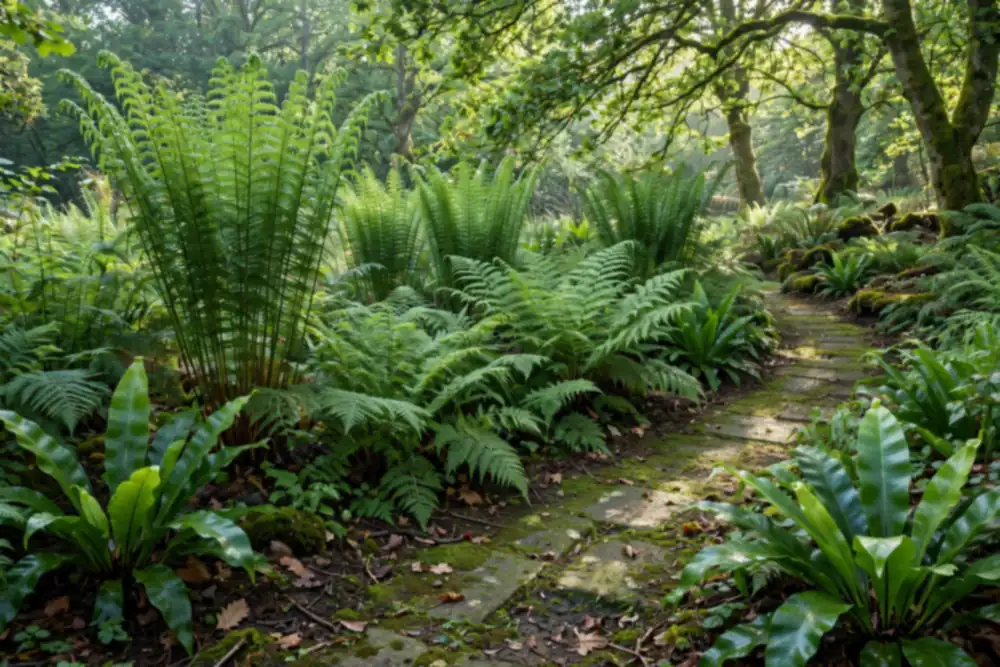
Every British garden has a corner where nothing seems to thrive: the strip behind the shed, the north-facing wall, the dry ground under a big tree. Grass thins out there, bedding plants sulk, and most shrubs just sit there looking resentful. A fern plant is the answer that corner has been waiting for. Ferns evolved on woodland floors, in shaded gullies and along damp banks, so a shady British garden is not a compromise for them — it is home. They ask for almost nothing: no feeding schedule, no deadheading, no winter wrapping for the hardy kinds. In return they give you texture no flowering plant can match, from the tight copper curls of spring croziers to the soft green arches that hold their shape deep into winter. This guide covers the ten best ferns for a UK shade garden, how to plant a fern properly, care through the year, growing ferns in pots, and the handful of problems worth knowing about.
What Is a Fern Plant?
A fern is one of the oldest kinds of plant on Earth. Ferns were already growing more than 360 million years ago, long before flowering plants existed, and they have barely changed since. That age shows in the way they reproduce: a fern plant produces no flowers and no seeds at all. Instead, the undersides of mature fronds carry clusters of tiny brown dots called sori, and each sorus releases thousands of dust-like spores. Given damp shade and patience, a spore can grow into a whole new plant — a slow, quiet process that takes a year or more, which is why most gardeners buy ferns as young plants or make new ones by division instead.
In the garden, ferns are perennials, which means they live for several years and come back season after season. Some are deciduous: their fronds die back in winter and fresh ones unfurl in spring. Others are evergreen and keep their foliage all year, which makes them valuable for winter structure in a shade garden. A few sit in between, described as semi-evergreen, holding their fronds through a mild winter and dropping them after a hard frost. Most ferns sold for UK gardens reach 60cm to 1.2m tall, with a few much smaller and a few — notably the tree fern — much larger. What they all share is the frond: a single divided leaf that unrolls from a tight spiral, the crozier, in spring. There is no prettier moment in a shade garden than a bed of croziers unfurling in April.
Ferns are also remarkably unfussy about the things that worry most gardeners. They need no rich feeding, they are rarely troubled by pests or disease, and the hardy kinds survive a British winter outdoors with no protection at all. Their one real demand is the right spot — and in a country as cloudy as ours, that is rarely a problem.
Why Ferns Are Perfect for a UK Shade Garden
Shade is the defining condition of a great many British gardens. Terraced houses throw long shadows, boundary hedges block the afternoon sun, and mature trees turn whole borders into dappled shade by June. London gardens feel this more than most: tall buildings, basement lightwells, walled courtyards and north-facing plots are everywhere, and the city is full of gardens that get an hour of sun a day if they are lucky. That is exactly the ground ferns were made for.
Not all shade is the same, though, and the first step in growing ferns well is knowing which kind you have. Dappled shade, under a deciduous tree or a tall hedge, is the easiest situation of all: the canopy takes the worst of the summer sun while soft light and most of the rain still get through, and the soil underneath is usually workable. Most hardy ferns will grow happily here. Dry shade is harder — under a conifer hedge, a mature sycamore or the eaves of a house, the ground is often dusty and packed with competing roots. You can still grow ferns there, but you need the tough ones and you need to improve the soil before planting. Deep, permanently damp shade, such as a north-facing wall or a damp corner by a downpipe, suits a different group again: the moisture-lovers that scorch in sun but look lush in cool shade.
Once you match the fern to the shade, the rewards are out of proportion to the effort. London’s garden centres stock all of these, so you can see the fronds before you buy. Ferns bring structure to the darkest part of the garden, they fill ground that would otherwise be bare soil or weeds, and they look good for months on end rather than for a single flowering fortnight. They pair beautifully with the other shade-lovers — hostas, pulmonaria, brunnera and ornamental grasses — and they give a woodland garden its atmosphere in a way no other plant does. Our guide to garden plants for shade covers the companions; this guide is about the ferns themselves.
10 Best Ferns for a UK Shade Garden
You do not need rare or expensive plants to make a shady border look good. The ten ferns below are all widely sold in UK garden centres and specialist nurseries, all are hardy, and all are forgiving of a beginner’s mistakes. The RHS lists dozens of hardy ferns for UK gardens, and the varieties below are the ones you will actually find for sale. Between them they cover damp shade, dry shade, deep shade, borders and pots — and they give you a spread of heights, textures and colours, from silver and burgundy to plain, honest green. Two more worth knowing are autumn fern (Dryopteris erythrosora), whose new fronds open bronze-orange in spring, and common polypody (Polypodium vulgare), a tough little fern for dry walls and rock crevices where other ferns fail.
1. Male Fern (Dryopteris filix-mas)
The workhorse. Male fern is a British native, tough as old boots, and the backbone of any shady border. It forms a shuttlecock rosette of mid-green fronds that reach around 90cm tall, deciduous in cold winters and semi-evergreen in mild ones. Once established it copes with dry shade better than most ferns, and it self-sows gently nearby, so a single plant can quietly become a colony over the years. If you buy only one fern, buy this one.
2. Golden Male Fern (Dryopteris affinis)
Golden male fern is the male fern’s smarter cousin. Its young fronds open bright yellow-green before maturing to rich green, and the golden-brown scaly stems give it interest even when the fronds are past their best. It is semi-evergreen, holding its fronds well into winter in a sheltered spot, and it tolerates very cold, dry situations once established. Expect it to reach about a metre tall in good conditions.
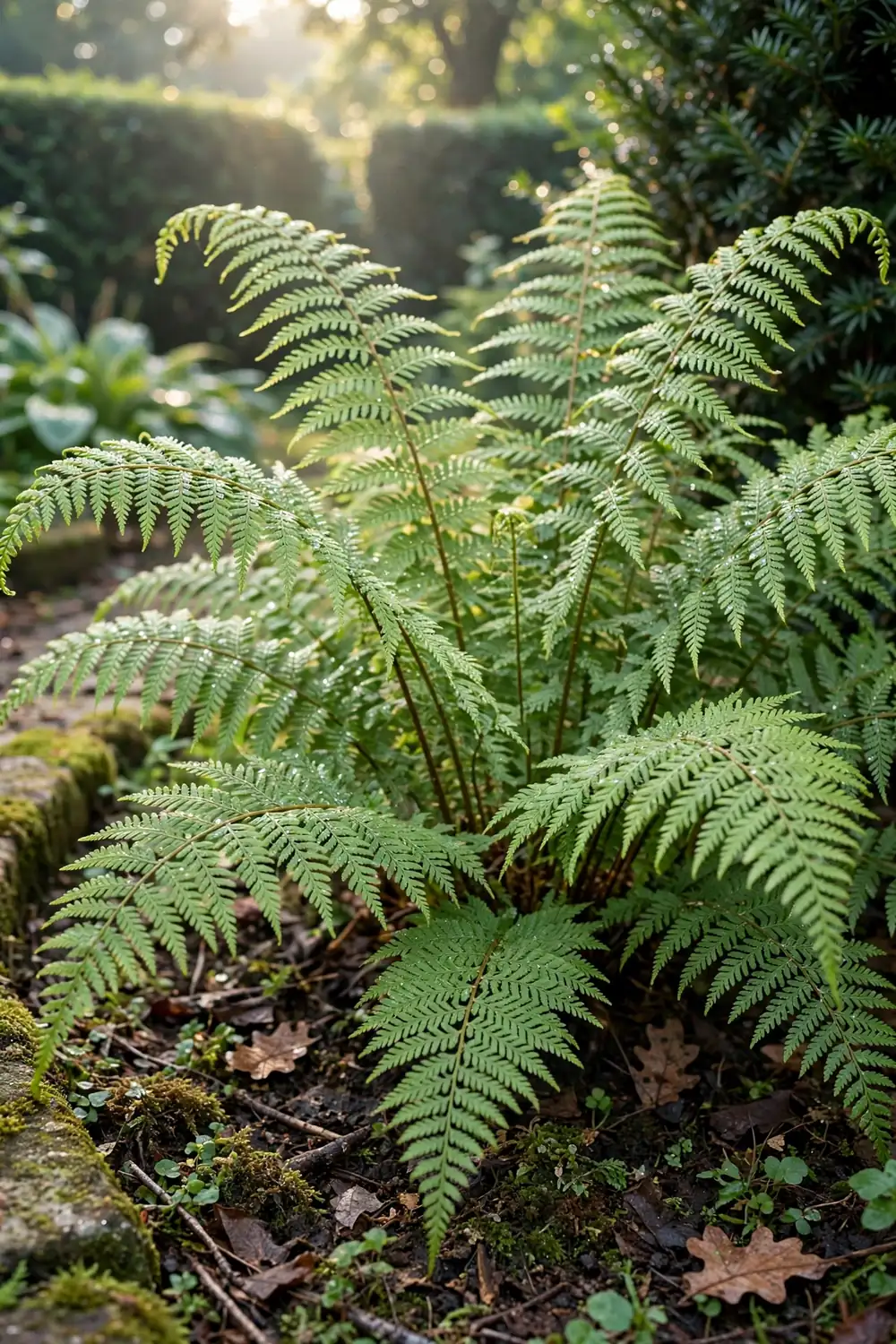
3. Soft Shield Fern (Polystichum setiferum)
Soft shield fern is the one to plant when you want the garden to look good in January. Its finely divided, arching fronds are soft to the touch and almost feathery, and because it is evergreen they stay in place all winter, giving a shaded border structure when most other plants have retreated underground. It manages drier shade under trees better than its delicate appearance suggests, and the cultivar ‘Herrenhausen’ is even tougher. A genuinely dark corner is no problem for this fern.
4. Hart’s Tongue Fern (Asplenium scolopendrium)
Hart’s tongue fern breaks the fern rulebook: instead of divided fronds it has glossy, undivided strap-like leaves that look more like a tropical plant than a British native. That contrast is exactly why it is so useful — planted among feathery ferns it stops the border from looking like a green blur. It tolerates lime, copes with drier shade, and is happy in the darkest corners, including the base of a north-facing wall. It is evergreen, so its glossy rosettes carry the winter garden.
5. Lady Fern (Athyrium filix-femina)
Lady fern is the most finely cut and lacy of the common garden ferns, a UK native with feathery fronds that naturalises beautifully in moist shade. It is happiest where the soil stays reliably damp — a shaded border that never bakes dry in summer, or the edge of a pond — and it bulks up quickly, so give it room. Its delicate look is deceptive: this is a vigorous, long-lived plant that will return bigger every year.
6. Japanese Painted Fern (Athyrium niponicum var. pictum)
If you want colour in a shady border, this is the fern to buy. Japanese painted fern has silver-grey fronds flushed with burgundy along the midrib, and no other hardy fern looks anything like it. It is slower growing than the big native ferns and reaches only 30 to 38cm tall, so it suits the front or middle of a shaded border, or a pot. It prefers moist soil and shelter from hot afternoon sun, and it is more tolerant of drier soil than its delicate looks suggest.
7. Shuttlecock Fern (Matteuccia struthiopteris)
Shuttlecock fern, also sold as ostrich fern, is the drama queen of the fern world. It grows 1 to 1.5m tall in a perfect upright vase shape, like a giant green shuttlecock, and it spreads by rhizomes to form a colony. Give it damp ground and room to travel — it is not a plant for a small border or a tidy scheme — and it will reward you with the most architectural foliage of any hardy fern. Keep it away from paths, because those runners mean business.
8. Royal Fern (Osmunda regalis)
Royal fern is one of our grandest native ferns, an upright, clump-forming plant that can reach 1.5m in a damp spot. Its fresh, bright green fronds unfurl from reddish-brown fiddleheads, and in autumn the whole plant turns butter-yellow, then russet — a rare splash of autumn colour from a fern. It loves damp shade and is perfect as a marginal plant around a pond or stream. Give it plenty of room to develop and do not cut its fronds down until the end of winter.
9. Hard Fern (Blechnum spicant)
Hard fern is a neat, evergreen native that earns its place through winter interest. Its dark green fronds form a low, tidy rosette, and in late summer it sends up distinct upright fertile fronds that stand proud of the rest of the plant. It needs acid to neutral, moist soil, so it suits the same conditions as camellias and rhododendrons, and it is one of the best ferns for a small shady garden because it stays compact.
10. Holly Fern (Cyrtomium fortunei)
Holly fern has leathery, glossy evergreen fronds that look as though they have been polished, and it is one of the best ferns for dry ground under trees — the situation that defeats almost everything else. It is not fully hardy in the coldest parts of the UK, so give it a sheltered spot, but in London and the south it sails through winter outdoors. Its bold, architectural leaves also make it one of the best ferns for a pot by a shady front door.
How to Plant a Fern in 6 Steps
Ferns are easy to plant and settle in quickly if you get the basics right. The best time to plant is spring or autumn, which gives the roots time to settle in before any extremes of hot or cold weather. May is often the best month of all: the soil is warming, the air is moist, and there is time for roots to establish before summer. Avoid planting in the middle of a hot, dry spell or when the ground is frozen.
1. Choose a sheltered, shady spot
Pick a place with partial or full shade and shelter from strong winds, which dry out the fronds. Under a deciduous tree, along a north-facing wall, or in the shadow of a hedge are all good. Most ferns can tolerate some sun as long as they have plenty of moisture, but full sun will scorch their fronds, so shade is the safe choice.
2. Improve the soil first
Dig in plenty of organic matter, such as garden compost or leaf mould, to improve the soil structure and help it hold moisture. The aim is soil that is moist, humus-rich and well-drained — ferns like plenty of moisture, but not waterlogging. Most ferns prefer moist, humus-rich soil that is neutral to slightly acidic — roughly pH 5.5 to 7.0. Most prefer neutral soil, although a few, such as hard fern, need acidic soil, and hart’s tongue fern tolerates lime.
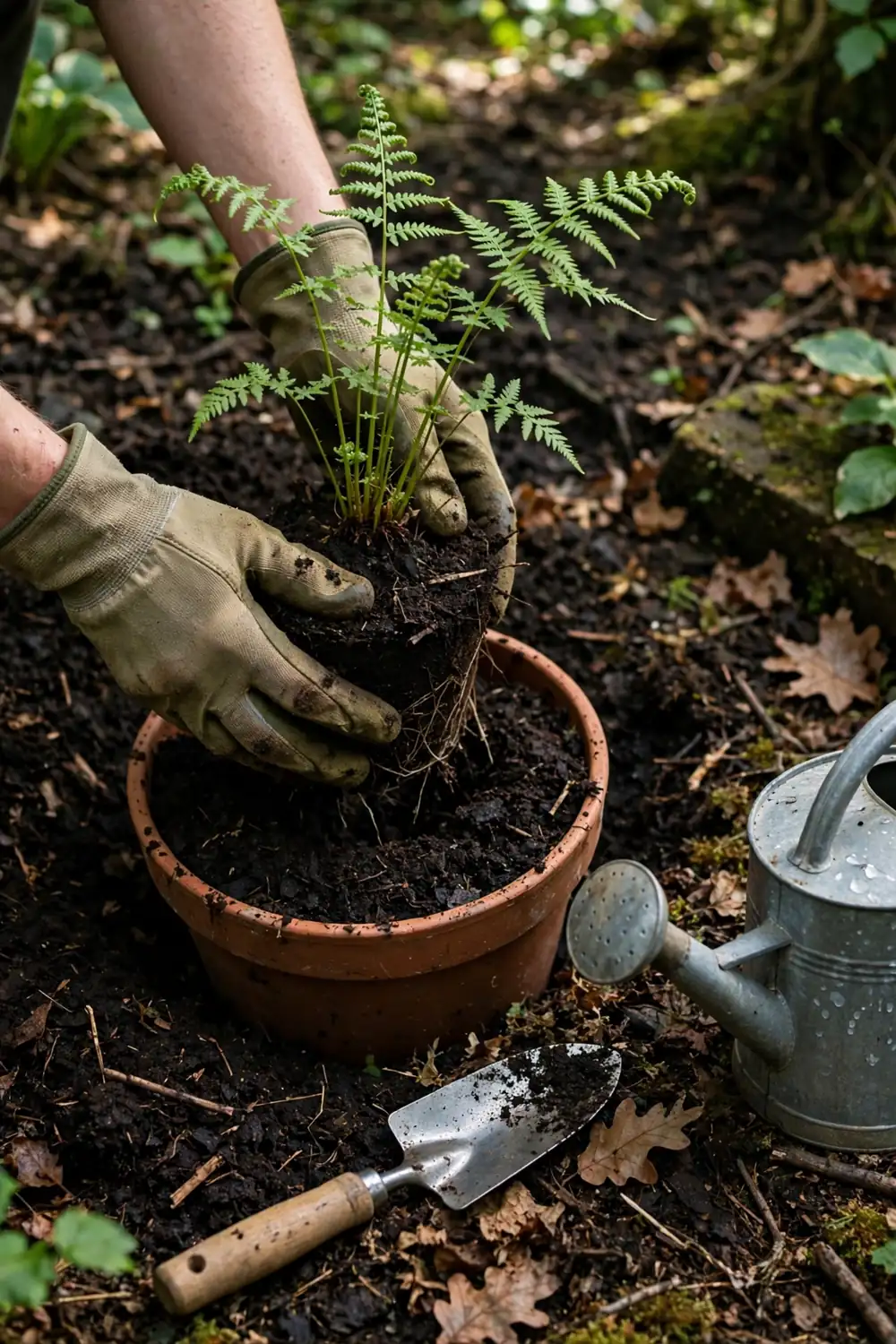
3. Dig a hole wider than the pot
Carefully remove the fern from its container and gently loosen any congested roots. Dig a hole slightly larger than the root ball, and position the plant so that it sits at the same depth as it was growing in its nursery pot. Planting too deep is one of the few ways to kill a fern: the crown, where the fronds emerge, must sit flush with the surrounding soil, never buried.
4. Space for the mature size
Space plants according to their mature spread, allowing room for the fronds to develop naturally. A male fern will want a metre of space in time; a Japanese painted fern needs only 40cm. Crowding ferns together looks lush at first and miserable by year three, when the fronds tangle and air cannot circulate. It is better to plant generously and let them grow into the space.
5. Backfill, firm and water well
Backfill with the improved soil, firm gently around the roots, and water thoroughly after planting to settle the soil around the root ball. If possible, water the roots and not the fronds — wet fronds in bright sun can scorch, and water sitting in the crown can encourage rot. A thick mulch of leaf mould or composted bark around the base, kept clear of the crown itself, will conserve moisture and suppress weeds.
6. Water through the first season
Water during dry periods, particularly throughout the first growing season, until the fern is established. Newly planted ferns need pampering for their first year or two — lots of water and humus — and after that they will largely look after themselves. Do not be alarmed if a new fern looks sulky for its first summer; ferns put their energy into roots before they put it into fronds.
Fern Plant Care Through the Year
Ferns do not ask for much, but they notice when you are paying attention. The work is light — a tidy in late winter, a mulch in spring, water in dry spells — and the calendar below covers the whole year in an afternoon or two of gardening.
Spring: clearing, dividing and feeding
Start in March by clearing winter debris. Remove dead fronds and damaged growth with clean secateurs, but wait until you can see whether a frond is truly finished — evergreen ferns such as holly fern and hart’s tongue keep useful old leaves through winter, so remove only the brown, tatty ones. Cut back deciduous ferns in late winter or early spring, before the new croziers emerge, so you do not snap the fresh growth. April is the month for division: if a clump has a bald centre or has outgrown its spot, lift it carefully and split it with two forks or a sharp spade, then replant the healthy outer sections at the same depth. Feed established ferns with a thin mulch of leaf mould or composted bark rather than a strong general fertiliser. Ferns are not hungry plants, and too much nitrogen produces soft, floppy fronds that are more likely to scorch or snap. Mulching in spring also keeps the soil moist through the first dry weeks of summer.
Summer: water and watch for scorch
June is about water and shade. In a typical British summer the rain may do the job, but do not assume it — a week of warm, breezy days can dry out shallow-rooted ferns, especially those under trees or against a south-facing wall. Water the soil, not the fronds, and mulch if you have not already. July is the cruellest month for ferns in pots: small containers heat up quickly, and even shade-loving ferns can scorch if they dry out at the roots. Check pots daily during hot spells, and if the compost has shrunk away from the sides, soak the whole pot in a bucket until the bubbles stop rising. Group pots together to raise the humidity, or stand them on a tray of damp gravel.
Autumn: planting season and a last tidy
Autumn is the second planting season, and in many ways the better one: the soil is still warm, the rain is returning, and a fern planted now has months to root before spring. It is also the time to let deciduous ferns die back naturally — leave the old fronds in place until late winter unless they look truly untidy, because they protect the crown from frost. If you grow ferns in pots, move tender kinds to a frost-free place before the first hard frost. A final mulch in autumn locks in moisture and gives the worms something to work on all winter.
Winter: mostly leave them alone
Winter is the ferns’ quiet season, and the best care is usually no care at all. Hardy ferns can be kept outdoors all year round in the UK and need no additional frost protection. Evergreen ferns keep the garden looking alive through the darkest months, which is one of the best reasons to plant them — see our guide to winter flowers for other plants that earn their keep in the cold season. Tree ferns are the exception: they are not fully hardy, so give them a warm, sheltered spot, and protect the crown of larger specimens with straw over winter. Smaller tree ferns are best brought indoors or into a frost-free greenhouse.
Growing Ferns in Pots and Containers
Ferns grow happily in pots, and containers are often the best answer for a small London garden, a shaded courtyard or a north-facing balcony where there is no border to plant in at all. Pots also suit tender ferns, which can be moved into a frost-free environment for the winter. In a London courtyard or on a shaded balcony, a group of pots is often the only way to grow ferns at all. Choose a container wider than it is tall, with good drainage holes, and fill it with a moisture-retentive, peat-free compost enriched with organic matter — a handful of leaf mould or composted bark mixed through works well. Plant at the same depth as the fern was growing in its nursery pot, firm gently, and position the container somewhere sheltered from harsh sunlight and drying winds.
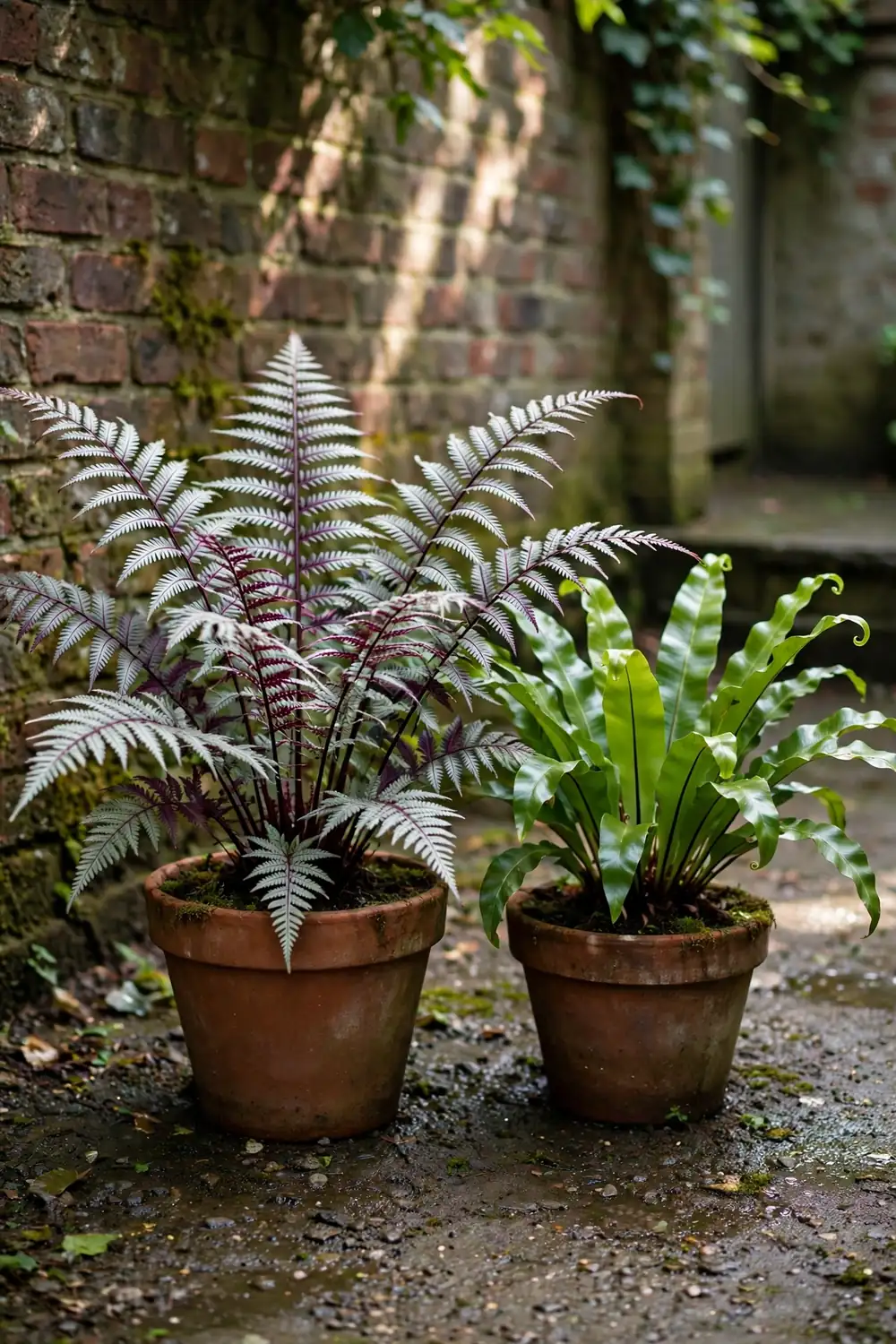
Aftercare is mostly about water. A fern plant in a pot needs more attention to watering than the same fern in the ground, because pots dry out far faster than the ground — especially terracotta pots, which breathe. Check the compost regularly and water whenever the surface begins to dry. In a hot spell, soak the pot in a bucket until the bubbles stop. Do not mist the fronds in full sun, as water droplets can act like tiny lenses and burn the leaves. Repot every few years in spring, when the roots fill the container, moving up just one pot size: ferns dislike being overpotted, and a much larger container holds wet compost that can rot the crown. Hart’s tongue, Japanese painted fern and holly fern all settle happily in pots, and a group of three or four pots by a shady front door makes an entrance that no bedding display can match.
Common Fern Problems and How to Fix Them
Ferns are generally reliable and trouble-free, but a few common problems can occasionally occur. Almost all of them have a simple cause and a simple fix.
Scorched fronds
Too much direct sunlight is the usual culprit. Scorched fronds turn bleached, brown or papery at the edges, and the plant looks tired by midsummer. Move container ferns into deeper shade, and for ferns in the ground, accept the damage for this year — cut the worst fronds away in spring and improve the shade or the watering for next year. Watering the soil rather than the fronds helps, and a mulch keeps the roots cool.
Slugs and snails on young fronds
Slugs and snails love the soft, unfurling croziers of spring, and a bad night can strip a young fern bare. Protect emerging croziers in April and May with the usual defences — beer traps, copper rings, or a gritty barrier — and remember that established ferns shrug off a nibble or two. The damage looks worse than it is: the plant will push out fresh fronds.
Crown rot
Rot is a problem when the crown of the fern sits in stagnant water, and it is usually caused by planting too deep or by soil that does not drain. Keep garden debris away from the base of your ferns, make sure the crown sits flush with the soil surface, and work horticultural grit or coarse bark into heavy clay. If you see signs of rot, clear the debris, improve the drainage, and the fern will usually shake it off. A few ferns, such as the tatting fern, will happily rest in an inch or so of water on the bank of a stream or pond — but most will not.
Ferns not growing, or growing slowly
A fern that sits still for a year is usually telling you about its soil, not its health. Dry shade under trees is the most common cause: the tree takes the water, and the fern gets the dust. Dig in compost, mulch thickly, and water through the first summer. Tree ferns (Dicksonia antarctica) deserve a special mention here — they are extremely slow growing, increasing by only about 2.5cm of trunk a year, so if you want immediate effect, buy a specimen with a trunk length that suits your planting scheme rather than waiting for a small one to grow up.
Yellowing fronds
Yellow fronds on a deciduous fern in autumn are normal: the plant is shutting down for winter. Yellow fronds in spring or summer usually mean the soil is too wet, too dry, or too alkaline for that particular fern. Check the drainage, check the watering, and check that you have the right fern for the spot — a hard fern in chalky soil will never be happy, while a hart’s tongue fern in the same soil will thrive.
How to Propagate Ferns
Making new ferns is easy, and it is the cheapest way to fill a shady border. The simplest method is division: in spring, lift a mature clump, split it into sections with two forks or a sharp spade, and replant the healthy outer sections at the same depth they were growing before. Water them in well and keep them moist through their first summer. Almost every clump-forming fern can be divided this way, and a single large male fern can give you four or five new plants.
Growing ferns from spores is slower but wonderfully satisfying. In late summer, look under a mature frond for the brown sori, cut the frond, and lay it spore-side down on a sheet of paper overnight. Tap the spores onto the surface of a tray of damp, sterile compost, cover it, and keep it warm and humid. Tiny green heart-shaped growths will appear over the following months, and from those, eventually, little ferns. It takes a year or more to get a plant big enough for the garden — which is why most gardeners divide, and only the patient grow from spores.
Tree ferns propagate differently again: they produce offsets, or “pups”, around the base of the trunk, which can be carefully removed and potted up. Whatever method you choose, the rule is the same as for planting — shade, moisture and patience, and the fern will do the rest.
Frequently Asked Questions
Do ferns need sunlight?
Almost no fern needs direct sun, and most actively dislike it. Ferns are woodland plants that evolved in shade, and they grow best in partial or full shade with soft, indirect light. A few hours of gentle morning sun is fine, and a few kinds can tolerate more sun if the soil stays moist — but as a rule, if a spot gets more than a couple of hours of direct sun a day, choose something else for it and give the ferns the shade.
When is the best time to plant ferns in the UK?
Plant in spring or autumn. Planting in spring gives the fern the whole growing season to establish, and May is often the best month because the soil is warm and moist. Autumn planting works just as well, because the soil is still warm and the winter rain keeps the roots moist. Avoid planting in the heat of summer or when the ground is frozen.
Are ferns hardy in the UK?
Most ferns sold for UK gardens are fully hardy and survive cold winters outdoors with no protection at all. A few are half-hardy or tender — notably some tree ferns and the more exotic kinds — and those need a sheltered spot in the mild south and west, or a pot that can be moved into a frost-free place over winter. Always check the plant label before buying, and when in doubt, choose a hardy native such as male fern or soft shield fern.
Do ferns come back every year?
Yes. Ferns are perennials, so they live for several years. Deciduous ferns die back in winter and send up fresh fronds in spring; evergreen ferns keep their foliage all year. Either way, the same plant returns each spring, bigger than the year before, and a well-placed fern can live for decades with almost no attention.
Can ferns grow in dry shade?
Yes, but only the tough ones. Dry shade under trees or hedges is the hardest situation in the garden, because the tree roots take the moisture. Male fern, golden male fern, soft shield fern, hart’s tongue fern and holly fern all cope with dry shade once established, provided you improve the soil with compost before planting and water through the first summer. Moisture-lovers such as lady fern and shuttlecock fern will struggle in dry shade, so save those for damper ground.