Picture a garden where roses tumble over the front door, foxgloves stand tall against an old brick wall, and lavender hums with bees along a winding gravel path. Nothing is in a straight line, nothing looks stiff — and yet the whole thing feels deliberate, generous and alive. That is the cottage garden, Britain’s best-loved garden style, and the classic English cottage garden is more achievable than it looks. You do not need a thatched cottage or acres of land to create one. A single border, a few well-chosen plants and an understanding of how the style works are enough to get started. This guide explains what a cottage garden really is, the design principles behind the look, the plants that define it, and a ready-to-use planting plan for a typical British garden.
What is a cottage garden?
A cottage garden is an informal, densely planted garden where flowers, herbs, fruit and vegetables grow happily side by side. Borders are packed so full that barely any bare soil shows, paths meander rather than march in straight lines, and plants are allowed to tumble, self-seed and weave together instead of standing in rigid rows. The overall effect is romantic, abundant and a little wild — but the “effortless” look is deceptive. Behind every good cottage garden is a surprising amount of thought about structure, layering and plant choice.
The style has deep roots in Britain, and cottage garden history is really the story of a working plot becoming a beloved decorative style. Cottage gardens began in Elizabethan times, when labourers used the ground around their homes to grow food — fruit, vegetables and medicinal herbs — because they had to. Over the centuries the practical plot softened into something more decorative, and by the late 19th century designers like Gertrude Jekyll and writers like William Robinson were championing the informal planting and naturalistic drifts that define the style today. Jekyll’s famous borders at Munstead Wood showed how drifts of colour, repeated planting and soft edges could look far more beautiful than formal bedding. The Victorian era kept the style alive in village gardens across the country, and later, Margery Fish carried the cottage garden idea into the 20th century from her garden at East Lambrook Manor in Somerset, proving the style worked brilliantly in a small space and celebrating the self-seeding plants that fill gaps for free.
The Royal Horticultural Society (RHS) still holds the cottage garden up as a classic British style, and for good reason: it suits our climate, it feeds pollinators, and it rewards the gardener with flowers from spring through to autumn. Unlike a formal garden, which demands constant clipping and control, a cottage garden asks for something gentler — regular editing rather than rigid discipline.
It is worth knowing what a cottage garden is not. It is not a wildflower meadow left to itself, and it is not a jumble of random plants with no plan at all. The best cottage gardens have a clear backbone of shrubs and roses, a simple layout, and plants chosen to flower in overlapping waves. Get those three things right and the informality takes care of itself.
The 5 design principles that make a cottage garden work
Before you buy a single plant, it helps to understand the principles that separate a genuine cottage garden from a border that is simply overcrowded. Every decision in this guide comes back to these five ideas.
1. Informality over geometry
Cottage gardens use soft curves rather than straight lines. Beds have irregular outlines, paths wander, and planting drifts across boundaries instead of stopping neatly at an edge. That does not mean there is no structure — quite the opposite. The structure is there to support the plants rather than to impose on them. A winding path, a low hedge or a simple arch gives the eye something to follow, while the planting does the rest. If you are working with a rectangular town garden, do not fight it: curve the borders, let the lawn narrow in places, and the geometry will soften on its own.
2. Abundance and density
Bare soil in a cottage garden is wasted ground. Dense planting fills every gap, and it serves a practical purpose too — closely packed plants suppress weeds far more effectively than sparse planting, and they shade the soil so it stays moist in a dry summer. Aim to plant in drifts and groups rather than ones and twos, and let plants knit together as they grow. A good rule of thumb is that you should barely be able to see the soil by midsummer.
3. Layered planting in three tiers
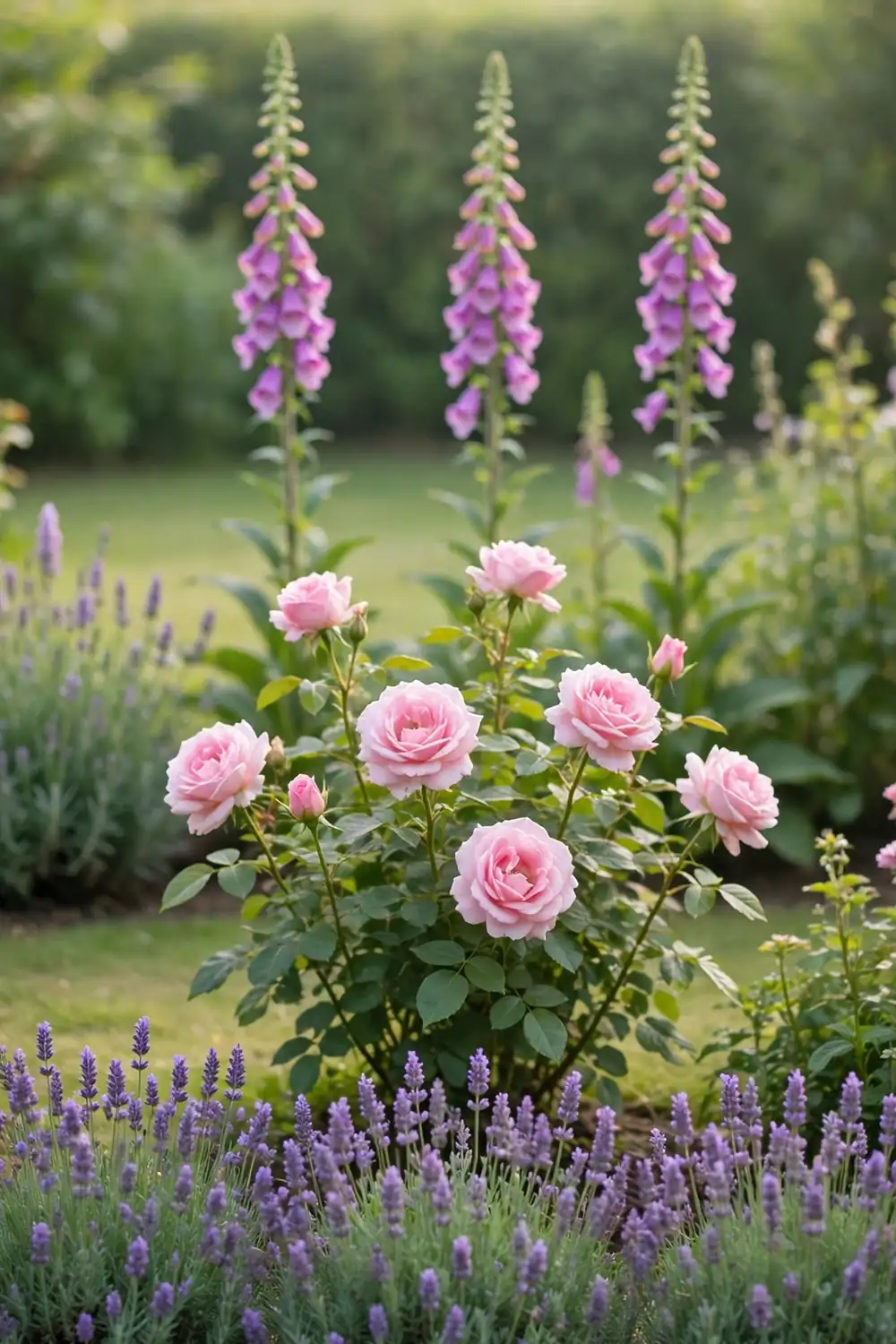
Layering is the defining technique of the cottage garden border. Think in three tiers: tall plants at the back, medium plants in the middle, and low plants spilling over the front edge. Foxgloves, delphiniums and hollyhocks form the tall back tier at 1.2 to 1.8 metres; peonies, shrub roses, catmint and phlox fill the middle at 60 to 90 centimetres; lavender, hardy geraniums and lady’s mantle soften the front edge and spill gently onto the path. When each layer overlaps the next, the border gains the depth and fullness that makes the style so appealing. In a border seen from both sides, put the tallest plants down the centre instead.
4. A soft, harmonious colour palette
Classic cottage gardens favour soft, romantic colours — pinks, lilacs, blues, creams and whites, with the occasional splash of deeper red or purple for contrast. That does not mean you cannot use hot colours, but restraint pays off: pick two or three main colours and repeat them through the border, then let one or two accent plants provide the drama. Repeating the same plants at intervals — three clumps of lavender spaced along a border, for example, or a rose at each end and one in the middle — creates rhythm and stops the planting looking chaotic.
5. Room for wildlife
A cottage garden is a working habitat as much as a pretty picture. The same dense, flower-rich planting that looks so good also feeds bees, butterflies and hoverflies for months on end. Lavender, catmint, foxgloves, single roses and herbs like thyme and rosemary are all superb for pollinators. Leave a few seed heads standing into autumn for birds, and let a corner of self-seeders do their own thing. If you garden with wildlife in mind from the start, the cottage style practically designs itself.
How to plan your cottage garden layout
Good cottage garden design starts with the layout, not the plant list. Keep the hard landscaping simple — the planting will be busy enough — and get these decisions right first.
Start with a single border. Cottage gardens need regular care, so avoid the temptation to convert the whole garden at once. Begin with one border, ideally 3 metres deep and 6 metres long if you have the room, and expand once your confidence grows. A single well-planted border gives you the look faster than a whole garden done thinly, and it teaches you which plants thrive in your soil before you commit further. For more cottage garden ideas on shaping beds, see our garden design ideas guide.
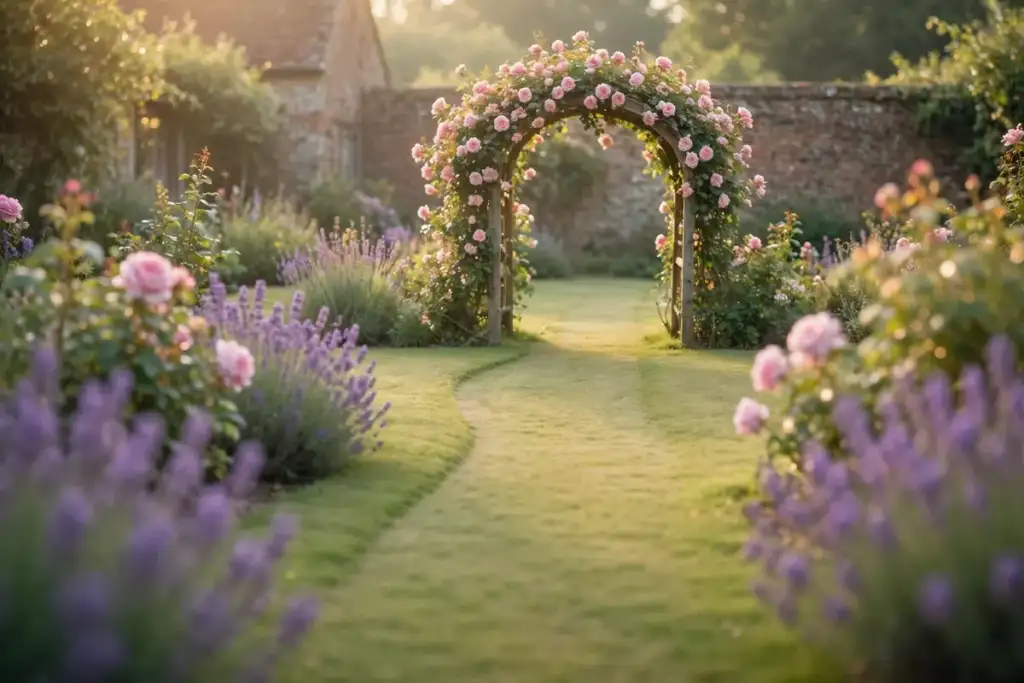
Give the garden a path to follow. A cottage garden should have winding paths, which in midsummer are only just visible between beds bursting with plants. Gravel, old brick, stepping stones or mown grass all suit the style; avoid stark concrete or sharp-edged paving, which fights the softness of the planting. Make the path wide enough to walk comfortably — about 60 to 90 centimetres — and let low plants like lavender, catmint and alchemilla spill over its edges. A path should lead somewhere: to a bench, a birdbath, a rose-covered arch or simply the front door. Our guide to garden edging covers materials that keep a soft border edge looking tidy.
Add a focal point. In a sea of flowers, the eye needs somewhere to rest. A garden seat or bench at the end of a path, a sundial or birdbath set within the planting, a clipped topiary ball, or a timber rose arch draped in climbing roses all work. One strong focal point per view is enough — two or three scattered about will compete with each other. An obelisk or arch also adds height, which matters in a style where most of the interest sits below waist height.
Test your soil before you plant. Cottage garden plants are forgiving, but they still need the right conditions. Dig a spadeful and check whether your soil is heavy clay, sandy or loamy, and test its acidity with a cheap kit from a garden centre. Most cottage plants prefer reasonably rich, well-drained soil, so dig in plenty of garden compost or well-rotted manure before planting — especially on heavy clay. If your soil stays wet in winter, raise the beds slightly or add grit to the planting holes; lavender and Mediterranean herbs will rot in soggy ground.
Think about sun and shade. The classic cottage border faces south or west and gets at least six hours of sun a day, which is what roses, lavender and delphiniums need to flower well. If your garden is partly shaded, you can still get the look: foxgloves, hardy geraniums, astrantia and honesty all cope with light shade, and our guide to garden plants for shade covers the best choices in more detail. Match the plant to the spot and you will spend far less time fighting nature.
The plants that define a cottage garden
Plant choice is where the cottage garden comes alive. The list below is built around plants that are reliable in UK gardens, flower over a long season, and combine well together — including several that are genuinely good for beginners. You do not need all of them — pick a backbone of roses and shrubs, then add perennials, biennials and annuals around them.
Roses: the backbone of the style
No cottage garden summer would be complete without roses and their perfume. Shrub roses and climbing roses give you structure, scent and flowers from early summer into autumn, and they anchor the whole design. For a border, repeat-flowering shrub roses such as ‘Gertrude Jekyll’ (deep pink, intensely scented) or ‘The Generous Gardener’ (soft pink climber) are hard to beat. Rambling roses suit a large arch or wall, but keep them away from small borders — they grow fast and need strong support. Plant roses in full sun with good air circulation, space them 60 to 90 centimetres apart, and mulch with compost rather than wood chips. Underplant them with lavender or catmint at their feet, which looks beautiful and helps keep the base of the rose cool and weed-free.
Tall plants for the back of the border
Height is what gives a cottage border its drama. Foxgloves (Digitalis purpurea) send up spires of bell-shaped flowers in early summer and take up almost no ground space; delphiniums give tall blue spires for height in June and July; hollyhocks (Alcea rosea) flower in July and August and seed themselves around happily. Verbena bonariensis is another cottage classic — its wiry stems carry purple flowers from July to October and it threads through other plants without crowding them. All of these need staking in exposed gardens, but their vertical drama is worth the effort. One safety note: foxgloves, delphiniums and lilies are toxic, so keep them away from areas where small children or pets play unsupervised.
The middle layer: perennials that carry the season
The middle tier is where most of the colour and fragrance lives. Peonies flower in May and June and their foliage stays handsome all summer. Phlox fills July and August with scent. Hardy geraniums such as ‘Rozanne’ flower from June to November and make superb ground cover. Catmint (Nepeta) flowers from May to September and, cut back after its first flush, will flower again. Add lupins for early summer spires, echinacea for late summer colour, and sweet Williams for a traditional biennial splash. Plant in odd-numbered groups of three, five or seven — odd numbers look more natural than pairs — and let the groups overlap their neighbours.
The front edge: low plants that soften and spill
The front of the border is where the cottage garden earns its softness. Lavender ‘Hidcote’ makes excellent low hedging and pathway edging, flowering from June to August and filling the air with fragrance. Lady’s mantle (Alchemilla mollis) softens edges with frothy lime-green flowers in June and July. Pinks (Dianthus) bring scent and neat cushions of grey-green foliage. Mexican fleabane (Erigeron karvinskianus) spills over walls and path edges with tiny daisies from May to October. Thyme and creeping rosemary work too, and they double as kitchen herbs. Let these plants spill onto the path — a cottage garden path should look as though the planting is gently reclaiming it.
Climbers, herbs and self-seeders
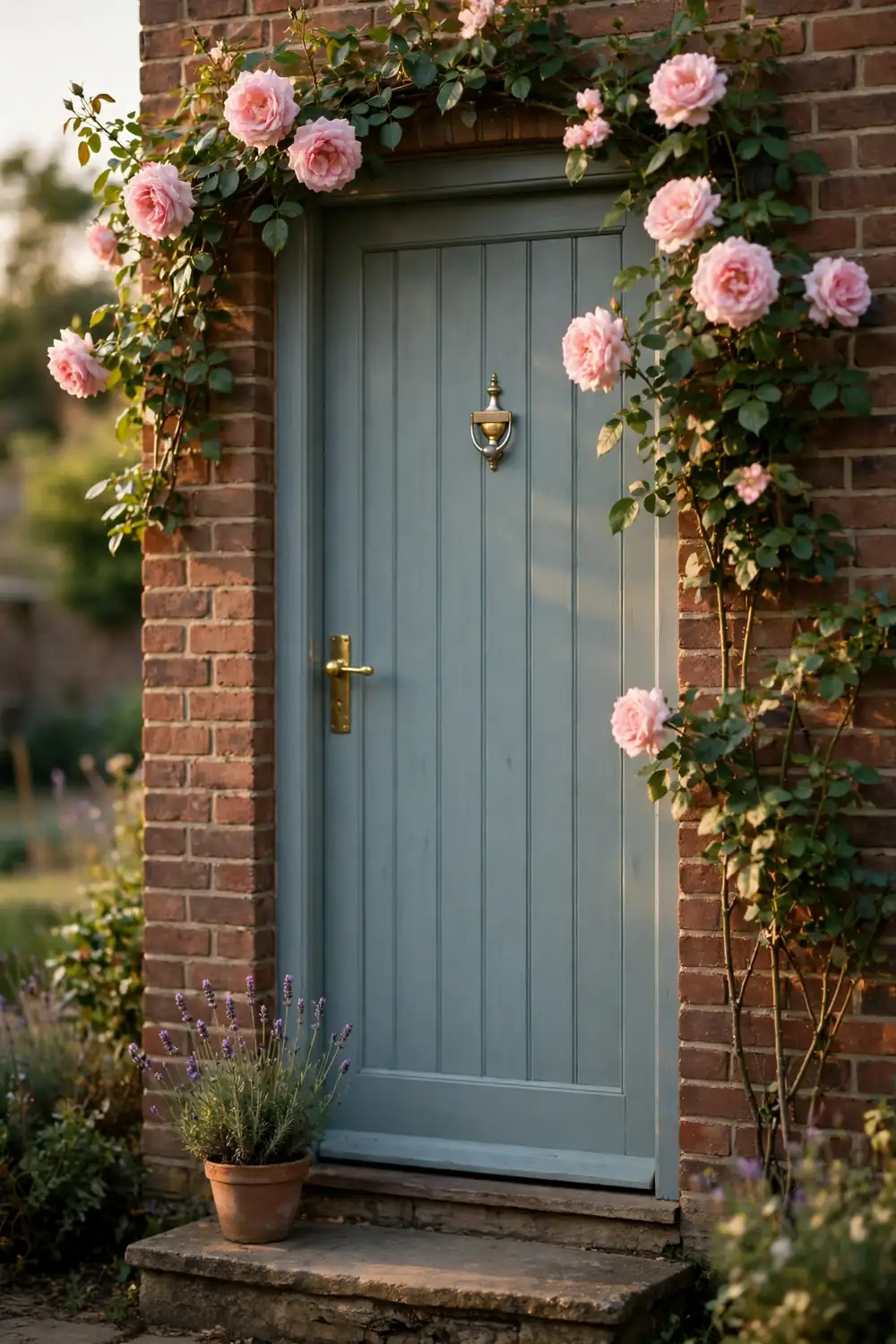
Climbers add the vertical layer that turns a flat garden into a cottage garden. Climbing roses, clematis and honeysuckle over an arch, doorway or fence give the most classic cottage image of all, and sweet peas — sown in spring, flowering all summer — are the fastest way to cover a wigwam or obelisk. Herbs belong in a cottage garden by tradition: rosemary, sage, thyme and chives tucked between the flowers nod to the style’s practical origins and are genuinely useful in the kitchen.
Then there are the self-seeders, the cottage gardener’s secret weapon. Foxgloves, aquilegia (columbine), nigella (love-in-a-mist), hollyhocks, honesty and forget-me-nots all seed themselves around happily, popping up in gaps and making lovely chance combinations. The skill is editing, not sowing: let seedlings grow where they look good, and pull out the ones that land in the wrong place. A garden that renews itself this way costs almost nothing to keep full, and it never looks exactly the same two years running — which is part of the charm. For a design that frames the planting well, our guide to creating stunning garden borders explains how edging and structure support this loose style.
A ready-to-use cottage garden planting plan
If you want a concrete starting point, this plan suits a south or west-facing border, 3 metres deep by 6 metres long, in full sun or light shade, on soil that is reasonably rich and drains well. It follows the three-tier layering described above and should flower from May through to October.
Back tier (tallest, against the wall or fence): 2 shrub roses ‘Gertrude Jekyll’, 5 delphiniums, 7 hollyhocks grown from seed, 5 Verbena bonariensis, and foxgloves scattered from seed. Middle tier: 3 peonies ‘Sarah Bernhardt’, 3 phlox ‘Blue Paradise’, 5 hardy geraniums ‘Rozanne’, 5 catmint ‘Walker’s Low’, 3 lupins. Front tier: 7 lavender ‘Hidcote’, 5 lady’s mantle, 5 pinks ‘Mrs Sinkins’, 5 Mexican fleabane. Climbers: one climbing rose and one clematis on an arch or obelisk at one end, with sweet peas sown at its base each spring.
Plant the shrubs and roses first, in autumn or early spring, then fill in the perennials. Leave room for growth — a border planted at the right spacing will look sparse in its first year and full by its second. Resist the urge to cram in extra plants to fill the gaps; instead, scatter self-seeders like nigella and aquilegia into the spaces and let them do the work. In year one, mulch well and water in dry spells. By year two, the layers will have knitted together and the border will largely look after itself, needing only seasonal editing.
Cottage gardens in small spaces
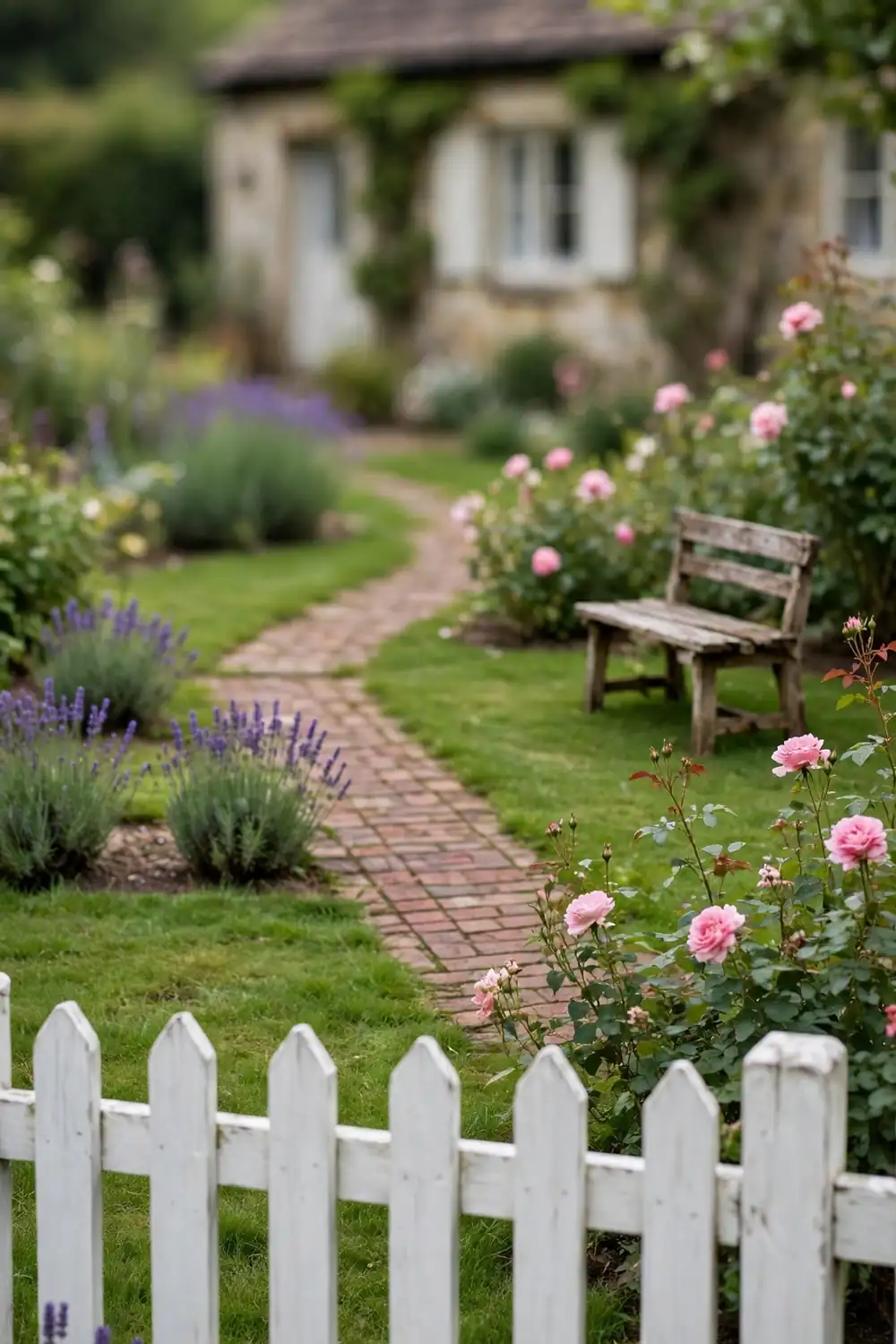
You do not need a big garden. The cottage look works brilliantly in a small plot, a front garden or even a courtyard — it just needs a few adjustments. Plant densely in informal drifts, mix flowers, herbs and a few edibles, and use classic cottage plants such as roses, lavender, foxgloves, delphiniums, hardy geraniums, catmint and alliums. Go up rather than out: tall foxgloves and delphiniums against a wall, a climbing rose over the door, and an arch or obelisk covered in sweet peas or clematis all add planting space without taking ground.
Use pots and containers to squeeze in more plants — terracotta pots, old tin baths and window boxes add space on patios and steps and can be moved as plants flower. Repeat a few key plants through a small border to hold it together, and finish with one focal point: a bench, a birdbath or a picket fence. A front garden is an ideal place for a cottage garden — it greets visitors with scent and colour, and passers-by get to enjoy it too. See our front garden ideas for ways to make a small front plot work harder.
In a small space, editing matters more than ever. One rampant plant can swamp a small border in a season, so choose compact varieties — ‘Hidcote’ lavender rather than tall lavandin, shrub roses rather than ramblers — and be ruthless with self-seeders that land in the wrong spot. A small cottage garden should feel abundant, not overcrowded, and a clear path through the middle keeps it feeling like a garden rather than a thicket.
Looking after your cottage garden through the year
A cottage garden is not a low-maintenance garden in the strictest sense — it is a medium-maintenance garden that rewards regular, gentle attention, and with the right plant choices it can come close to low maintenance for much of the year. The work is spread across the year rather than concentrated in one season, and most of it is pleasant.
Spring: cut back dead growth, divide overcrowded perennials, and sow annuals like sweet peas, nigella and poppies. Plant bare-root roses in late winter or early spring, and feed borders with garden compost. Watch for self-seeded foxgloves and aquilegia, and move or remove seedlings while they are small.
Summer: deadheading roses, delphiniums and phlox encourages repeat flowering — a few minutes of deadheading each week makes a visible difference — and cut catmint back hard after its first flush for a second show. Water new plants in dry spells, and stake tall plants before they flop — it is far easier to stake in May than to rescue a fallen delphinium in July. Cut sweet peas regularly: the more you pick, the more they flower.
Autumn: plant spring bulbs — tulips, alliums and narcissi — in gaps between perennials for early colour next year. Cut back perennials that have finished, but leave seed heads of echinacea, teasel and honesty standing for birds and winter structure. Plant bare-root roses and shrubs while the soil is still warm.
Winter: prune roses in late winter, cut back old stems, and mulch the borders with compost. This is also the time to repair paths, repaint fences and plan next year’s additions. A cottage garden in winter should still have structure — the roses, shrubs, grasses and seed heads carry it and give the garden year-round interest — so resist the urge to cut everything to the ground.
The single most useful habit is a weekly wander with a pair of secateurs: deadhead what has finished, pull the odd weed, move a seedling, tie in a climber. Ten minutes a week keeps a cottage garden looking intentional rather than neglected, and it is the difference between a garden that looks loved and one that looks abandoned.
7 mistakes to avoid with a cottage garden
1. Planting too sparsely. The most common mistake is spacing plants as though they were specimens. Cottage gardens need density — plant in groups, let them knit together, and fill gaps with self-seeders.
2. Choosing plants for looks alone. A plant that needs full sun will sulk in shade, however pretty it is. Match every plant to your soil and aspect, and check its eventual size before you plant it.
3. Forgetting structure. Without a backbone of roses, shrubs and a focal point, a cottage garden collapses into a shapeless jumble by August. Keep the bones strong and the froth can be as wild as you like.
4. Letting one thug take over. Some cottage favourites — mint, Alchemilla, Verbena bonariensis — seed or spread enthusiastically. Give them room, edit them yearly, and keep mint in a pot.
5. Overfeeding. Too much fertiliser produces soft, floppy growth that needs staking and attracts greenfly. A mulch of garden compost each spring is usually enough.
6. Ignoring the front edge. A border with no edging plants looks unfinished. Low lavender, geraniums and pinks along the front are what make the border feel like a cottage garden rather than a flower bed.
7. Trying to control self-seeders completely. Pulling out every seedling defeats the purpose. Edit them — keep the ones in good spots, remove the rest — and let the garden surprise you.
Frequently asked questions
What is a cottage garden?
A cottage garden is an informal, densely planted garden in the English tradition, where roses, perennials, biennials, annuals, herbs and climbers grow together in layered borders with winding paths. It originated in Elizabethan times as a practical plot for food and herbs, and was developed into a decorative style by designers like Gertrude Jekyll in the late 19th century. The look is abundant and romantic, with barely any bare soil showing.
What plants are best for a cottage garden?
The classic cottage garden plants are roses, foxgloves, delphiniums, hollyhocks, lavender, peonies, catmint, hardy geraniums, phlox, sweet peas, lupins and lady’s mantle, with climbers like clematis and honeysuckle for height. Add self-seeders such as aquilegia, nigella and honesty to fill gaps for free. Choose varieties that suit your soil and aspect, and plant in odd-numbered groups for a natural look.
How do I start a cottage garden from scratch?
Start with a single border rather than the whole garden. Test and improve your soil with compost, lay a simple winding path, add one focal point such as an arch or bench, then plant in three layers: tall plants at the back, medium perennials in the middle, and low edging plants at the front. Plant roses and shrubs first, fill in with perennials, and scatter self-seeders into the gaps. Expect the border to look sparse in year one and full by year two.
Can you have a cottage garden in a small garden?
Yes — the style adapts very well to small plots and front gardens. Plant densely, use tall plants and climbers to go up rather than out, add pots and window boxes for extra space, and repeat a few key plants to hold the design together. Choose compact varieties and edit self-seeders firmly so the small space feels abundant rather than overcrowded.
Do cottage gardens need a lot of maintenance?
They need regular but gentle care rather than heavy work: a weekly wander with secateurs to deadhead, weed and tie in climbers, plus seasonal jobs like pruning roses in late winter, cutting back catmint after flowering, and editing self-seeders in spring. Dense planting suppresses weeds, and self-seeders fill gaps for free, so a well-planned cottage garden takes less effort than a formal garden of the same size.