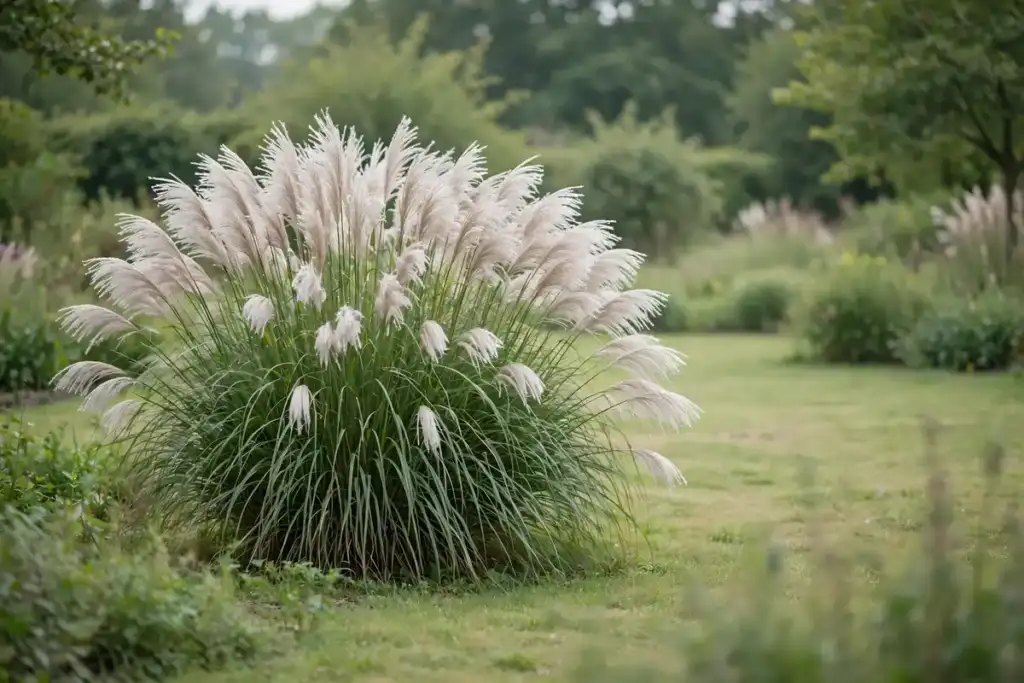
Stand in a garden on a breezy September afternoon and you will hear them before you see them: the soft rustle of ornamental grasses as their plumes catch the wind. No other group of garden plants does so much with so little. Ornamental grasses bring movement, texture and year-round structure to a border, they flower late when most perennials are fading, and their seed heads keep a garden beautiful through frost and low winter sun. Most ask for nothing more than sun, free-draining soil and one cut back a year. This guide brings together the 15 best ornamental grasses for UK gardens — from towering Miscanthus sinensis to neat blue fescue for the front of the border — plus how to choose, plant and cut back each type, which grasses cope with clay soil and shade, and which ones grow happily in pots and containers.
Why Ornamental Grasses Belong in Every UK Garden
Ornamental grasses earn their place for one simple reason: they do several jobs at once. In mixed borders they soften hard edges, fill gaps between shrubs and perennials, and add a layer of movement that no woody plant can match. A single clump of Stipa gigantea catching the evening light can turn an ordinary border into something special, while a drift of feather reed grass gives a flat planting scheme the vertical accent it was missing. Garden designers reach for grasses precisely because they bridge the gap between structure and softness.
They are also among the most low maintenance garden plants you can grow. Most ornamental grasses need very little feeding, rarely suffer pests, and shrug off drought and poor soil once established. They are at their best from late summer into autumn, when their plumes and flower heads appear — and unlike summer bedding, they do not collapse at the first frost. Leave the seed heads standing and they catch frost, catch low light, and shelter overwintering insects and birds through the coldest months. That winter interest is half the point: a garden of grasses looks deliberate in January, when so many borders look empty.
The choice is wider than most gardeners realise. There is a grass for every spot, from tall Miscanthus screens to little Festuca edging a path, from sun-baked gravel to damp clay and even deep shade. The secret is matching the grass to the site — sun, drainage and soil type — and choosing clump-forming varieties that stay where you put them. Get those two decisions right and grasses largely look after themselves.
The 15 Best Ornamental Grasses for UK Gardens
Every grass below is clump-forming, which matters more than anything else: these varieties grow in neat tufts and do not run or spread aggressively, so they behave themselves in a mixed border without bullying their neighbours. They are grouped by height — tall, medium and low — so you can build a border from back to front with confidence. Heights are for a typical UK garden in full sun.
1. Miscanthus sinensis (Maiden Grass)
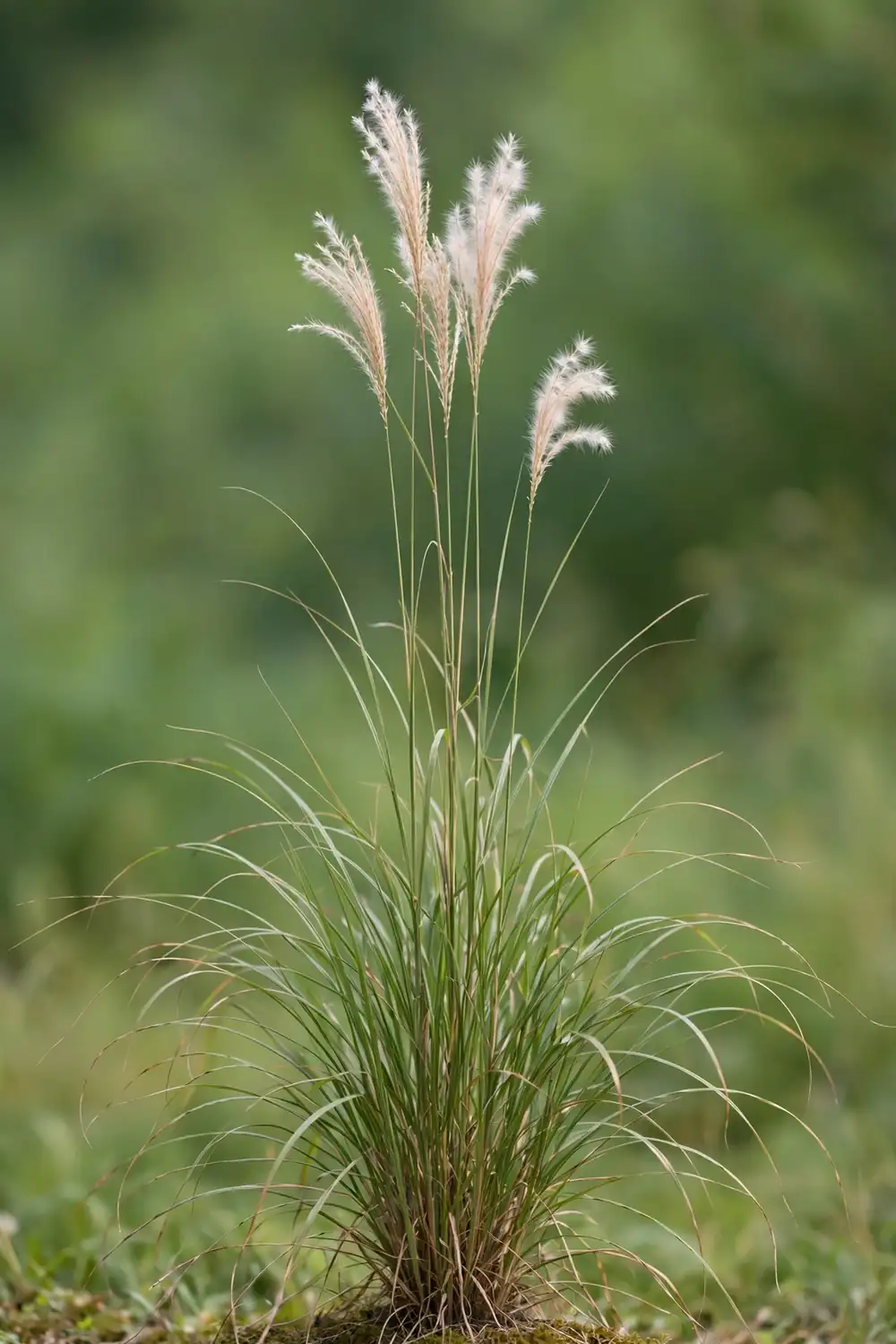
Miscanthus sinensis is the king of tall grasses. It reaches about 2 to 2.5 metres, with arching leaves and silky plumes from September, and it makes a bold statement as a centrepiece, a natural screen or a backdrop behind lower plants. The variety ‘Malepartus’ has red-bronze plumes that fade to silver, ‘Gracillimus’ has very fine leaves and makes an elegant fountain shape, and ‘Morning Light’ has white-edged leaves that glow in low light. All are fully hardy and grow in neat clumps that do not run.
Give Miscanthus plenty of room — at least a metre from a fence or wall — in full sun and free-draining soil. It is deciduous, so the stems stand brown through winter and are cut back hard in late February or March. The RHS notes that it copes better than most grasses on heavy soils, which makes it one of the most reliable tall grasses for London gardens on clay.
2. Stipa gigantea (Golden Oats)
Stipa gigantea is one of the most dramatic grasses you can grow. Tall flower stems shoot up from a low, leafy base, and the oat-like flowers open purple-green in June and ripen to gold, lasting well into winter. It is semi-evergreen, so it never needs a hard cut — just pull out the old flower stems in spring. Because it is see-through, it can go nearer the front of the border than you would think, and it makes a lovely see-through screen in a cottage garden planting scheme.
Plant it in full sun in well-drained soil and give it space to arch. It dislikes winter wet more than cold, so sharp drainage matters more than shelter. In a gravel garden or a sunny border it is close to unbeatable for height, light and movement from a single plant.
3. Calamagrostis x acutiflora ‘Karl Foerster’ (Feather Reed Grass)
Calamagrostis ‘Karl Foerster’ is the most upright grass going, and the one designers reach for when they need a strong vertical accent. Its stiff stems stand tall and do not flop, even in heavy rain, and the plumes appear in June — earlier than most grasses — turning from pinky-bronze to golden buff. It stays standing through the worst winter weather, holding its shape long after other grasses have collapsed.
It takes up very little ground, so it is great for tight borders or planted in rows along a path. It is happy in sun or light shade on most soils except very dry positions, and it tolerates clay better than most. Cut the whole clump back in mid to late February, before the new shoots appear, to about 10 cm above the ground.
4. Stipa tenuissima (Mexican Feather Grass)
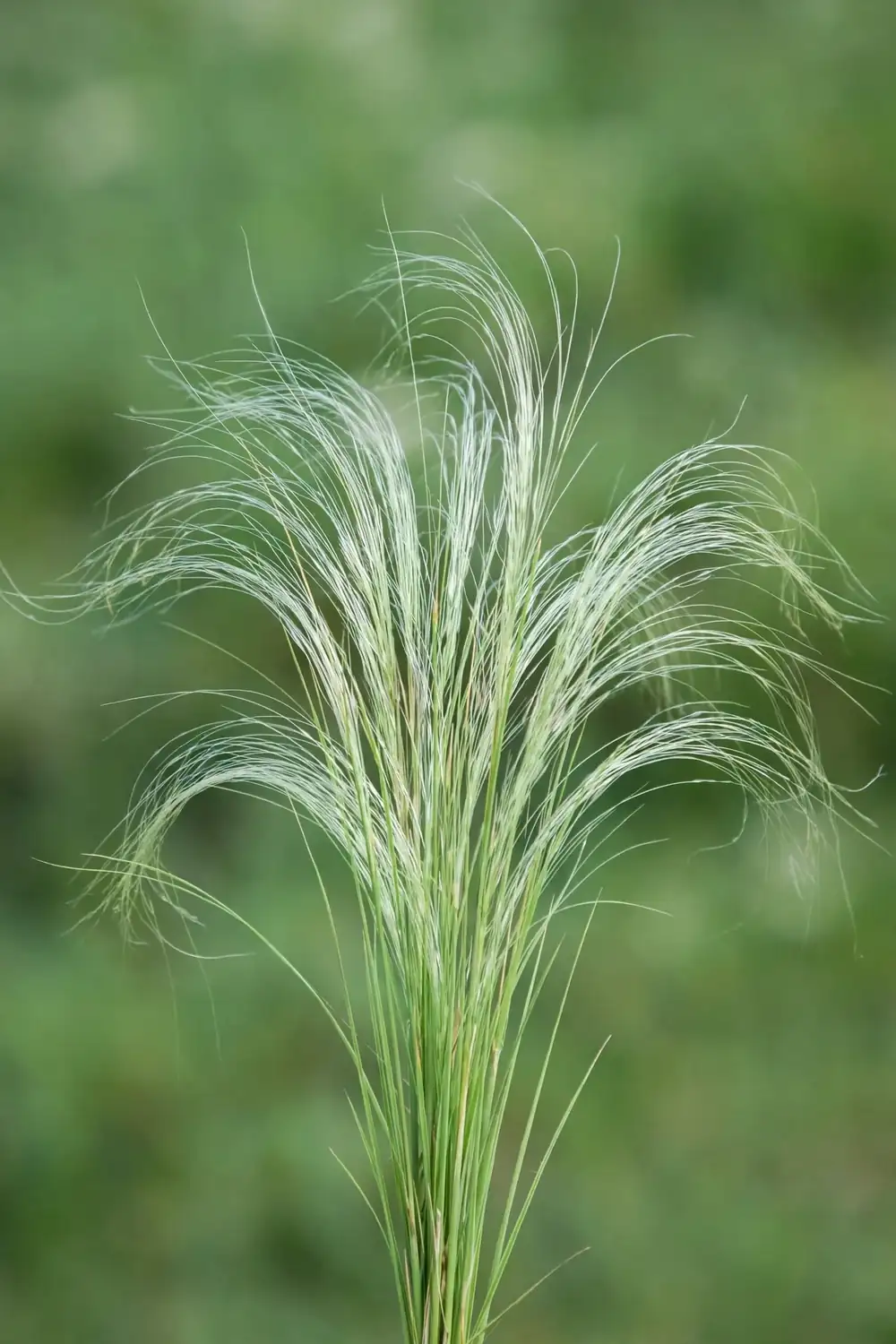
Stipa tenuissima, or Mexican feather grass, is one of the UK’s favourite grasses — and with good reason. It makes a soft tuft of hair-fine leaves, about 60 cm tall, that sways in the lightest breeze, and its feathery flower heads shimmer all summer. It threads beautifully through a mixed border, softening the edges of paving and spilling gently over path edges without ever looking untidy.
It wants full sun and sharp drainage, and it resents winter wet — in a cold, wet garden it is safer in a pot or a raised bed with gritty soil. It self-seeds lightly, which most gardeners welcome, and the seedlings are easy to pull out or move. Comb out the dead growth in March or April rather than cutting it to the ground.
5. Pennisetum alopecuroides (Fountain Grass)
Pennisetum alopecuroides, or fountain grass, has fluffy bottlebrush flowers from August to October. The variety ‘Hameln’ is a reliable choice, with soft pinky-brown spikes that sparkle with dew on autumn mornings. It forms a neat, arching mound about 60 to 90 cm tall, and its leaves turn warm gold before winter.
Give it a warm, sheltered, well-drained spot, especially in colder northern gardens, because it hates winter wet and can be lost in a cold, soggy winter. In the south and in mild coastal gardens it is a safe bet; further north, grow it in a pot and move it somewhere sheltered over winter. Cut it back in March to early April, once the frosts ease.
6. Molinia caerulea (Purple Moor Grass)
Molinia caerulea, or purple moor grass, is a British native that loves damp, acid soil where other grasses sulk. It grows to about 1.2 metres with its flower stems, and its fine, airy plumes turn purple, then gold, as autumn advances. The variety ‘Transparent’ is tall and see-through, perfect for the middle of a border, while shorter forms suit the front.
This is the grass to plant if your soil stays moist: on clay soil, in a damp hollow, or beside a pond, Molinia actively wants the moisture that kills other grasses. It is deciduous and very easy — pull away the loose stems in late winter and cut the rest to 5 to 10 cm. It is also excellent for wildlife, its seed heads feeding birds into the winter.
7. Deschampsia cespitosa (Tufted Hair Grass)
Deschampsia cespitosa, or tufted hair grass, is one of the few grasses that genuinely likes some shade. It copes with heavy clay, damp soil and spots under trees, and its cloud-like flower heads appear in June. Good named forms include ‘Goldtau’ and ‘Bronzeschleier’, both with warm, glowing plumes that catch the light beautifully.
It is semi-evergreen, so in February or March simply remove the old flower stems and comb out the dead leaves, cutting to 10 cm only if the clump looks tatty. It is a British native, fully hardy, and a natural choice for a shady garden or a north-facing border where sun-loving grasses would sulk.
8. Panicum virgatum (Switch Grass)
Panicum virgatum, or switch grass, is a North American prairie grass that has become a favourite in contemporary planting schemes. It grows 1 to 1.5 metres tall, with upright stems and airy flower heads that turn pink, then beige, as autumn advances. Varieties such as ‘Heavy Metal’ have steely-blue leaves, while ‘Shenandoah’ flushes red in late summer — both give a border colour and movement at once.
It wants full sun and copes with clay if grit is added to the planting hole, though it dislikes soil that stays waterlogged. Cut the whole clump back in March to about 10 cm. It is clump-forming and well behaved, and its upright habit makes it a good partner for late perennials such as asters and rudbeckia.
9. Anemanthele lessoniana (Pheasant’s Tail Grass)
Anemanthele lessoniana, also known as pheasant’s tail grass and sometimes sold as Stipa arundinacea, forms lovely large clumps of arching foliage, wider than they are tall. The leaves are green in spring and summer but gradually turn bronze and orange for autumn, looking lovely with that season’s daisies: asters, rudbeckia and helenium. Purplish flowers appear from late summer.
Grow it in sun or partial shade in free-draining soil, and give it room — it reaches about 80 cm tall and spreads wider. It is evergreen in mild winters, so never cut it to the ground; simply comb out the dead leaves in spring. It is borderline hardy in exposed northern gardens, so a sheltered spot suits it best.
10. Festuca glauca ‘Elijah Blue’ (Blue Fescue)
Festuca glauca, or blue fescue, makes neat, steely-blue domes about 25 cm tall and wide, and ‘Elijah Blue’ and ‘Intense Blue’ have the best colour. It is the classic edging grass: a row of blue fescue along a path or around a bed gives a border a crisp, finished edge, and its colour sets off silver and purple planting beautifully.
It needs sharp drainage and full sun, and it rots in heavy clay — grow it in gravel, raised beds or pots if your soil is wet. It is evergreen, so do not cut it back hard; comb out the dead leaves and divide overcrowded clumps every three to four years in spring. In a small garden, a few domes of blue fescue can do the work of a whole edging scheme.
11. Hakonechloa macra ‘Aureola’ (Japanese Forest Grass)
Hakonechloa macra, or Japanese forest grass, is the grass for shade. Its tumbling, bamboo-like leaves turn from fresh green to amber in autumn, and the variety ‘Aureola’ has golden striped leaves that light up dark corners. It is slow to get going but spreads into a lovely carpet over a few years, and it is one of the few ornamental grasses that is genuinely happy in part shade.
Give it moist, rich soil and shelter from drying winds, and be patient — it takes a season or two to settle. Cut it back in late February or March to about 5 cm, before the new shoots show. It is perfect for a shady border, under trees, or in a pot in a sheltered courtyard.
12. Carex oshimensis ‘Evergold’ (Japanese Sedge)
Carex oshimensis ‘Evergold’ is really a sedge rather than a true grass, but it does the same job — and does it all year. Its cream-and-green striped leaves stay bright through January, at about 30 cm tall, and it is great in pots, under shrubs and as edging. It is hardy and happy in shade, and one of the best low-maintenance plants around.
It copes with clay soil as long as it is not waterlogged, and it tolerates sun or part shade. There is almost nothing to do: remove the occasional dead leaf and divide the clump every few years if it outgrows its spot. For winter colour in a shady corner, it is hard to beat.
13. Briza media (Quaking Grass)
Briza media, or quaking grass, is a small native perennial that brings a touch of wildflower meadow into a garden border. Its stems carry tiny, pale green flowers that dangle like lockets, shimmering in the slightest breeze — a detail that rewards a close look. It grows to about 45 to 50 cm and is easily grown from seed.
Plant it in sunny spots threaded through a mixed border, where its airy stems can weave between perennials. It is also good cut and used as a dried flower. Like most small grasses, it asks for sun and free-draining soil, and it self-seeds gently without becoming a nuisance.
14. Carex comans ‘Bronze’ (Bronze Sedge)
Carex comans ‘Bronze’, or bronze sedge, is an evergreen sedge with fine, copper-bronze foliage that keeps its colour all year. It forms a soft, arching mound about 30 to 40 cm across, and it is useful wherever a border needs a warm, dark accent — beside silver foliage, against pale gravel, or at the front of a bed.
It is fuss-free in sun or part shade and copes with most soils that drain reasonably well. Comb out dead leaves in spring and divide it if the centre goes bare. In pots it is a reliable, year-round filler that never needs cutting back.
15. Sesleria autumnalis (Autumn Moor Grass)
Sesleria autumnalis, or autumn moor grass, is a quiet achiever: a tidy, evergreen grass with fresh green leaves and silvery flower heads in late summer. It grows to about 30 to 40 cm, stays neat without ever flopping, and it is one of the toughest grasses for dry shade — a combination that defeats most plants.
It tolerates sun or shade, chalk or clay, and drought once established, which makes it a good choice for the front of a border under trees. There is nothing to cut back; simply comb out any dead leaves in spring. If you want a grass you can plant and forget, this is the one.
How to Choose the Right Grass for Your Garden
Choosing ornamental grasses is mostly about reading your garden honestly. Start with sun: most grasses want at least six hours of sun a day, and sun-loving species such as Calamagrostis, Stipa and Miscanthus will sulk in shade. If your border gets less sun, choose Hakonechloa, Deschampsia or a Carex instead — these are the grasses that perform in shade, and they are genuinely invaluable for difficult north-facing borders.
Next, check your soil. Dig a hole, fill it with water, and see whether it is still there after 24 hours: if it is, your drainage is poor and you should choose moisture-tolerant grasses such as Molinia and Deschampsia, or improve the soil with grit before planting anything that hates winter wet. British gardens differ more than most people assume between the drier, warmer south-east and the wetter, cooler north and west, so what thrives in a London garden may struggle in a cold, exposed northern one. Most grasses prefer lean ground to rich soil, so resist the urge to feed them heavily — too much fertiliser makes them floppy.
Finally, think about height and place. Tall grasses belong at the back of a border or as a screen; medium grasses fill the middle; low grasses edge paths and fronts. A good rule is to plant in drifts of three or five rather than ones and twos, and to repeat the same grass in two or three places so the border feels designed rather than accidental. For more on building a border, see our guide to creating stunning garden borders.
How to Plant Ornamental Grasses
Spring is the best time to plant ornamental grasses in the UK, from March to May, when the soil is warming and the plants have a full season to establish before winter. Autumn planting can work for hardy types in mild gardens, but spring is safer — especially for grasses that dislike winter wet, such as Pennisetum and Stipa tenuissima.
Dig a hole twice as wide as the pot and the same depth, and mix grit into the backfill if your soil is heavy clay. Set the plant at the same depth it was growing in the pot — planting too deep is the commonest cause of rotting crowns. Water well after planting and keep the soil moist for the first few weeks, then let the plant fend for itself; established grasses are notably drought tolerant. Space plants according to their final size, not their size in the pot: a Miscanthus needs a metre of room, while blue fescue can sit 25 cm apart. Mulch with gravel rather than bark, which holds moisture against the crown.
When and How to Cut Back Ornamental Grasses
Cutting back is the one annual job grasses demand, and getting it right for each type is the difference between a fresh, upright clump in June and a tired, brown thatch that never quite recovers. The golden rule is to leave deciduous grasses standing through winter — their seed heads look good in frost, feed the birds, and shelter wildlife — and cut them back in late February or March, before the new shoots grow through.
Cut deciduous grasses such as Miscanthus, Calamagrostis, Panicum and Pennisetum to about 10 to 15 cm above the ground. Tie the clump into a bundle with string before cutting — it makes the job much cleaner and easier to handle — and use a serrated sickle or sharp shears, which slice through a gathered clump in a few pulls. In the south and in mild coastal gardens you can start a week or two earlier; in the north or in cold, exposed gardens it pays to wait until March.
Never cut evergreen grasses to the ground. Evergreen grasses such as Carex, Festuca and Stipa gigantea keep their leaves year-round and need a lighter touch: comb out the dead leaves in spring with your fingers or a rake, and pull out the old flower stems at the base. Cutting an evergreen grass hard can kill it or set it back for a whole season. Semi-evergreen types such as Stipa tenuissima and Deschampsia sit in between — comb them out in March or April, and cut hard only if the clump looks tired. Divide overcrowded clumps every three to four years in spring, replanting the healthy outer pieces.
Ornamental Grasses in Pots and Containers
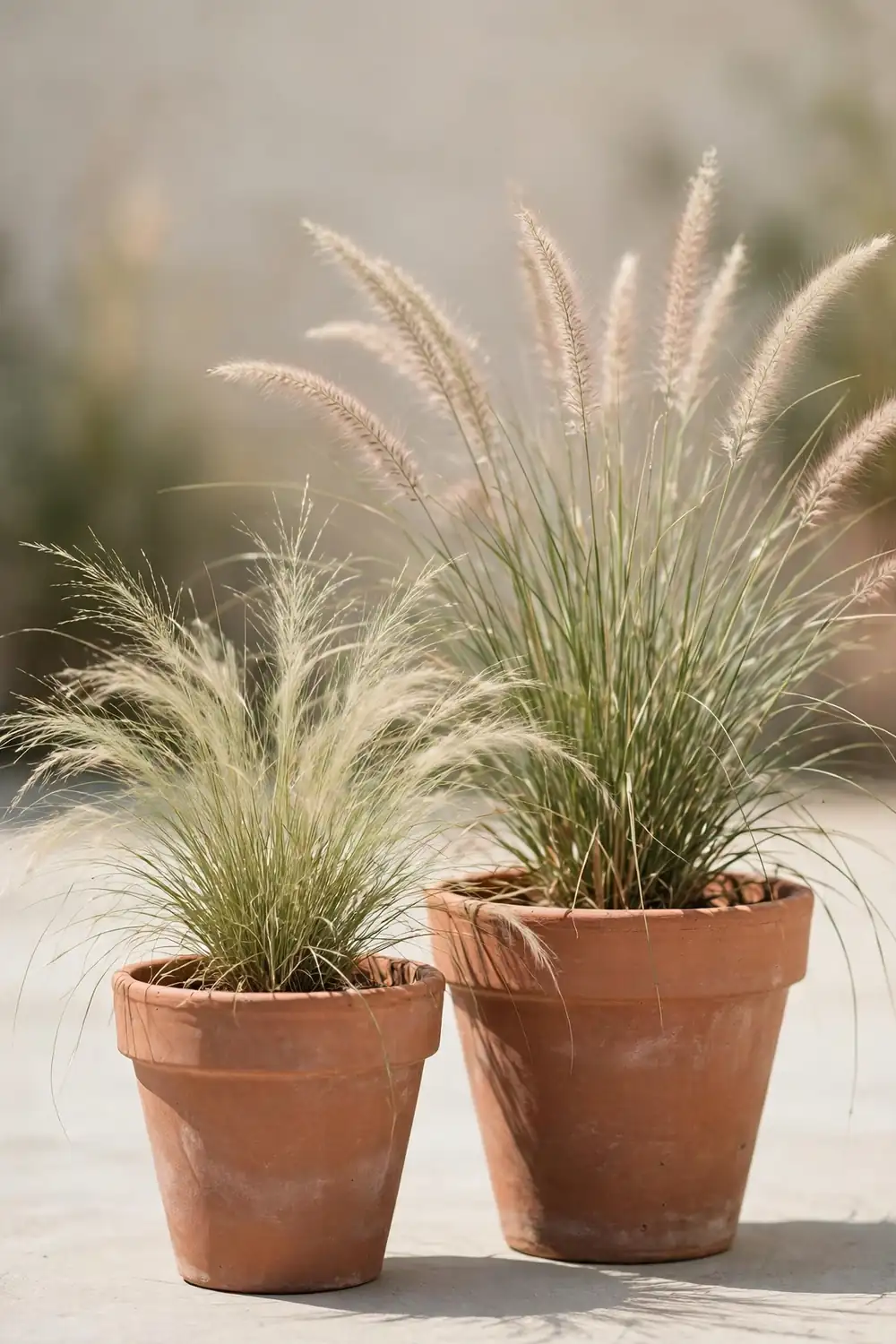
Grasses are superb in pots and containers, and they solve the two problems that defeat many container plants: they look good for months on end, and they survive neglect. A tall Calamagrostis in a large pot makes a moveable screen for a London balcony or patio, while low grasses such as Festuca glauca and Carex ‘Evergold’ edge a pot display all year. Even small gardens and courtyards can hold a collection of grasses in pots.
Use a large pot with drainage holes and a gritty, free-draining compost — grasses in pots hate sitting wet in winter, so raise the pot on feet and never let it stand in a saucer of water. Water through the first summer, then water only in dry spells. Feed lightly once in spring; too much feed makes soft, floppy growth. Divide or repot every two or three years, when the roots fill the pot, and move tender types such as Pennisetum to a sheltered spot for the coldest weeks. If you are planning a container display, our garden design ideas guide has more ways to use pots and structure in a small space.
Ornamental Grasses for Shade
Shade is the hardest test for ornamental grasses, because most of them evolved in open, sunny grassland. But a handful genuinely thrive in shade, and they are worth knowing: Hakonechloa macra is the best of them, with golden leaves that light up a dark corner; Deschampsia cespitosa copes with shade, heavy clay and damp soil all at once; and Carex ‘Evergold’ keeps its cream-striped leaves bright all year in part shade or even full shade.
For the darkest corners, pair grasses with shade-loving perennials rather than forcing sun-lovers into the gloom — a combination of Hakonechloa, ferns and hostas is one of the most reliable plantings for a north-facing border. Our guide to garden plants for shade lists 21 plants that thrive in the darkest corners, and several of them sit happily beside these grasses. Evergreen shrubs can give a shady border its backbone through winter; see our evergreen shrubs guide for the best choices.
5 Mistakes to Avoid with Ornamental Grasses
1. Planting a running grass in a border. Some grasses spread by underground runners and will take over a bed. Always check that the variety you buy is clump-forming — every grass in this guide is — and be wary of unnamed Miscanthus or pampas grass sold cheaply at markets.
2. Cutting evergreen grasses to the ground. Deciduous grasses want a hard cut in late February; evergreen grasses want only a comb-through. Cut a Carex or a Festuca to the ground and you may lose it altogether.
3. Planting sun-lovers in wet clay. Most grasses die of wet, not cold, in a British winter. On heavy clay, choose Molinia, Deschampsia or Carex, or plant in raised beds and pots with gritty soil.
4. Cutting back too early. Cut in autumn and you lose the winter display, the wildlife shelter and the frost protection the old stems give the crown. Wait until late February.
5. Feeding them like roses. Grasses want lean soil. Rich feeding produces soft, tall growth that flops in the first rain. A light spring feed is plenty.
Frequently Asked Questions
When should I cut back ornamental grasses in the UK?
Cut deciduous ornamental grasses back in late February or March, to about 10 to 15 cm above the ground, before the new shoots grow through. Evergreen grasses should not be cut back at all — just comb out the dead leaves in spring. Leave all grasses standing through winter for their seed heads and the shelter they give wildlife.
Do ornamental grasses come back every year?
Yes — almost all ornamental grasses are hardy perennials that come back every year. Deciduous types die back to the crown in winter and regrow in spring, while evergreen types keep their leaves all year. Divide overcrowded clumps every three to four years in spring to keep them vigorous.
What are the best ornamental grasses for shade?
Hakonechloa macra (Japanese forest grass) is the best ornamental grass for shade, followed by Deschampsia cespitosa (tufted hair grass) and Carex oshimensis ‘Evergold’. All three cope with part shade, and Carex ‘Evergold’ will grow in full shade. Avoid sun-lovers such as Miscanthus and Stipa in shady spots — they will grow weak and flop.
Can ornamental grasses grow in pots?
Yes, ornamental grasses grow very well in pots and containers. Use a large pot with drainage holes and gritty, free-draining compost, raise it on feet so it never sits in water, and water through the first summer. Good choices include Festuca glauca, Carex ‘Evergold’, Calamagrostis ‘Karl Foerster’ and Pennisetum ‘Hameln’.
Are ornamental grasses low maintenance?
Yes — they are among the lowest maintenance garden plants you can grow. Most need no feeding beyond a light spring feed, rarely suffer pests or disease, and need only one cut back or tidy-up a year. They are drought tolerant once established and cope with poor soil, which is why they are so popular in low-maintenance and gravel gardens.