Most gardeners assume the planting season ends when the first frost arrives. It does not — it changes. Planting flowers in the winter is perfectly possible in the UK, as long as you plant the right flowers, in the right way, on the right days. Hardy winter bedding, tough perennials and spring bulbs all go into the ground in the cold months, and the ones planted now are exactly what keep a garden colourful from November to March, when most gardens have gone quiet. This guide covers the 15 flowers you can still plant in November, when to plant each one, how to plant them so they survive a frost, and the mistakes that kill more winter flowers than the cold ever does.
Can you plant flowers in the winter?
Yes — planting flowers in the winter works in the UK, with two conditions. First, the plants must be hardy enough for British winters: winter pansies, violas, cyclamen, hellebores and spring bulbs are bred or built for frost, while tender summer bedding such as petunias and begonias will not survive a single cold night. Second, the soil must be workable — not frozen solid and not waterlogged. Choose a bright, frost-free day, when the ground is damp but crumbly rather than sodden, and roots will establish slowly through the mild spells that punctuate a British winter. The Royal Horticultural Society (RHS) is clear on the point: November is the last chance to plant out winter bedding, and tulip bulbs should still go in this month. What you cannot do in winter is plant anything tender, sow summer annuals outdoors, or plant into frozen or soaking wet soil and expect it to thrive. Get the plant and the day right, and winter planting is one of the most reliable jobs in the gardening year — the plants establish quietly underground while you are indoors, then flower for months.
There is also a timing truth worth stating plainly. The ideal window for winter bedding is late September to mid-October, while the soil is still warm, so roots establish before the cold sets in. If you are planting in late November, you have missed that window — but you have not missed the season. Garden-ready plants bought in pots, with buds or open flowers already showing, will give you colour straight away, and hardy perennials and bulbs planted now will still perform. What changes in late November is the margin for error: buy sturdy plants rather than tiny plugs, plant on frost-free days, and protect anything borderline hardy. Our guide to winter flowers covers the full range of plants that flower through the cold months, if you want to plan the whole season at once.
When to plant winter flowers in the UK
Timing is the single biggest factor in whether winter planting succeeds. Roots need soil above about 5°C to grow, and once the soil drops below that, growth all but stops — so the earlier in autumn you plant, the more root a plant grows before winter. That is why September and October are the classic months for winter bedding plants. In November, the soil is cooling but usually still workable across most of the UK, especially in the south and in sheltered urban gardens, and the RHS November advice still lists planting out winter bedding as a job for this month. By December, planting is only sensible on mild, frost-free days, and only with sturdy, garden-ready plants.
Different plants keep different calendars. Winter pansies and violas, cyclamen, primroses and polyanthus are planted from September to November. Wallflowers, forget-me-nots and bellis daisies go in during autumn to flower in spring. Hellebores are best planted in autumn or early spring, while the ground is moist but not frozen. Tulip bulbs must be planted in November — later than other spring bulbs, because they prefer cold soil — while daffodils and crocus should already be in the ground by then, ready to flower after the last frost. Snowdrops are the exception to every bulb rule: they are planted “in the green”, as lifted plants with leaves still attached, in early spring just after flowering — buy them to plant in the green, not as dry bulbs. And one date matters more than any other: the first hard frost, which usually arrives between late October and mid-November and ends the summer flowers — dahlias, cosmos and zinnias — in a single night. After it, the garden belongs to the winter flowers below.
The 15 best flowers to plant in the winter
These fifteen are the most reliable flowers for planting flowers in the winter in a UK garden. They are grouped by type — winter bedding first, then long-lived perennials and shrubs, then bulbs — and every one of them is hardy enough for a British winter, available at garden centres now, and proven to flower between November and April. Mix bedding for instant colour with perennials and shrubs for structure, and the garden will have something in flower in every month of winter, from the first frosts of November right through to the new year and beyond. When you buy, look for the RHS Award of Garden Merit on the label — it marks plants proven to perform in UK gardens — and check each plant’s hardiness rating against your part of the country.
1. Winter pansies
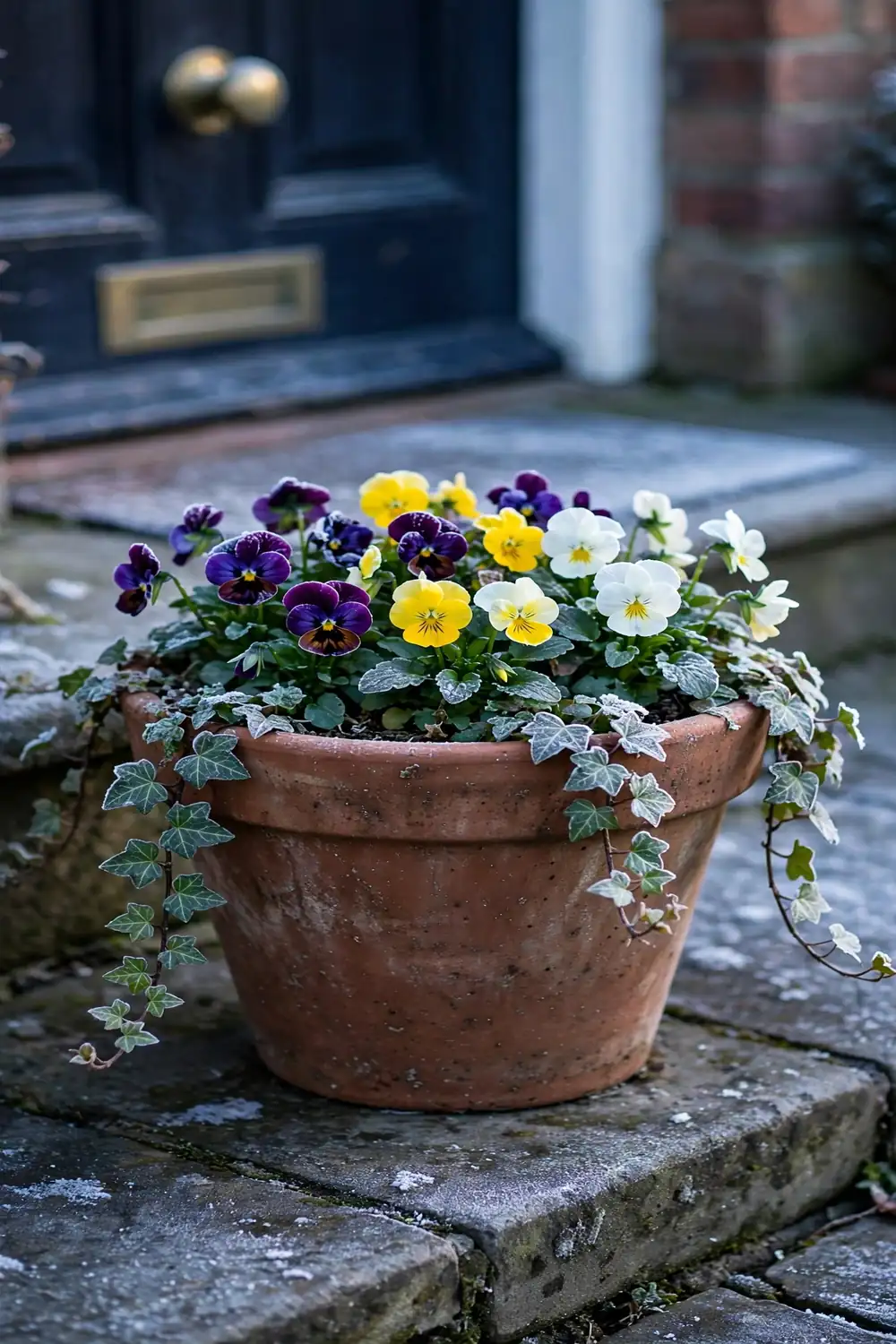
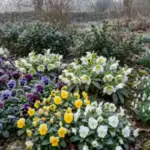
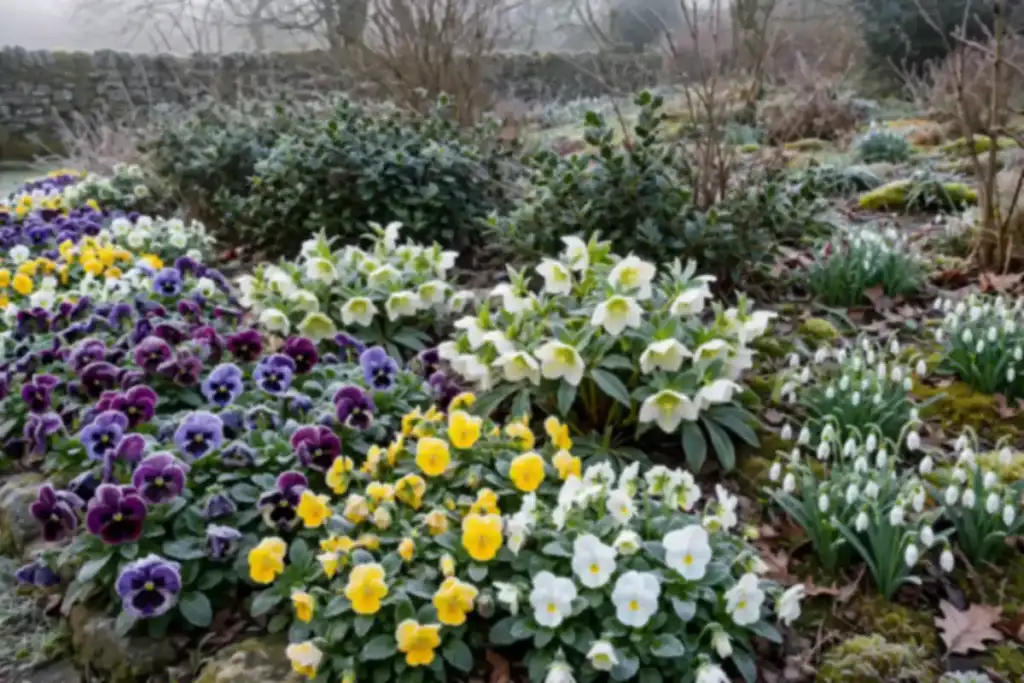
Winter pansies are the most reliable winter bedding plant available, and the first thing to plant if your garden is bare in November. Modern varieties, such as the Matrix series, have been bred to tolerate frost: they may droop during a hard freeze, then spring back once the sun comes out, and they flower intermittently right through even the coldest months before blooming fully in spring. Plant them from September to November in sun or part shade, in well-drained soil or containers, and pack them tightly — in winter, plants grow slowly, so you do not need to leave much space between them. They come in almost every colour, from deep purple and near-black to bright yellow and white, and they are at their best in pots, window boxes and hanging baskets near the front door, where you actually see them. Watch out for downy mildew and black spot, the two diseases the RHS warns about on winter pansies, and remove any soggy leaves promptly. Deadheading faded flowers through mild spells — snipping off the spent blooms — keeps the display coming.
2. Violas
Violas are the smaller, tougher sister of the winter pansy, and many gardeners prefer them for winter planting. Their flowers are daintier, but they produce them in greater numbers, they trail beautifully over the edge of pots and baskets, and they shrug off frost with remarkable resilience — arguably even tougher in cold weather than pansies. Buy plants labelled for winter flowering, and choose plants with buds or open flowers if you want colour straight away. Violas flower from October to May in a mild winter, in purples, lilacs, pinks, blues and magentas, and they are brilliant in hanging baskets, where their trailing habit shows to best effect. Plant them from September to November in sun or part shade, and keep the compost moist but never waterlogged: winter plants usually die from waterlogged roots rather than cold. In a windy spot, put violas on the sheltered side of the pot, behind a low evergreen such as a compact Carex, and they will flower through weather that flattens less hardy bedding.
3. Cyclamen
Cyclamen are one of the few winter flowering plants that genuinely thrive in shade, which makes them perfect for north-facing pots, shaded porches and sheltered borders where little else will flower. The hardy species to look for is Cyclamen coum, with elegant nodding flowers in pink or white above beautifully marbled foliage, flowering from January to March. Plant it in autumn, especially September, in part shade and well-drained soil — it hates sitting wet — and combine it with primroses and winter aconites for a woodland feel. In containers, cyclamen works beautifully with a small evergreen fern: group three potted cyclamen near the rim where their flowers will show, and the fern carries the display during cold spells when the cyclamen pauses. Note that the large-flowered cyclamen sold as houseplants are not hardy outdoors; buy the small, hardy garden kinds, and check the label before you plant.
4. Primroses and polyanthus
Primroses and their showier cousins, polyanthus, are planted in autumn and sit quietly through the coldest months before bursting into colour from late winter into spring. Primroses start blooming from mid-winter onwards in hardy varieties, while polyanthus bring bold, jewel-bright colour in a wide range of rich shades. Both are planted from September to November in sun or part shade, in moist but well-drained soil, and both are excellent in pots, window boxes and the front of borders. They are also some of the earliest nectar sources for pollinators: on a mild February day, queen bumblebees emerging early will visit primrose flowers when almost nothing else is open. Plant them in drifts of at least five or seven rather than ones and twos — a generous group reads as a deliberate planting, while single plants disappear into the border. After flowering, leave the foliage alone: it feeds next year’s flowers.
5. Wallflowers
Wallflowers are the classic cottage garden plant for winter planting, and one of the most fragrant flowers you can plant in the winter. Planted in autumn, they establish through winter and fill the spring garden with a sweet, distinctive scent from March to May. They need full sun and well-drained soil, and they are at their best planted in drifts along the front of a border or in containers by a path, where you brush past them. The classic combination pairs wallflowers with tulips: the wallflowers bridge the gap between winter bedding and the arrival of summer colour, and their warm oranges, reds and yellows set off the tulips beautifully. Wallflowers are biennials, so they flower in their second season — sow or plant them in autumn, enjoy them in spring, and replace them the following autumn. If you love the romantic, old-fashioned end of garden design, our cottage garden guide shows how wallflowers fit the style.
6. Forget-me-nots and bellis daisies
Forget-me-nots and bellis daisies are the quiet workhorses of winter planting: cheap, tough, and generous with flowers exactly when the garden needs them. Forget-me-nots (Myosotis) are hardy biennials planted in autumn for a cloud of tiny blue flowers in spring; they self-seed freely, so one planting often returns year after year in the same spot. Bellis daisies, the little pompom daisies in pink, red and white, are often overlooked but genuinely lovely, producing cheerful flowers through the coolest months in sun or part shade. Plant both in September or October into well-prepared ground or pots of suitable compost, and use them to fill the gaps between bigger plants — under roses, along path edges, and in the front of borders where they knit the planting together. They are also ideal for the gardener on a budget: a tray of either costs very little and covers a surprising amount of ground.
7. Hellebores
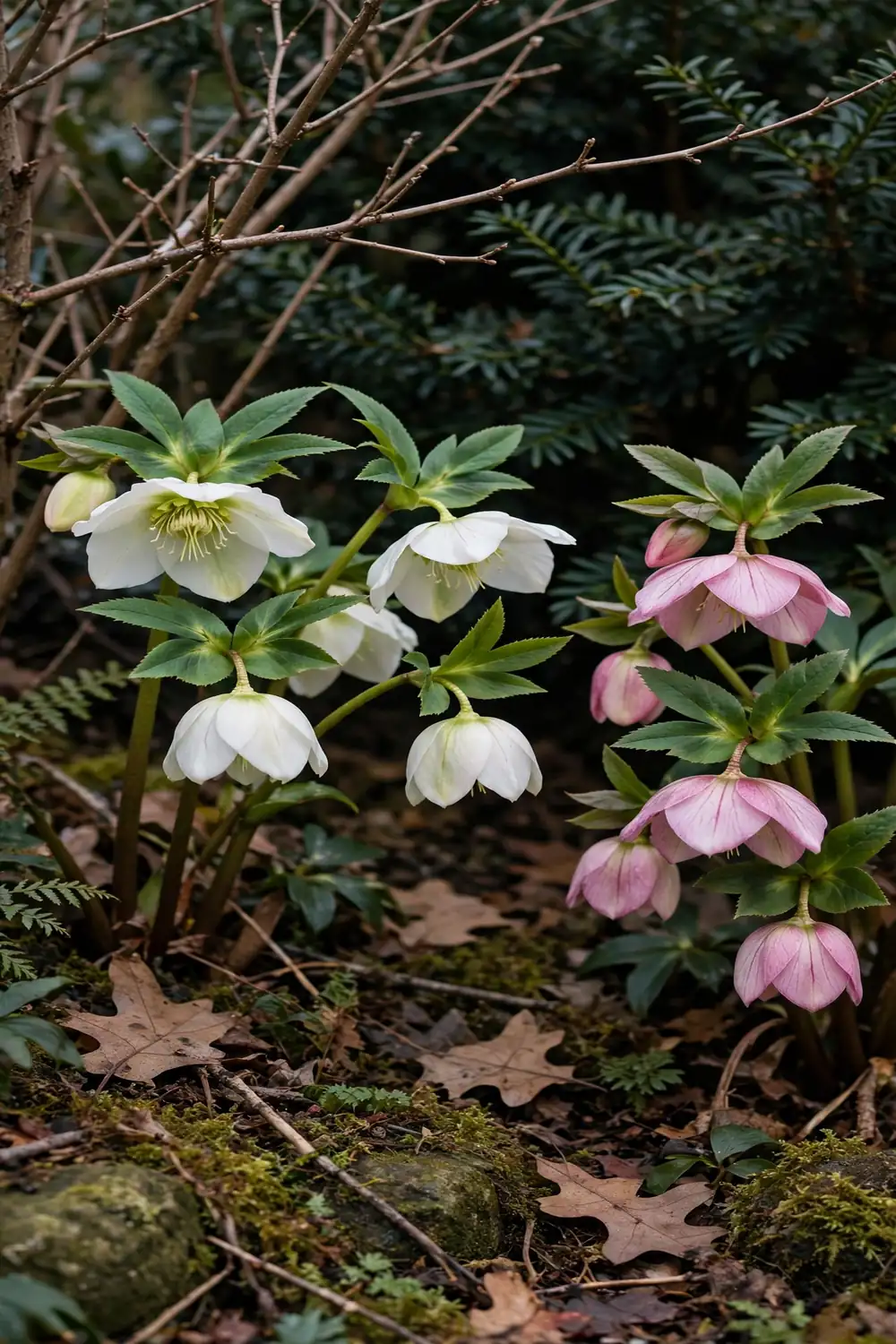
If you plant only one thing for winter, make it a hellebore. These are tough, long-lived perennials that shrug off frost, snow and heavy clay, and they flower when almost nothing else will. Helleborus niger, the Christmas rose, opens its pure white blooms around December; Helleborus orientalis, the Lenten rose, follows from February into April in shades of plum, pink, cream and near-black. They are happiest in dappled shade or a spot that gets morning sun and afternoon protection, in moisture-retentive but free-draining soil — hellebores sulk in waterlogged ground — and they are one of the best plants for shaded borders that need winter flowers at ankle height. Dig in plenty of well-rotted compost or leaf mould before planting, set the crown just at soil level, and space plants 45 to 60 centimetres apart, since they bulk up steadily and resent disturbance. Cut back old foliage in late winter so the flowers are not hidden by tatty leaves, and mulch with leaf mould each autumn. Position hellebores near a path or doorway so you actually see them — their nodding flowers face downwards and are easily missed from a distance. For more shade-loving choices, our guide to garden plants for shade covers the best companions.
8. Sarcococca — Christmas box
Sarcococca, or Christmas box, is a small evergreen shrub with one extraordinary talent: its tiny, creamy-white flowers pump out a heady, vanilla-like scent in the shadiest corner of the garden, in December and January, when you least expect perfume outdoors. It is the single best scented plant for a winter garden, and it asks for almost nothing — shade, moist soil, and no attention at all. Plant it by the front door, beside a path, or under a window, anywhere you will pass it on a cold morning, and the fragrance will stop you in your tracks. It grows slowly to about a metre, with glossy dark leaves that look good all year, and it is fully hardy. If you want a front garden that greets visitors with scent as well as colour, our front garden ideas guide shows how to place scented shrubs where they earn their keep.
9. Mahonia
Mahonia is the winter shrub for gardeners who want drama: upright spires of fragrant yellow flowers, scented like lily-of-the-valley, rising above bold, spiky evergreen leaves from November to February. Mahonia x media ‘Charity’ is the best-known variety, and it is adored by late bees — on a mild winter day, you will see bumblebees working its flowers when almost nothing else is open. It needs a sheltered spot in shade or part shade, with moist, well-drained soil, and it grows into a substantial shrub, so give it room. Mahonia is also one of the best plants for a shady border that needs winter structure: its evergreen foliage holds the border together through the months when herbaceous plants have died back, giving the garden evergreen structure when it needs it most. Plant it in autumn, water it well in its first year, and then leave it alone — it is one of the lowest-maintenance shrubs you can grow.
10. Witch hazel
Witch hazel (Hamamelis) is the most spectacular winter shrub of all, with spidery, ribbon-like flowers in yellow, orange or copper-red unfurling on bare branches from December to March, and a spicy, clove-like scent that carries across the garden on a still day. It is a specimen plant: give it a prominent spot in a border or a lawn, in sun or part shade, in moist, acid to neutral soil, and it will earn its place every winter for decades. Hamamelis x intermedia ‘Diane’, with copper-red flowers, is one of the finest varieties. Witch hazel is slow-growing and needs little pruning — just remove dead or crossing branches after flowering — but it does need patience: a young plant may take a few years to flower freely. Buy the largest plant you can afford, plant it in autumn, and mulch it well. In a small garden, it is worth the space; in a large one, it is the plant visitors ask about.
11. Daphne
Daphne is the connoisseur’s winter shrub: small, neat, evergreen, and possessed of one of the most powerful fragrances of any garden plant. Daphne bholua ‘Jacqueline Postill’ carries clusters of pink-flushed white flowers from January to March, and its perfume is legendary — a single plant can scent a whole garden on a crisp morning. It needs a sheltered spot, ideally against a wall, in well-drained soil, and it dislikes being moved or disturbed, so choose its position carefully and plant it once. Daphne is not the easiest shrub to grow, and it can be short-lived in wet soil, but in the right spot it is unforgettable. Plant it near a doorway or a path you use every day, where the scent will find you, and keep it watered in dry spells during its first year. For a scented winter border, pair daphne with sarcococca and witch hazel, and the garden will smell wonderful from December to March.
12. Viburnum
Viburnum gives you two winter-flowering shrubs in one genus, and both are worth planting in the winter. Viburnum x bodnantense ‘Dawn’ carries clusters of rose-pink, sweetly scented flowers on bare branches from October to March — one of the longest flowering periods of any winter shrub — and it is superb as a specimen or in a mixed border. Viburnum tinus, the laurustinus, is an evergreen shrub with white flowers from November to April, useful for hedging and year-round structure. Both are hardy, undemanding and long-lived, and both are excellent for wildlife: their flowers feed early pollinators, and their berries feed birds. Plant viburnum in sun or part shade in autumn, in any reasonable soil, and give it room to grow — ‘Dawn’ reaches two to three metres. Prune lightly after flowering if needed, and otherwise leave it to do its work.
13. Winter jasmine
Winter jasmine (Jasminium nudiflorum) is the cheerful optimist of the winter garden: a scrambling shrub that bursts into bright yellow blooms from November to March, on bare green stems, with no leaves at all to get in the way. It is one of the best winter plants for walls and fences, where its arching stems can be trained up a trellis or allowed to cascade over a wall, and it is almost impossible to kill — it roots wherever a stem touches the soil. Plant it in sun or part shade in autumn, give it something to climb or sprawl over, and prune it after flowering to keep it tidy. It has no scent, but its colour is so bright against a grey winter wall that it hardly matters — on a south-facing fence it flowers earliest and longest. Winter jasmine is also one of the cheapest winter shrubs to buy, and a single plant will cover a surprising amount of fence within a few years.
14. Camellia and winter heather
Camellias and winter heather are two very different plants that solve the same problem: colour in the garden from late winter into spring. Camellias flower from November to April, depending on variety, with large, rose-like blooms in white, pink or red, and they need a sheltered wall and acid soil — they will not thrive on chalky ground. Winter heather (Erica carnea) is the opposite: a low, evergreen shrub that flowers from November to April in pink, red or white, thrives in sun, tolerates most soils, and makes superb ground cover and container planting. Heather is also loved by bees, which visit its flowers on mild winter days. Plant camellias in autumn against a sheltered wall, and plant winter heather in drifts at the front of borders or in pots, where its low carpet of colour shows to best effect. Together, they give you flowers at two heights — the camellia above, the heather below — through the whole of winter.
15. Tulips
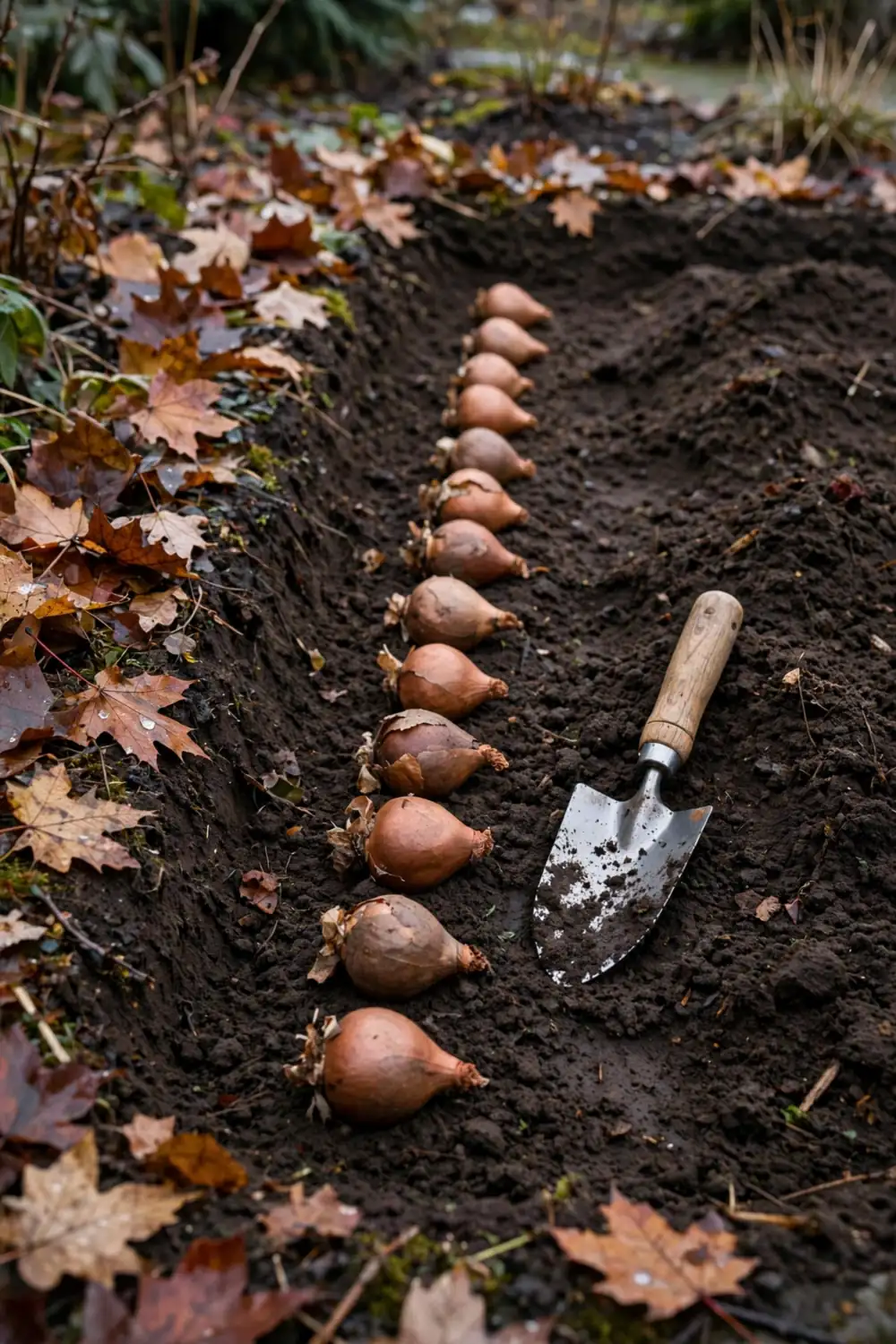
Tulips are the one bulb you must plant in winter, and November is their month. Unlike daffodils and crocus, which go in during September and October, tulips prefer cold soil — planting them in November reduces the risk of tulip fire, a fungal disease that thrives in warm soil. Plant them 15 centimetres deep, pointed end up, in well-drained soil or pots, in sun or part shade, and plant them in drifts of at least ten rather than ones and twos. For a longer display, layer bulbs in the same hole — a technique often called lasagne planting: tulips deepest, daffodils in the middle, and crocus or grape hyacinths on top, so three waves of flowers emerge from one spot. Tulips flower from March to May, and they are the reward for winter planting: the bulbs you put in the ground on a cold November afternoon are the flowers that open the spring garden. Stagger the bloom time by planting early, mid-season and late varieties, and the display lasts for weeks — this is succession planting in its simplest form. Some tulips persist year to year, while others perform less well and are treated as bedding, replaced every year — check the variety before you buy.
More bulbs to plant in winter for spring colour
Tulips are not the only bulbs for winter planting. Snowdrops are the great consolation of late winter: a single clump is charming, and a drift of them is unforgettable, flowering from January to March and offering nectar when little else is available. The golden rule with snowdrops is to plant them in the green — as lifted plants with leaves still attached, sold in spring just after flowering — rather than as dry bulbs, which establish poorly. Set them 8 to 10 centimetres deep in light shade under deciduous shrubs or at the edge of a lawn, water well in dry spells, and leave the foliage to die back naturally for at least six weeks, since it feeds next year’s flowers. Snowdrops naturalise beautifully if left undisturbed; lift and divide congested clumps every few years, immediately after flowering, and spread them along a hedge or beneath a tree. Winter aconites (Eranthis hyemalis) follow the same pattern, flowering in January and February with bright yellow cups, and they pair perfectly with snowdrops. Crocus, daffodils and alliums should already be in the ground by November, but if you still have bulbs in the shed, plant them now rather than leaving them to dry out — a late-planted bulb flowers better than a bulb left in a bag. Our how to winterize your garden guide covers the other autumn jobs that protect bulbs and plants through winter.
How to plant flowers in winter — step by step
Planting flowers in the winter follows the same steps as planting at any other time of year, with a few cold-weather adjustments. First, pick a frost-free day when the soil is workable: if the ground is frozen solid or soaking wet, wait. Digging wet soil destroys its structure and causes compaction, so never work a bed when it is sodden. Second, prepare the ground: fork over the soil, remove weeds, and dig in well-rotted garden compost or leaf mould to improve drainage and feed the soil. Winter plants usually die from waterlogged roots rather than cold, so drainage matters more than anything else — in heavy clay, mix horticultural grit into the planting hole, and in pots, use fresh peat free multipurpose compost with about 20 per cent grit. Third, plant at the right depth: bedding plants at the same depth they were in their pots, with the top of the rootball level with the surrounding compost, and bulbs at two to three times their own depth. Fourth, firm the soil gently around the roots and water well, even in winter — newly planted flowers need water to settle the soil around their roots, and a dry rootball in cold wind is a dead plant. Finally, mulch: a layer of compost, bark or leaf mould around the plant, kept clear of the stem, insulates the roots, suppresses weeds and holds moisture. Do not feed plants this late in the season — they are no longer growing, and the nutrients will wash into rivers and streams with winter rain.
One more winter planting job worth knowing: November to March is bare root season. Bare root roses, shrubs, hedging and fruit trees are sold without pots while they are dormant, they cost far less than potted plants, and they establish quickly because their roots go straight into the soil with nothing to untangle. Plant them on a frost-free day, soak the roots for an hour first, and spread them out in a wide hole rather than bunching them up.
Winter containers, pots and hanging baskets
Containers are the easiest way to enjoy planting flowers in the winter, because you can place them where you will see them — by the front door, on the doorstep, on a patio, or under a window — and move them if the weather turns. The classic container formula is “thriller, filler, spiller”: a tall centrepiece for height, a ring of fillers for colour, and trailing plants at the edge. For a bright, sheltered patio, use a 30 to 35 centimetre pot with one compact heuchera as the centrepiece and three winter-flowering violas around it. For sheltered light shade, use a 35 to 40 centimetre pot with a small hart’s-tongue fern and three potted Cyclamen coum near the rim, or a small skimmia japonica for winter berries. For a windy patio, use a broad, stable pot with a low evergreen sedge such as Carex ‘Evergold’ and two winter-flowering violas on the sheltered side. Choose frost-proof pots — terracotta marked frost-proof, or plastic and resin containers that will not crack when damp soil expands in freezing weather — and raise every pot on pot feet so water drains freely and the base does not sit in a puddle. Use fresh peat-free compost, set the rootballs level with the surface, and water sparingly until the roots are established: over-watering containers in winter encourages rot. Snip off faded viola flowers through mild spells, take out any soggy leaves, and the display will last from November to April. For more ideas on arranging pots and borders, our garden arrangement ideas guide covers layering, grouping and colour schemes that work in any season.
Protecting winter flowers from frost
Hardy winter flowers survive frost — that is the point of them — but a little protection makes the difference between plants that merely survive and plants that flower well. The first rule is to plant on frost-free days and let roots establish before the coldest weather: root establishment is what makes a plant hardy, and a plant with roots in the ground is far harder than a plant sitting in a pot on a bench. The second is drainage: raise pots on pot feet, add grit to compost, and never let containers sit in water, because frozen water around roots is what kills container plants. The third is mulch: a thick autumn mulch of compost, bark or leaf mould protects the roots of borderline hardy plants such as agapanthus, and keeps the soil temperature steadier through freeze and thaw. The fourth is fleece: in a forecast hard freeze, drape horticultural fleece or hessian over tender or newly planted flowers in the evening and remove it in the morning — never leave it on for days, or the plants will sweat and rot. A cloche over a single precious plant works the same way, trapping a little warmth around it overnight. Large tubs at risk of cracking in the frost should be wrapped in bubble wrap or hessian to insulate them. Bring tender plants and bulbs indoors or into a heated greenhouse before winter, and protect alpines from the wet. And remember that frost itself is not the enemy of winter flowers: winter pansies droop in a hard freeze and recover when the sun comes out, hellebores flower through snow, ornamental grasses left standing give the garden shape all winter, and snowdrops push through frozen ground. What kills winter flowers is wet roots, wind, and being planted too late to establish — not the cold itself.
7 mistakes to avoid when planting flowers in the winter
1. Planting into frozen or waterlogged soil. If the ground is frozen solid or sodden, wait for a frost-free day. Planting into wet soil compacts it and rots roots; planting into frozen soil leaves roots exposed to air pockets that freeze.
2. Planting tender summer flowers. Petunias, begonias, marigolds and other half-hardy bedding will not survive a single frost. In winter, plant only hardy varieties — winter pansies, violas, cyclamen, hellebores, bulbs and shrubs.
3. Buying tiny plugs in late November. Plants grow slowly in winter, so tiny plug plants can leave a container looking bare for much of the season. In late autumn, buy sturdy garden-ready plants with buds or open flowers for an immediate display.
4. Over-watering containers. Winter plants need far less water than summer ones, and damp soil plus chilly weather encourages rot. Water sparingly until roots are established, and always let pots drain freely.
5. Forgetting drainage. More winter plants die from waterlogged roots than from cold. Add grit to compost, use pots with drainage holes, and raise pots on pot feet.
6. Planting in deep shade and expecting flowers. Most winter flowers need at least some light — sun or part shade for pansies and violas, dappled shade for hellebores, true shade only for cyclamen, sarcococca and ferns. Match the plant to the light, not the other way round.
7. Feeding plants in late autumn. Plants are no longer growing, so fertiliser is wasted — and worse, it can wash into watercourses with winter rain. Feed in spring, not in November.
Frequently asked questions
Can you plant flowers in the winter in the UK?
Yes. Planting flowers in the winter works in the UK as long as you choose hardy plants — winter pansies, violas, cyclamen, hellebores, spring bulbs and winter-flowering shrubs — and plant them on frost-free days when the soil is workable, not frozen or waterlogged. November is the last chance to plant out winter bedding, according to the RHS, and tulip bulbs should still go in this month. Tender summer flowers will not survive winter outdoors.
What is the best month to plant winter flowers?
Late September to mid-October is the ideal window, while the soil is still warm and roots can establish before the cold sets in. November is still a good month for sturdy, garden-ready plants and for tulip bulbs, which prefer cold soil. By December, plant only on mild, frost-free days, and only with plants that already have buds or open flowers.
What flowers can I plant in November?
In November you can still plant winter pansies, violas, cyclamen, primroses, polyanthus, wallflowers, forget-me-nots, bellis daisies, hellebores, sarcococca, mahonia, witch hazel, daphne, viburnum, winter jasmine, camellia and winter heather, plus tulip bulbs. Choose garden-ready plants rather than tiny plugs, plant on frost-free days, and protect anything borderline hardy with mulch or fleece.
Can winter pansies survive a frost?
Yes. Winter-hardy pansies are bred to survive UK frosts. They may droop during a hard freeze, but they recover quickly once the sun comes out, and modern varieties flower intermittently right through the coldest months. The main risk is not frost but waterlogged soil, so plant them in well-drained compost and raise pots on pot feet.
Do I need to water flowers in winter?
Yes, but sparingly. Newly planted flowers need watering to settle the soil around their roots, and containers dry out even in winter, especially in wind. Water on mild days, water in the morning so the compost is not wet overnight, and never let pots sit in water. Established plants in borders rarely need watering in winter, since rain usually provides enough.