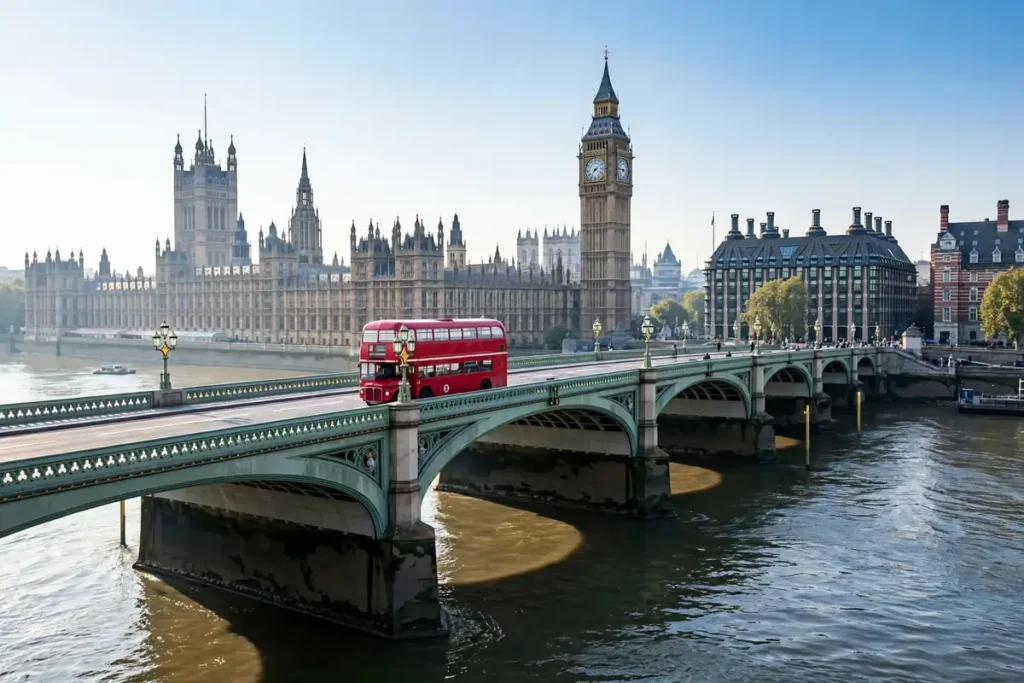
London rewards the visitors who sort the boring bits before they land: the right train from the airport, a bank card that works on the Tube, a neighbourhood that suits their budget. This guide covers all of it — arriving, getting around, where to stay, what things cost, the weather, safety and the points of etiquette that make the city easier. Read it once, and the rest of the trip is just sightseeing.
Arriving: From the Airports Into the City
Six airports use London’s name, but most first-timers land at Heathrow or Gatwick, and every one has a train or Tube link — none requires a taxi.
Heathrow: three ways in, three prices
The Piccadilly line Tube is the cheapest way in, taking 50 to 60 minutes to the centre on an ordinary fare. The Elizabeth line is faster and comfortable — around 40 minutes to the West End, a little longer to the City — at a higher fare. The Heathrow Express reaches Paddington in 15 minutes and is the priciest of the three, though booking ahead softens that. If your hotel sits near either line, the choice makes itself.
Gatwick, Stansted, Luton and London City
From Gatwick, ordinary trains to Victoria or London Bridge are often barely slower than the Gatwick Express and cheaper. The Stansted Express runs to Liverpool Street in about 45 to 50 minutes. Luton Airport connects via a short shuttle to Luton Airport Parkway station, then a train to St Pancras — about an hour all-in. London City is the closest airport of all: the DLR has you at Bank in the City in around 20 to 25 minutes.
Getting Around: Contactless Is All You Need
Put your wallet away and use your phone. Contactless bank cards and phones work on the Tube, buses, the Elizabeth line, the DLR and suburban trains — at the same fares and the same daily cap as an Oyster card. That means visitors no longer need to buy an Oyster at all: tap in and out on trains, tap in only on buses, and once your day’s fares reach the cap, the rest of the day’s travel is free. Buses are one flat fare, with a free second bus within the hour (the Hopper fare).
Walk more than you expect
Central London is smaller than the Tube map suggests. Leicester Square to Covent Garden is a four-minute walk and a pointless one-stop Tube ride; the same is true of half the journeys in Zone 1. Use the Tube for the long legs, and stand on the right of every escalator — the left lane is the overtaking lane, and London takes this seriously. On Friday and Saturday nights, the Night Tube runs on the main lines, so late evenings are painless.
Where to Stay: Neighbourhoods by Budget
Prioritise a good station over a glamorous postcode — the areas below reliably work for first-timers:
Watching the budget
King’s Cross is the value champion — a transport hub with hotels and hostels at every price, and half the city one ride away. Earl’s Court and Hammersmith offer cheaper rooms on the Piccadilly line, which also runs to Heathrow.
The comfortable middle
Bloomsbury is quiet, bookish and museum-rich — the thinking person’s base. Angel and Islington bring a local, food-loving feel with excellent restaurants on Upper Street, while South Kensington puts the big museums on your doorstep in handsome streets.
Splashing out
Marylebone is polished village-London with a famous high street, Mayfair is the full luxury treatment, and the South Bank trades a postcode for a river view and an evening walk home past the lit Thames.
Money, Tipping and What a Day Really Costs
Cards are accepted everywhere, from market stalls to pubs, and London buses take no cash at all — a small amount of sterling is handy for the odd kiosk or tip. On tipping: many restaurants add a service charge of 10 to 12.5 per cent to the bill, so check before adding more; where none is added, 10 to 12.5 per cent is the norm. In pubs there is no expectation of tipping at the bar, and for taxis, rounding up is enough.
As for a realistic day — excluding your hotel — a budget traveller can enjoy London for £50 to £70 a day, leaning on the free museums, a supermarket meal deal and one paid sight. A mid-range day with a nice lunch and two attractions lands nearer £120 to £180, and a comfortable, taxis-and-theatre day can pass £250. The city’s secret is that its greatest museums charge nothing, which keeps every budget saner than expected.
Weather and What to Pack
London weather is not extreme, just indecisive — four seasons in a day is the cliché because it keeps happening. Pack layers rather than one heavy coat, a waterproof jacket, and comfortable, broken-in walking shoes. A small umbrella earns its space. Time of year matters more for daylight than temperature: in June it stays light until past nine, while in December it is dark by four — schedule your viewpoints accordingly.
Safety and Etiquette
London is a generally safe city; standard big-city awareness is all most visitors need. The one crime to know about is phone snatching, usually by riders passing close to the kerb — so use your phone a step back from the road edge, and keep bags zipped on busy Tubes. For etiquette: let passengers off the train before boarding, queue patiently, order at the bar in pubs, and remember that “sorry” is punctuation here.
Good to Know
- The great museums are free — the British Museum, National Gallery, Tate Modern and the V&A charge nothing for their permanent collections.
- Book the big-ticket sights ahead — including the free Sky Garden, whose tickets are released about three weeks out.
- The best views can be free too — our round-up of the best free views of London covers the rooftops and hills that cost nothing.
- Contactless beats Oyster for visitors — same fares, same daily cap, nothing to buy or top up.
- Stand on the right — on every escalator, every time; London will thank you.
Frequently Asked Questions
How many days do you need in London?
Three days is the sensible minimum for the highlights — enough for the City, Westminster and the museums without running. Four or five is more comfortable and leaves room for a market, a neighbourhood or a day trip. If you have three, our 3-day London itinerary groups the sights so no day is wasted crossing town.
Do I need an Oyster card, or is contactless fine?
Contactless is fine — a bank card or phone gives you the same fares and the same daily cap as Oyster on the Tube, buses, Elizabeth line and DLR. Each traveller needs their own card or device.
How expensive is London per day?
Excluding hotels, £50 to £70 a day on a budget, £120 to £180 mid-range, and £250-plus for a comfortable splurge. The free museums and free viewpoints are what keep London cheaper than its reputation suggests.
What is the best area to stay in for a first visit?
Bloomsbury for quiet and museums, King’s Cross for transport and value, or the South Bank for atmosphere and river walks. Anywhere near a well-connected station works — you will spend your days out, not in.
Is London safe for tourists?
Yes, by big-city standards, with ordinary precautions. Watch for phone snatching near kerbs, keep an eye on bags in crowds, and use licensed taxis or apps late at night. Violent crime against visitors is rare.






1 thought on “How to Visit London in 2026: The Complete First-Timer’s Guide”