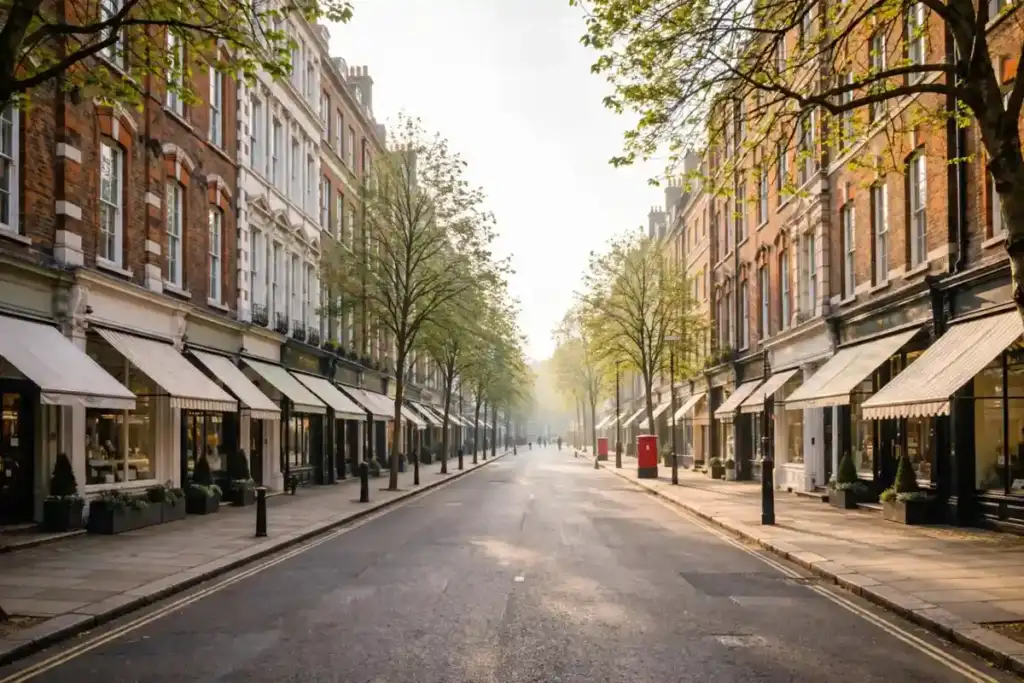
Marylebone is the London neighbourhood that feels like a village, even though Oxford Street is five minutes away. Behind the busy edges of Marylebone Road and Baker Street, you will find a quiet high street of independent shops, a world-class art collection you can walk into for free, a Sunday farmers’ market that locals plan their weekends around, and some of the prettiest Georgian streets in central London. This guide covers the best things to do in Marylebone, where to eat and shop, how to get there, and how to pair it with a free trip to Sky Garden — so you can enjoy the area like a local, not just pass through it.
Where Is Marylebone in London?
Marylebone sits in central London, just north of Oxford Street and south of Regent’s Park, with Hyde Park to its south-west and Fitzrovia to its east. Its heart is Marylebone High Street, a broad, tree-lined street that runs south from Regent’s Park towards Oxford Street, with Marylebone Lane, Moxon Street and Chiltern Street branching off it. Most visitors arrive through Marylebone station, Baker Street station or Regent’s Park station, all within a short walk of the High Street.
First, the pronunciation: locals say “MAR-lee-bun”, with the middle syllables squashed together. The name comes from St Mary-le-bourne, the church of St Mary by the bourne, or stream, of the River Tyburn, which still flows underground beneath the area. Say it the local way and you will immediately sound less like a tourist.
The area grew up in the 18th century on the Portman and Howard de Walden estates, which is why so much of it still has elegant Georgian townhouses, garden squares and green space. That history is exactly what gives Marylebone its village feel: the streets were planned for living in, not just for shopping, and they still work that way today. The parish church that gave the area its name, St Marylebone Parish Church on Marylebone Road, still stands at the area’s northern edge, and Harley Street, famous for its medical practices, runs just east of the High Street.
The Best Things to Do in Marylebone
You could spend a happy half-day here without ever leaving a few streets. Start with the big three — the Wallace Collection, Daunt Books and the High Street itself — then add the market, a park and a concert hall if you have longer.
The Wallace Collection: London’s Best Free Museum Secret
The Wallace Collection, on Manchester Square just off the High Street, is one of London’s finest free museums and somehow still feels like a secret. It is housed in Hertford House, a grand 18th-century townhouse, and holds paintings, furniture, porcelain, arms and armour collected by the Marquesses of Hertford and Sir Richard Wallace. Look out for Fragonard’s The Swing, Canaletto’s views of Venice, and the glittering armoury galleries.
Entry to the permanent collection is free, although special exhibitions may charge. Allow around 90 minutes, and finish with coffee in the glass-roofed courtyard restaurant — one of the prettiest places to sit in Marylebone. Check opening times before you go, as the museum is closed on some days and exhibition hours can differ.
Daunt Books: The Bookshop You Will Photograph
Daunt Books at 83 Marylebone High Street is an Edwardian bookshop with long oak galleries, skylights and a calm, almost chapel-like atmosphere. It specialises in travel writing, and its books are arranged by country rather than by genre, so browsing feels like planning a trip. Even if you buy nothing, step inside: it is regularly called one of the most beautiful bookshops in the world, and it earns the title.
Pick up a London guide or a novel set in the city, and you will leave with the perfect Marylebone souvenir — far better than anything from a gift shop on Oxford Street.
Stroll Marylebone High Street, Marylebone Lane and St Christopher’s Place
Marylebone High Street is the area’s main event: independent boutiques, food shops, florists and cafés, mixed with a few well-chosen bigger names. This stretch, often called Marylebone Village, is where the neighbourhood’s independent shops cluster most thickly. Turn off it and the character changes. Marylebone Lane is narrower and quirkier, with small restaurants and bars tucked into old mews. St Christopher’s Place, a pedestrianised alley just off Oxford Street, is made for a coffee stop. Chiltern Street, meanwhile, is where you will find design-led shops, the Monocle Café and some of the area’s smartest restaurants.
This is also the best place in central London for slow shopping. There is no single department store pulling a crowd; instead, you wander, you look in windows, and you find things you did not know you wanted.
Marylebone Farmers’ Market (Sundays, 10am–2pm)
Every Sunday, rain or shine, the Marylebone Farmers’ Market takes over St Vincent Street, Aybrook Street and the top of Moxon Street, just off the High Street. It has run since 2003 and is one of London’s flagship farmers’ markets, with around 40 stalls selling seasonal fruit and vegetables, meat and poultry, fish, cheese, bread, flowers and hot food to eat on the spot.
Arrive before 11am for the best choice, bring your own bags, and note that some stallholders take card while others are cash-only. Afterwards, take your haul for a picnic in Paddington Street Gardens, a small green square minutes away, or simply graze your way along the stalls — the mushroom sandwiches and fresh pastries are local favourites.
Regent’s Park and Queen Mary’s Gardens
Regent’s Park, one of London’s Royal Parks, is a ten-minute walk north of the High Street, and it changes Marylebone completely. One minute you are among shops; the next you are beside the boating lake, the Open Air Theatre or the rose gardens of Queen Mary’s Gardens, which are at their best from late spring into summer. London Zoo sits at the park’s northern edge, and the Regent’s Canal runs along its north side towards Camden and Little Venice.
If you want a longer walk, follow the canal towpath west from Regent’s Park towards Little Venice, where the canal meets the Grand Union Canal — a peaceful, houseboat-lined stretch that feels a world away from central London.
If you are searching online, you will also find the park listed as Regent Park, without the apostrophe — same park, same entrance from Marylebone.
Baker Street, Sherlock Holmes and Madame Tussauds
At Marylebone’s eastern edge, Baker Street is famous for one fictional resident: Sherlock Holmes. The Sherlock Holmes Museum at 221B Baker Street recreates the detective’s sitting room and study, complete with Victorian detail, and a statue of Holmes stands outside Baker Street station. It is small and popular, so go early or book ahead if you can.
Next door, Madame Tussauds London is the area’s big-ticket family attraction. It is fun, it is busy, and it is best booked in advance — and it makes a natural pairing with the quieter pleasures of the High Street afterwards. Just north of Baker Street, Lord’s Cricket Ground, the home of cricket, offers tours and a museum for sports fans.
Wigmore Hall and Marylebone’s Music
Wigmore Hall, on Wigmore Street, is one of the world’s great chamber-music venues, with lunchtime and evening concerts most days of the week. Tickets are often surprisingly affordable, and a lunchtime recital is a wonderful way to break up a day of shopping and sightseeing. The Royal Academy of Music’s Duke’s Hall and the Marylebone Theatre add more live performance to the area, from classical concerts to new plays.
Where to Eat and Drink in Marylebone
Marylebone eats well at every price, and the restaurants in Marylebone cover everything from a quick market breakfast to a special-occasion dinner. For a classic experience, book afternoon tea at The Landmark London, whose soaring glass atrium is one of the grandest rooms in the city, or at The Wallace Collection’s courtyard café. For everyday eating, the High Street and its side streets are full of cafés, bakeries and brunch spots — try a Swedish cinnamon bun at the Nordic Bakery, or browse the cheese counters at La Fromagerie on Moxon Street.
For dinner, the area covers everything from Italian pasta at Lina Stores and Fischer’s Austrian cooking on Marylebone High Street to Sri Lankan hoppers and Japanese small plates. The Ginger Pig on Moxon Street is a local institution for meat, pies and sausage rolls, and it also runs butchery classes. If you want a special night out, Chiltern Firehouse, in a converted fire station on Chiltern Street, is Marylebone’s most famous restaurant — book well ahead.
One practical tip: Marylebone’s best meals are often its simplest. A market breakfast on Sunday, a long lunch on the High Street and a drink in a Marylebone Lane bar will tell you more about the area than any tasting menu.
Shopping in Marylebone: What to Buy
Marylebone High Street rewards browsers. Daunt Books is the essential stop, but keep going: there are design shops, jewellers, beauty and fragrance boutiques, homeware stores and food specialists, many of them independent. Look out for David Mellor’s cutlery and design shop, Diptyque for candles and fragrance, and the food halls and delis that make the area so good for edible souvenirs.
If you are shopping for London gifts, Marylebone is a better bet than Oxford Street. The shops are smaller, the staff have time to talk, and you are far more likely to find something you would not find at home.
How to Get to Marylebone
Marylebone is one of the easiest parts of central London to reach. Marylebone station serves the Bakerloo line and National Rail trains towards Oxford, Birmingham and the Chilterns. Baker Street station, a six- or seven-minute walk away, serves the Bakerloo, Jubilee, Circle, Hammersmith & City and Metropolitan lines. Regent’s Park station, on the Bakerloo line, is the closest stop for the park and the northern end of the High Street, while Bond Street station, on the Central and Jubilee lines, is a short walk south for Oxford Street and Mayfair.
From central London, the simplest approach is usually to take the Tube to Baker Street or Regent’s Park and walk. From Heathrow, take the Elizabeth line to Bond Street or Paddington and change, or the Heathrow Express to Paddington and walk or take one Tube stop. If you are staying in Marylebone, you can walk to Oxford Street, Soho and Mayfair in 15–20 minutes, and to Regent’s Park in ten.
From Marylebone to Sky Garden: The Free Viewpoint Pairing
Marylebone pairs beautifully with Sky Garden, London’s highest public garden, because the two experiences are opposites: one is a quiet village at street level, the other is a tropical garden 35 floors above the City. Together they make a perfect London day.
The route is simple. Take the Bakerloo line from Marylebone station one stop to Baker Street, change to the Jubilee line, and ride to London Bridge. From there it is roughly a 15-minute walk north across London Bridge and through the City to 20 Fenchurch Street, the Walkie-Talkie building, where Monument and Bank stations are also nearby. Allow around 35–45 minutes door to door.
Sky Garden itself is free to enter, but you must book a timed ticket in advance, and popular slots go quickly — book as early as you can. If you want the full picture before you go, read our guide to the best free views of London and our guide to eating at Sky Garden. And if one free viewpoint leaves you wanting more, Primrose Hill is another of London’s great free viewpoints, with a very different, open-air panorama to the north.
A word of honesty: Sky Garden is not a secret, and at busy times you will queue even with a ticket. Go early in the morning or on a weekday if you can, and treat Marylebone’s calm streets as the antidote afterwards — or before.
A One-Day Marylebone Itinerary
Morning: Start at the Wallace Collection when it opens, then coffee in its courtyard café. Walk the High Street slowly, stopping at Daunt Books and the side streets.
Midday: Lunch on or around Moxon Street — La Fromagerie for cheese, The Ginger Pig for a pie, or a café on the High Street. On Sundays, start instead at the farmers’ market from 10am.
Afternoon: Walk north to Regent’s Park for Queen Mary’s Gardens and the boating lake, or head to Baker Street for Sherlock Holmes and Madame Tussauds. Fit in a Wigmore Hall lunchtime concert if one is on.
Evening: Dinner on Chiltern Street or Marylebone Lane, a drink in a local bar, and — if you have booked ahead — a sunset slot at Sky Garden to finish the day above the city.
Practical Tips for Visiting Marylebone
Best day to visit: Sunday for the farmers’ market and a village atmosphere, or a weekday morning for the quietest shops and museums. Saturdays are lively but busier.
How long do you need? Half a day covers the High Street, the Wallace Collection and Daunt Books. A full day lets you add Regent’s Park, a concert and a long dinner.
Money: The Wallace Collection’s permanent galleries are free, but bring a card and some cash for the market, where not every stall takes cards. Most shops and restaurants take cards.
Step-free access: Marylebone station’s Underground platforms are not step-free, so if you need step-free access, use Baker Street or Bond Street and check the latest step-free information before travelling. Regent’s Park and the High Street themselves are level and easy to walk.
Check before you go: Museum, market and concert times change with seasons and special events, so check the official websites on the day of your visit rather than relying on any single guide, including this one.
Frequently Asked Questions About Marylebone
Is Marylebone worth visiting?
Yes. Marylebone is one of the best neighbourhoods in London for a relaxed day out: a free world-class museum, one of the world’s great bookshops, a famous high street, a Sunday farmers’ market and Regent’s Park are all within a few minutes’ walk of each other, and it is far calmer than Oxford Street or Soho.
How do you pronounce Marylebone?
Most Londoners say “MAR-lee-bun”. The name comes from St Mary-le-bourne, the church of St Mary by the stream of the River Tyburn. Saying “Mary-le-bone” with every syllable is understood, but the squashed version marks you out as someone who knows the area.
Is the Wallace Collection free?
Yes, entry to the Wallace Collection’s permanent collection is free. Special exhibitions may charge separately, and the courtyard café and shop are good places to support the museum if you enjoy your visit.
When is Marylebone Farmers’ Market?
The Marylebone Farmers’ Market runs every Sunday from 10am to 2pm, rain or shine, on St Vincent Street, Aybrook Street and the top of Moxon Street, just off Marylebone High Street. Arrive early for the best choice, and check the organiser’s website for any changes.
How do I get from Marylebone to Sky Garden?
Take the Bakerloo line from Marylebone station to Baker Street, change to the Jubilee line to London Bridge, then walk about 15 minutes to 20 Fenchurch Street. The whole journey takes around 35–45 minutes. Remember that Sky Garden is free but requires an advance timed booking.
Where should I stay in Marylebone?
Marylebone is an excellent base for a London trip: it is central, quiet at night by London standards, and close to Regent’s Park, Oxford Street and several Tube lines. Stay near the High Street or Baker Street for the easiest access to shops, restaurants and transport, and check that your hotel is within a short walk of Marylebone, Baker Street or Regent’s Park station.