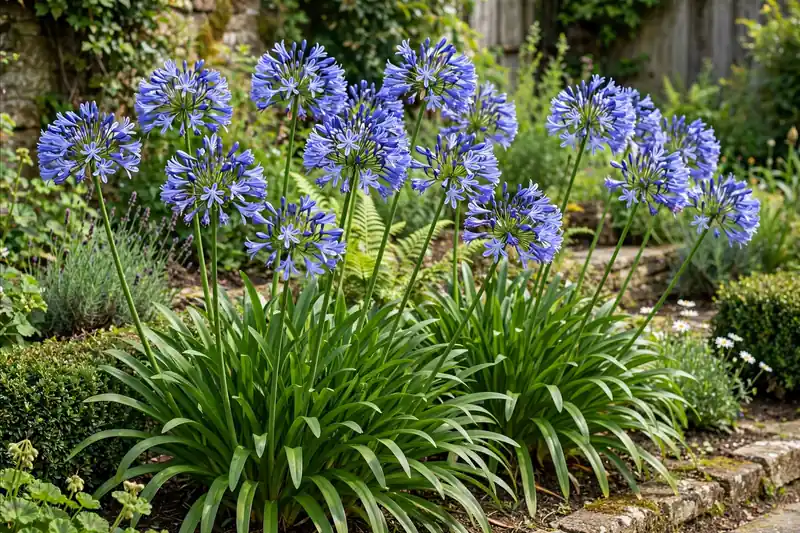
There is a moment in high summer, usually in July, when a well-grown agapanthus stops you in your tracks. Tall, clean stems rise out of a fountain of strappy green leaves, each one topped with a globe of blue or white trumpet flowers. It looks exotic, almost tropical — yet this South African native is one of the most reliable summer perennials you can grow in a British garden.
Agapanthus, often called the African lily or Lily of the Nile, earns its place for three reasons: it flowers for weeks, it asks for very little once established, and it thrives in pots on a sunny patio just as happily as in an open border. The catch? There are two very different types — hardy deciduous and tender evergreen — and mixing up their winter care is the single most common reason agapanthus fail in the UK. Get that one decision right and the rest is easy.
This guide covers everything: choosing the right variety, planting in beds and pots, feeding for the biggest flower heads, winter protection, dividing clumps, and fixing the classic problem of an agapanthus that refuses to flower.
What Is Agapanthus?
Agapanthus is a clump-forming perennial from South Africa, grown for its spectacular summer flower heads. The best-known species is Agapanthus africanus, the evergreen African lily from which many garden varieties descend. Each flower head is a rounded umbel made up of dozens of individual trumpet-shaped blooms, carried on a tall, leafless stem called a scape. Depending on the variety, plants range from compact dwarfs around 40cm tall to statuesque forms reaching 1.2 metres or more.
The flowers are most famously blue — from pale sky blue to deep indigo — but white, purple and even pink forms exist. Flowering runs from July into September in most UK gardens, and the blooms make excellent cut flowers, lasting well in a vase.
Deciduous vs Evergreen: The Decision That Matters Most
Before you buy, find out which type you are getting, because their winter needs are completely different:
- Deciduous agapanthus lose their leaves in winter and are the hardy ones. They survive most UK winters outdoors in well-drained soil. Headbourne Hybrids, the classic UK-bred strain, belong here, along with hardy varieties such as ‘Northern Star’ and ‘Blue Storm’.
- Evergreen agapanthus keep their leaves all year and are tender. Frost can damage or kill them, so in most of the UK they need a frost-free greenhouse, conservatory or sheltered porch over winter. ‘Peter Pan’ and ‘Snowball’ are popular evergreen forms, and they are best grown in pots so they can be moved under cover.
Garden centre labels are not always clear — a pot may simply say “blue agapanthus”. If the label does not say deciduous or evergreen, ask before you buy. It is the one question that saves you a dead plant in February.
How to Plant Agapanthus
Agapanthus grow from fleshy rhizomes, not bulbs, and they like their roots slightly crowded. That quirk shapes everything about planting: snug pots flower better than roomy ones, and clumps left undisturbed often flower more heavily than those divided every year.
Choosing the Right Spot
Give agapanthus full sun — at least six hours of direct sun a day — and free-draining soil. A sheltered, south- or west-facing position is ideal, because warmth through the growing season encourages flower buds to form. In heavy clay, dig in plenty of horticultural grit or sharp sand to improve drainage; waterlogged winter soil rots the fleshy roots far faster than cold does.
Planting in a Border
Plant in spring, from March to May, when the soil is warming up. Dig a hole a little wider than the root ball, set the plant so the crown sits just below the surface, and firm the soil gently. Space dwarf forms about 30cm apart and larger varieties around 60cm apart. Water well after planting, then mulch with compost or bark to hold moisture through the first summer.
Growing Agapanthus in Pots
Pots are where agapanthus truly shine, and they often flower better in containers than in the ground. Choose a sturdy, frost-proof terracotta pot with good drainage holes, only slightly larger than the root ball — a 30–40cm pot suits a decent clump. Use a free-draining mix of loam-based compost, such as John Innes No 3, with around a third horticultural grit or perlite mixed in.
Do not rush to repot. Agapanthus flower best when slightly root-bound, so only move up a pot size — about 2.5–5cm wider all round — every two or three years, or when roots are visibly bursting from the drainage holes. Overpotting into a huge container is a classic cause of poor flowering.
Agapanthus Care Through the Year
Watering
Established agapanthus are drought tolerant, but they still need regular water while they are growing and flowering. Water deeply once or twice a week in dry spells, and water pots more often — containers dry out fast in summer. One caution: do not let pot-grown plants dry out completely from midsummer into early autumn, because that is when next year’s flower buds are forming, and drought stress now means fewer flowers next year.
Feeding for Bigger Flower Heads
Agapanthus are hungry plants, and feeding makes a visible difference. From spring until early autumn, feed every two weeks with a high-potassium liquid feed — tomato fertiliser works perfectly. Start with a balanced feed in spring for strong leaf growth, then switch to the high-potash feed once flower stems appear. Too much nitrogen gives you lush leaves and few flowers, so keep the feed potash-rich.
Deadheading and Tidying
Once a flower head fades, snip the stem off at its base. Deadheading stops the plant wasting energy on seed and keeps the clump looking tidy. Leave the strap-like leaves alone — they are feeding the rhizomes for next year’s display. In autumn, deciduous types will yellow and die back naturally; clear away the dead foliage once it has fully collapsed.
Agapanthus Winter Care
Winter care depends entirely on which type you own, so this is where that early buying decision pays off.
Hardy Deciduous Types Outdoors
Deciduous agapanthus can stay in the ground all winter in most of the UK. In colder spots, or before a forecast hard frost, pile a thick mulch — 10–15cm of bark, compost or straw — over the crown in late autumn to protect the roots. Remove the mulch in spring before new growth starts. Pots of hardy types can stay outside too, but wrap the pot itself in bubble wrap or hessian so the roots do not freeze solid.
Tender Evergreen Types Under Cover
Move evergreen agapanthus in pots to a frost-free greenhouse, conservatory, shed or porch before the first frost, usually in October. Keep them barely moist through winter and cool rather than warm — around 5°C is ideal. Too much winter warmth can trigger weak early growth and poor flowers. Tender plants still in the ground should be lifted in late September, potted up and kept frost-free until May.
For more on getting garden plants safely through the cold months, see our guide on how to winterize your garden.
Dividing Agapanthus: When and How
Divide agapanthus every four or five years, or sooner if the centre of the clump stops flowering. Spring — late March into April or May — is the best time, as the roots heal and re-establish before summer.
Lift the whole clump with a fork, then split it with a sharp spade or knife into pieces, each with several shoots and plenty of roots. Discard any woody, exhausted centre sections. Replant straight away at the same depth in well-drained soil, or pot the divisions up separately. One honest warning: a newly divided clump may skip a flowering season while it settles, especially if the pieces are small. Large divisions usually flower in the same year.
Agapanthus can also be grown from seed, but seedlings will not come true to the parent plant and can take three to four years to flower — division is the reliable way to multiply a variety you love.
Best Agapanthus Varieties for UK Gardens
- Headbourne Hybrids — the classic hardy deciduous strain, sky-blue and white flowers to around 90cm. The safest choice for colder gardens.
- ‘Northern Star’ — very hardy deciduous form, deep blue flowers, around 80cm. Excellent in open borders.
- ‘Blue Storm’ — compact deciduous variety, rich blue flowers at 50–60cm. Ideal for small gardens and patio pots.
- ‘Lilliput’ — dwarf blue agapanthus at just 40cm, perfect for small containers and the front of a border.
- ‘Peter Pan’ — evergreen dwarf with mid-blue flowers, best in pots that can move under cover in winter.
- ‘Loch Hope’ — tall deciduous form with rich blue flower heads to 1.2m, a real statement plant.
Agapanthus in Garden Design
Agapanthus earn their keep far beyond a single summer show. Their architectural leaves give structure to a border all season, and their tall flower stems punctuate planting schemes without blocking the view behind. They pair beautifully with ornamental grasses, lavender and other sun-lovers, and they are one of the few perennials that tolerate salty coastal air — a genuine asset for seaside gardens.
In a border, use them as repeat accents along a path or as a bold drift at the back of a sunny bed. In containers, a row of matching terracotta pots flanking a doorway or steps looks effortlessly smart. For ideas on building the beds they will live in, see our guide to creating stunning garden borders, and for flower-filled planting partners, our roundup of cottage garden flowers pairs well with these summer stars.
Why Is My Agapanthus Not Flowering?
This is the most common agapanthus complaint, and it almost always has one of four causes:
- Too much shade. Agapanthus need full sun to form flower buds. Move the plant to a sunnier spot.
- Overpotting or recent division. A plant in a pot far too big, or divided last spring, may sit out a season. Be patient and let the roots fill the pot.
- Wrong feeding. High-nitrogen feeds produce leaves, not flowers. Switch to a high-potassium tomato feed.
- Drought at bud-formation time. Letting pots dry out completely in late summer can abort next year’s buds. Water consistently through to early autumn.
Also check winter damage: a tender evergreen type left out in a hard frost may survive but flower poorly the following summer. Protect it properly next winter and it usually recovers.
Frequently Asked Questions
Is agapanthus hardy in the UK?
Deciduous agapanthus are hardy in most of the UK and can stay outdoors all winter in well-drained soil, especially with a mulch over the crown. Evergreen types are tender and need frost-free cover from October to May.
When should I plant agapanthus?
Plant agapanthus in spring, from March to May, when the soil is warming. This gives the rhizomes a full growing season to establish before their first winter.
Do agapanthus flower better in pots?
Yes, often. Agapanthus like slightly snug roots, so a pot that is just big enough encourages heavier flowering than a roomy border position. Use a free-draining compost with added grit and do not overpot.
How often should I divide agapanthus?
Every four or five years, in spring. Divide sooner only if the centre of the clump stops flowering. Replant divisions immediately and expect smaller pieces to take a season to flower again.
Are agapanthus good for coastal gardens?
Yes. Agapanthus tolerate salty air and coastal winds better than most perennials, making them a reliable choice for seaside gardens, provided the soil drains freely.