Most gardens go quiet in November. The summer bedding is gone, the leaves are down, and for the next four months the garden can feel like a place you only hurry through on the way to the front door. It does not have to be that way. A well-planned winter garden can flower from November right through to March, with white flowers glowing against dark green foliage, pink flowers opening on bare branches, and scent drifting across a cold garden on a still morning. This guide brings together the 15 best winter flowers for UK gardens — the hardy perennials, shrubs and bulbs that genuinely bloom in the colder months — plus when to plant them, where they grow best, and how to keep them flowering year after year.
Why Winter Flowers Are Worth the Effort
Winter flowering plants are some of the most underused tools in a gardener’s armoury. Most of us plant for spring and summer, then accept a bare garden for a third of the year, yet the plants that flower in winter ask for surprisingly little. They evolved to bloom in low light and cold temperatures, and many of them come back better each year with almost no attention. A few well-chosen plants near the house will reward you from December right through to April, and they do it exactly when you need colour most.
There is a practical case too. Winter blooming shrubs and bulbs provide early nectar for pollinators at a time when almost nothing else is in flower. In a mild spell, queen bumblebees, honeybees and hoverflies will visit hellebores, snowdrops and mahonia when the rest of the garden offers nothing. Planting winter flowers is one of the easiest ways to make a garden genuinely useful to wildlife through the winter months.
The trick is choosing plants that are truly hardy in UK conditions, not summer flowers pushed past their season. The British winter is wet as often as it is cold, so the winners are plants that cope with frost, rain and short days all at once. Every plant in this guide does exactly that, and most of them are widely available at garden centres from September onwards.
The 15 Best Winter Flowers for UK Gardens
Here are the reliables: plants that bloom from October through to March without fuss. They are grouped by type — perennials, shrubs and bulbs — so you can mix them into borders, pots and shady corners with confidence.
1. Hellebores (Christmas Rose and Lenten Rose)
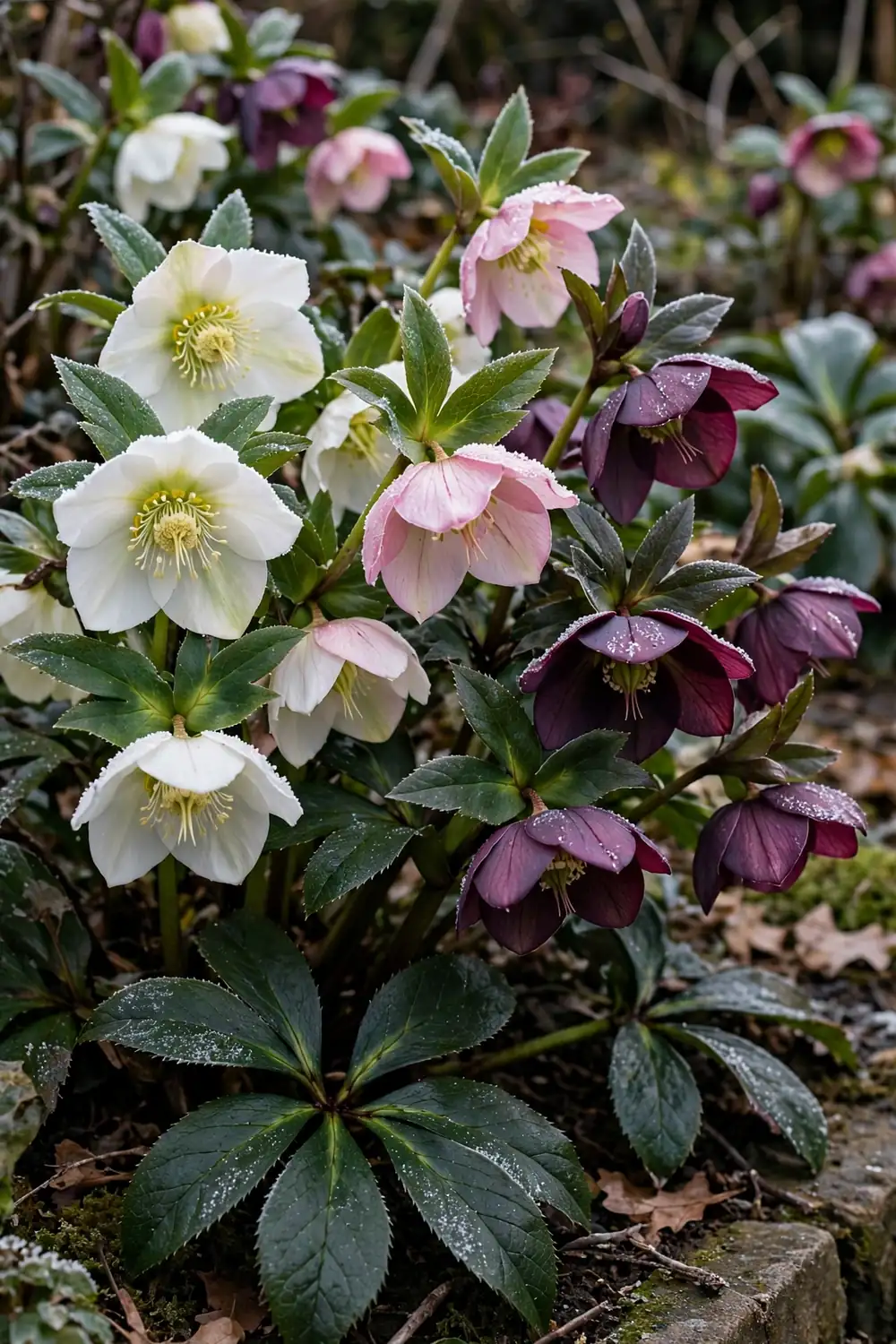
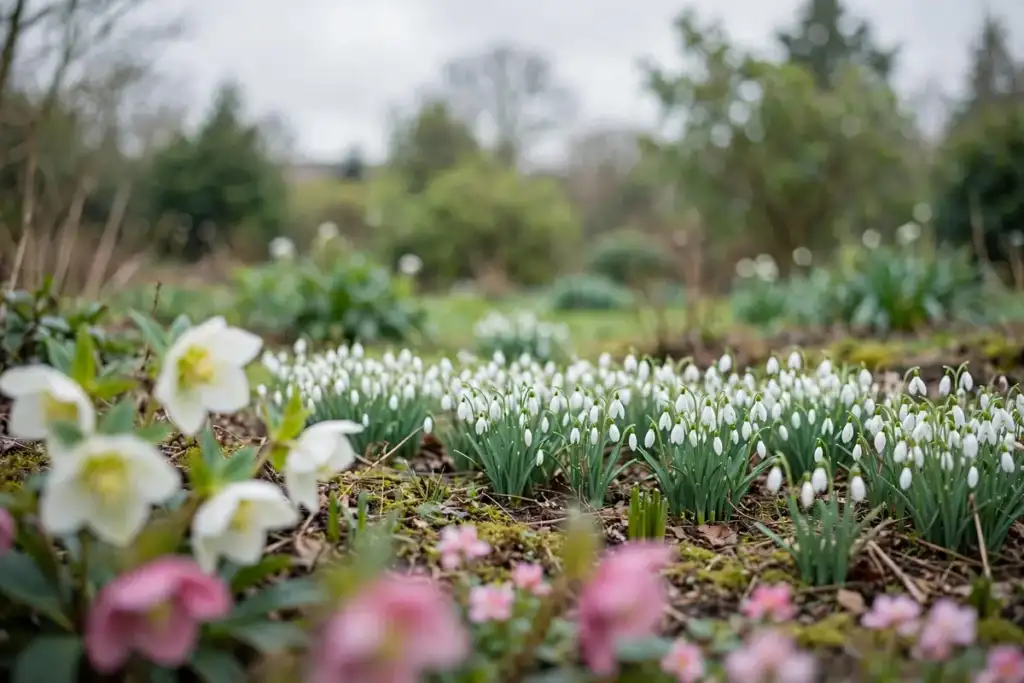
If you plant only one thing for winter, make it a hellebore. These tough, long-lived perennials shrug off frost and snow, and they flower when almost nothing else will. Helleborus niger, the Christmas rose, opens pure white, cup-shaped flowers as early as December. Helleborus x hybridus, the Lenten rose, follows from February into April in shades of white, pink, plum and near-black, with dark green, leathery leaves that look good all year.
Hellebores thrive in part shade under deciduous trees, in rich, moist but well-drained soil. Plant them in autumn so the roots establish before the first flowers appear, and cut back the old leaves in January to protect the emerging buds and let the flower heads show. One warning worth heeding: all parts of hellebores are toxic if eaten, and the foliage can irritate skin, so wear gloves when you handle them. Once settled, a hellebore can live for twenty years or more in the same spot.
2. Snowdrops
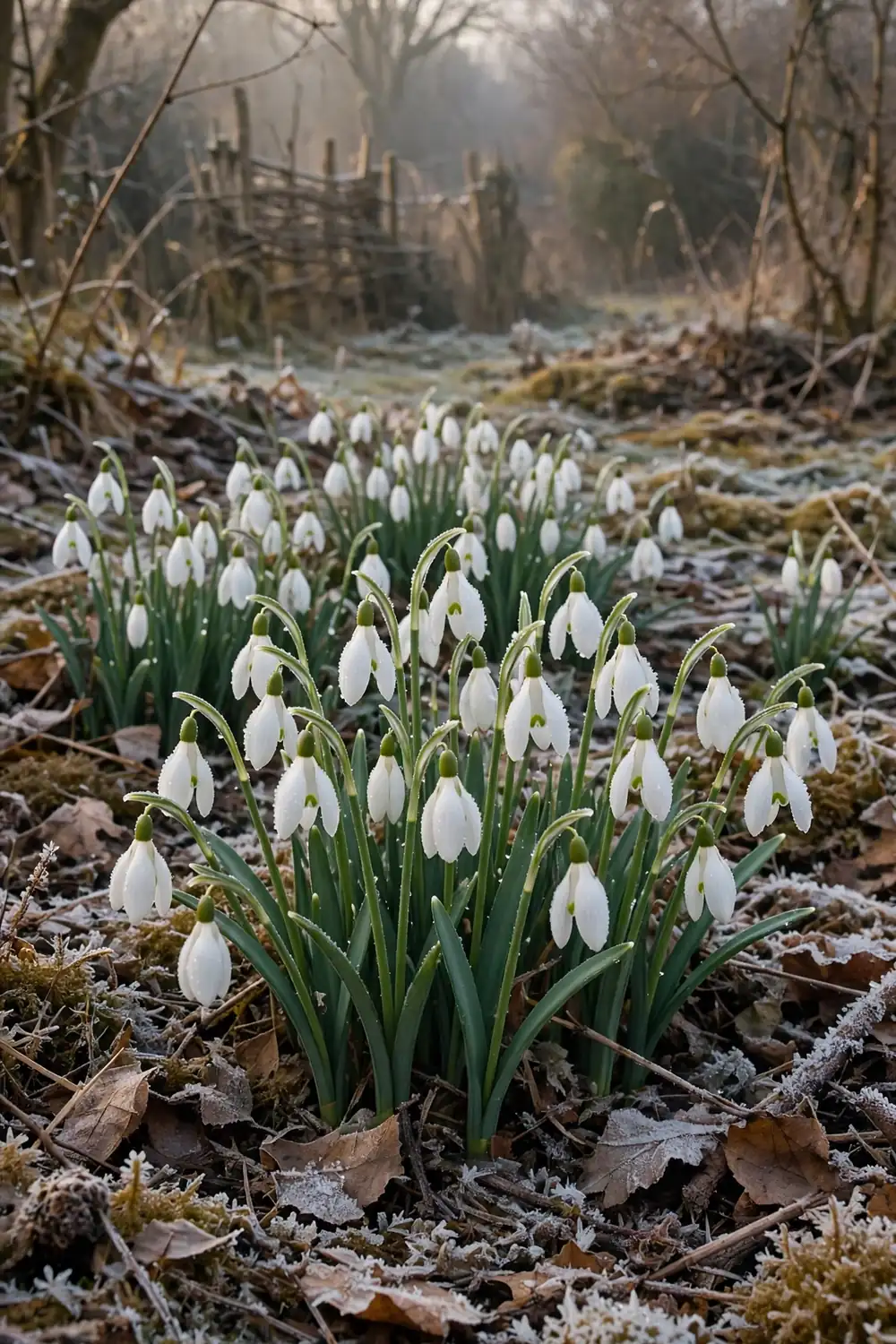
Snowdrops are the flowers that say winter is ending. Their delicate, bell-shaped white flowers often push through frozen ground in January, and in the south of the UK they can appear as early as late December. A few early varieties are flowering as early as November, though most snowdrops peak in February. Galanthus nivalis, the common snowdrop, is fully hardy and naturalises freely under trees and in lawns, forming drifts that grow more beautiful every year.
The golden rule with snowdrops is to plant them in the green — as lifted plants with leaves still attached, bought and planted in late February or March, just after flowering. Dry bulbs can be planted in October and November, about 10 cm deep, but they are slower to establish. Choose a spot with moist, humus-rich soil in partial shade, and leave clumps undisturbed so they multiply. Snowdrops pair beautifully with hellebores, and the two together are the classic late-winter combination.
3. Winter Aconites
Winter aconites are small, cheerful flowers that do something remarkable: they open bright yellow, cup-shaped flowers in January, often while frost still sparkles on the ground. Eranthis hyemalis, to give it its proper name, is a low-growing bulb that forms carpets of gold beneath deciduous trees, flowering from January to March. Plant the tubers in autumn, about 5 cm deep, in well-drained soil, and leave the seed to self-sow — over time the plants will form generous drifts.
Aconites look their best planted in large groups rather than dotted about singly, and they combine perfectly with snowdrops, the white flowers and yellow flowers lifting each other against bare earth. Like hellebores, they are toxic if eaten, so they are best kept out of reach of curious pets and children.
4. Winter Jasmine
Winter jasmine is a scrambling shrub that covers walls and fences with bright yellow, star-shaped flowers from November to March. Jasminum nudiflorum is deciduous, so the flowers open on bare branches — a splash of sunshine against a grey wall at the darkest point of the year. It is not fragrant, but what it lacks in scent it makes up for in sheer reliability and the length of its flowering season.
Give it a sunny wall or fence and tie the long stems in as they grow. It copes with poor soil and cold winds, and it can be cut back hard after flowering if it gets out of hand. In a small garden, train it over a trellis by the front door, where the yellow flowers are the first thing you see when you come home.
5. Witch Hazel
Witch hazel is the winter shrub for gardeners who want both colour and scent. From December to March, its bare branches carry spidery, ribbon-like flowers in yellow, orange and red, and many varieties are strongly fragrant — the scent carries across a cold garden on a still morning. Hamamelis x intermedia varieties such as ‘Arnold Promise’ (bright yellow) and ‘Diane’ (copper-red) are among the best, and the RHS has given several cultivars its Award of Garden Merit.
Witch hazel grows slowly into a graceful, vase-shaped shrub, and it needs a sheltered spot in sun or light shade with moist, well-drained soil. It is a plant for the long term — a specimen that gets better every year — so give it room and be patient. The autumn leaf colour, in golds and reds, is a bonus.
6. Sarcococca (Christmas Box)
Sarcococca, often called Christmas box or sweet box, is a small evergreen shrub with a secret: tiny white flowers, almost invisible among the dark green leaves, that produce one of the strongest scents of any winter flower. From December to February, a single plant by a doorway can perfume the whole entrance, and the flowers are followed by black berries.
Sarcococca confusa is the most widely grown, and it thrives in part shade or even full shade, in any reasonable soil. Plant it near paths, doorways and entrances, where you will brush past it on cold mornings — that is where fragrant shrubs earn their keep. It is slow-growing and undemanding, and it also makes a useful evergreen for containers in a shady porch.
7. Daphne
Daphne is the connoisseur’s winter shrub. Daphne bholua ‘Jacqueline Postill’, one of the most recommended varieties, carries clusters of intensely fragrant pink flowers from January to March, and the scent is strong enough to stop you in your tracks. Daphne odora, the winter daphne, flowers a little later with pink flowers and cream-edged leaves.
Daphnes are fussier than most plants in this guide: they need well-drained soil, a sheltered spot, and they dislike being moved or disturbed once planted. Choose the position carefully, plant in autumn, and then leave the shrub alone. In return you get one of the finest fragrances of the winter garden, concentrated into a plant small enough for a pot by the front door.
8. Viburnum x bodnantense ‘Dawn’
Viburnum x bodnantense ‘Dawn’ is, for many gardeners, the single best winter-flowering shrub. From October onwards, its bare branches carry clusters of pink flowers with a sweet, almond-like scent, and the display continues right through to March — one of the longest flowering periods of any shrub. The flowers open pink and fade to white, so a single branch can carry several shades at once.
Plant it in a mixed border in full sun or part shade, where its scent can drift across a path, and cut a few stems for the house — the flowers last well in a vase and will scent a room. Its close cousin, Viburnum tinus, is a larger evergreen with white or pink flower clusters from November to April, useful for hedging and year-round structure, and its berries feed the birds.
9. Mahonia
Mahonia is a bold, architectural shrub that brings winter flowers to shade. From November to February, its upright spikes of bright yellow flowers rise above spiky, dark green holly-like leaves, and the scent is sweet and lily-like. Mahonia x media ‘Charity’ is the classic variety, growing tall enough to make a real statement in a shady border.
Mahonia is outstanding for bees, with abundant flowers providing early nectar from late autumn onwards, when little else is available. It thrives in part shade or full shade and tolerates dry soil once established, making it one of the best choices for the difficult dry shade beneath trees. The blue-black berries that follow the flowers are popular with birds.
10. Cyclamen coum
Cyclamen coum is a small hardy bulb that flowers from January to March with neat, pink flowers and beautifully marbled leaves. Unlike the tender florist’s cyclamen sold as houseplants, this is a fully hardy outdoor species that thrives in dappled shade under deciduous trees and shrubs, where it forms drifts over time.
Plant the tubers in autumn in well-drained soil, and leave the plants alone to self-sow. Cyclamen are also one of the few winter flowering plants that genuinely thrive in shade, which makes them perfect for north-facing pots and sheltered borders where little else will flower. A pot of cyclamen by the front door, paired with winter pansies, is one of the simplest winter displays there is.
11. Winter Heather
Winter heather, Erica carnea, is a low, evergreen shrub that produces masses of small pink or white flowers from December to April. It is compact, tough and hardy to -15°C, and it flowers for months on end, even through frost and snow. It suits acidic soils, rock gardens and the front of borders, and it is equally at home in pots.
Plant winter heather in groups for the best effect — a single plant can look lost, but a drift of them makes a carpet of colour at ankle height. Trim lightly after flowering to keep the plants dense, and avoid planting it in soil that stays wet in winter.
12. Winter Pansies and Violas
Winter pansies are the most reliable winter bedding plants available. Modern varieties flower intermittently right through even the coldest months, and they spring back into full bloom once temperatures rise. Violas are arguably even tougher in cold weather: they trail beautifully over the edge of pots and hanging baskets and shrug off frost with remarkable resilience.
Plant winter bedding in the ground by late September or early October, while the soil is still warm, in a sunny or partly shaded spot. Deadhead regularly and feed monthly with liquid feed, and the plants will flower from October to April in every colour from deep violet to soft apricot. Mix trailing violas with upright pansies for a fuller, more layered container display.
13. Primrose and Polyanthus
Primroses and polyanthus are the quiet achievers of the winter garden. Planted in autumn, primroses sit quietly through the coldest months before bursting into colour from late winter into spring, while polyanthus bring rich, jewel-bright colours to borders and containers from late winter onwards. Both are hardy perennials that return year after year if they are kept moist and out of the hottest sun.
Use them to edge a border, fill a shady pot, or naturalise under shrubs, where their low rosettes of leaves form a green carpet long before the flowers appear. They are inexpensive, widely available, and one of the easiest ways to add early colour to a garden that otherwise wakes up slowly.
14. Crocus
Crocus are small bulbs with an outsized impact. Planted in groups in autumn, they push colourful, cup-shaped flowers through the grass and borders in February and March — purple, yellow and white cups that open in the sun and close at night. Crocus tommasinianus, the early crocus, is one of the first to flower and naturalises happily in lawns.
Plant the corms in autumn, about 8 cm deep, in sun or part shade, in drifts of twenty or more for the best display. Squirrels can be a nuisance, so plant deeply and consider a layer of wire mesh over freshly planted bulbs in areas where they are a problem. Once established, crocus come back year after year with no attention at all.
15. Wintersweet
Wintersweet, Chimonanthus praecox, is a shrub that earns its name. From December to March it carries small, waxy, pale yellow flowers with a maroon centre on bare branches, and their fragrance is extraordinary — sweet and spicy, and strong enough to carry across an entire garden on a crisp January morning. The RHS recommends it alongside Daphne as one of the most fragrant of all winter flowers.
Wintersweet needs a sunny, sheltered wall to flower well in the UK, and it can be slow to settle — sometimes taking a few years before it flowers freely. Be patient, give it the warmest spot you have, and prune lightly after flowering. Once it starts, it will perfume your garden every winter for decades.
When to Plant Winter Flowers in the UK
Timing matters more with winter flowers than with almost any other group of plants. The planting window for most winter flowers is September to November, while the soil is still warm from summer. Planting in autumn gives roots time to establish before the cold sets in, so the plants are ready to flower from December onwards.
Winter bedding plants — pansies, violas, cyclamen and primroses — should go in by late September or early October for the best establishment. Garden centres sell winter bedding as plug plants from late summer, which is the cheapest way to fill a lot of pots, though garden-ready plants are worth the extra cost if you want instant colour. Hardy perennials such as hellebores are also best planted in autumn, or in early spring while the ground is moist but not frozen. For winter-flowering bulbs, the rules vary: snowdrops and winter aconites are best planted in the green in late February or March, though dry bulbs can go in during October and November, while crocus corms should be planted in autumn, about 8 cm deep.
If you have missed the autumn window, do not despair. Garden centres stock potted hellebores, winter jasmine and scented shrubs all winter, and a pot-grown plant can go into the ground on any mild, frost-free day. The key is to water well after planting and to mulch around the roots, which protects them from the worst of the frost.
Winter Flowers in Pots and Containers
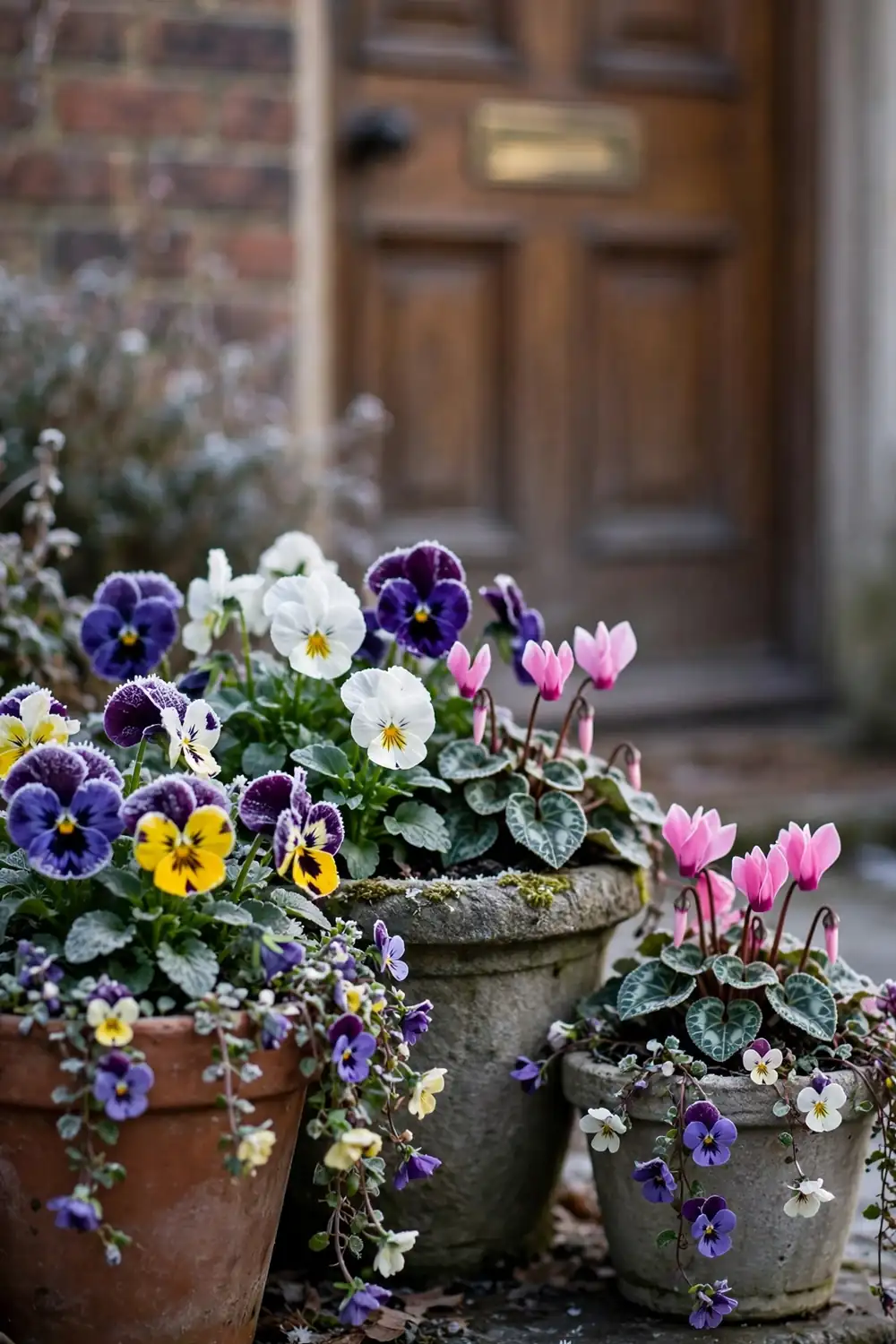
You do not need a big garden to enjoy winter flowers. Pots, hanging baskets and window boxes are ideal for winter colour, and they let you put scent and flowers exactly where you will see them — by the front door, on a patio, or outside a kitchen window. Winter pansies, violas and cyclamen are the top choices for pots, with Bellis daisies and primrose excellent for adding variety.
Use a good multi-purpose compost mixed with grit for drainage, and never let containers sit in saucers of water through winter — wet roots in cold weather will rot faster than anything else. Raise pots on feet so water drains freely, and water sparingly in cold spells, only when the compost feels dry. A small evergreen shrub such as Sarcococca or Skimmia japonica in a large pot will give structure all year and scent in the depths of winter, with pansies planted around its base for colour.
For hanging baskets, trailing violas are the best choice: they flower through mild spells from October to April, cope with frost, and spill gracefully over the edge of the basket. Plant them in September or October, keep them sheltered from the worst winds, and deadhead regularly to keep the flowers coming.
How to Care for Winter Flowers
Winter flowers are, on the whole, low-maintenance plants, but a few simple habits will keep them flowering at their best. First, soil: most winter flowers need well-drained soil. Wet, heavy ground in winter is the biggest killer, so dig in grit or garden compost when planting, and avoid spots where water lies after rain. Raised beds are an excellent option for winter flowers, and if you want to build one, our guide to building a raised garden bed covers the whole job step by step.
Second, mulch. A layer of leaf mould or garden compost around the plants in autumn keeps the roots insulated, holds in moisture, and feeds the soil as it breaks down. Mulch is also the simplest way to protect newly planted winter flowers from a hard frost. Third, deadhead: removing spent flower heads from pansies, violas and polyanthus encourages more flowers and stops the plants running to seed too early.
Finally, feed lightly. A monthly liquid feed during the flowering season is enough for bedding plants; shrubs and perennials rarely need feeding at all if the soil is decent. Overfeeding produces soft growth that frost damages easily, so less is more in the winter garden. For the wider winter garden — protecting the plants you already have and preparing beds for spring — see our guide to winterizing your garden.
Designing with Winter Flowers: Scent, Colour and Structure
The best winter gardens are designed, not just planted. Think in layers: tall shrubs such as witch hazel and Viburnum bodnantense for height and scent, mid-height perennials such as hellebores for the borders, and low bulbs such as snowdrops and winter aconites for a carpet of colour at ground level. Add evergreen structure with shrubs such as Mahonia, Skimmia japonica and winter heather, so the garden has shape even when nothing is in flower. That evergreen framework is what gives a garden real winter interest: shape, texture and colour that hold the planting together on the greyest days.
Put fragrance first. Group fragrant shrubs near doorways and paths, where you will actually smell them — Sarcococca by the front door, Daphne beside a garden seat, Viburnum x bodnantense where its scent drifts across a path. A scented shrub in the wrong place is wasted; the same plant by a door is a daily pleasure all winter.
Colour matters too, especially on grey days. White flowers glow in low light, which is why snowdrops, white hellebores and white winter heather are so effective in shade. Bright yellow flowers — winter jasmine, winter aconites, mahonia — act like lamps in a dark garden. And pink flowers, from Viburnum ‘Dawn’ to pink hellebores and polyanthus, bring warmth to borders that would otherwise be all green and brown. For more ideas on putting a planting scheme together, our garden design ideas guide covers borders, structure and year-round interest, and our evergreen shrubs guide is a good companion for the structural planting that carries a winter garden.
Frequently Asked Questions
What flowers bloom in winter in the UK?
Quite a few, once you know where to look. The most reliable winter flowers for UK gardens are hellebores, snowdrops, winter aconites, winter jasmine, witch hazel, Sarcococca, Daphne, Viburnum x bodnantense, mahonia, cyclamen, winter heather, winter pansies, violas, primroses, crocus and wintersweet. Together they cover every month from November to March, and many of them flower for three or four months at a time.
When should I plant winter flowers?
The main planting window is September to November, while the soil is still warm. Winter bedding such as pansies and violas should go in by late September or early October. Hardy perennials like hellebores are best planted in autumn or early spring. Snowdrops and winter aconites are the exception: they establish best when you plant in the green, in late February or March, just after flowering.
What are the easiest winter flowers for beginners?
Winter pansies and violas are the easiest of all — plant them in autumn in pots or borders and they flower for months with only deadheading and the occasional water. Snowdrops, winter aconites and crocus are also very easy once established, as they naturalise and come back year after year. Hellebores are nearly as easy, provided you give them part shade and well-drained soil and leave them alone.
Do winter flowers survive frost and snow?
Yes — the plants in this guide are chosen precisely because they are hardy in UK conditions. Winter pansies may droop during a hard freeze but recover once the sun emerges; hellebores, snowdrops, winter jasmine and witch hazel all cope with frost and snow without protection. The main risk is not cold but wet soil, so good drainage matters more than frost protection. Mulching around the roots in autumn gives extra insurance.
Which winter flowers are fragrant?
The most fragrant winter flowers are Sarcococca (Christmas box), Daphne, Viburnum x bodnantense ‘Dawn’, witch hazel, wintersweet and mahonia. Plant them near doorways, paths and seating areas so you can enjoy the scent. Sarcococca is the strongest of all for its size — a single small plant can perfume a whole entrance from December to February.