Every garden has a bare wall, a tired fence or a dull corner that the ground-level planting never quite reaches. Climbing plants are the answer hiding in plain sight: they take up almost no room at ground level, yet they can cover a two-storey wall, scent an entire seating area, screen an overlooked boundary and turn a flat, two-dimensional plot into a garden with real height and layering. The best climbing plants for UK gardens do all of that while asking for surprisingly little — a bit of support, a decent planting hole and the right aspect. This guide picks the 15 most reliable climbers for British gardens, grouped by the job they do best: scent, shade, evergreen cover, fast screening, fences, pergolas and arches — with honest advice on planting, training and pruning, so the plant you choose actually thrives where you put it.
How to Choose a Climbing Plant for Your Garden
Most disappointment with climbers traces back to one mistake: choosing on looks alone instead of matching the plant to the situation. A wisteria on a flimsy fence panel, a sun-loving jasmine on a north wall, a vigorous Virginia creeper crammed into a tiny courtyard — all of them end in frustration. Get three things right and almost any climber will reward you.
Aspect comes first. A south- or west-facing wall bakes in the afternoon sun and suits the more Mediterranean, heat-loving climbers: wisteria, star jasmine, passion flower and large-flowered clematis. A north- or east-facing wall stays cooler and shadier, and calls for something else entirely — ivy, climbing hydrangea, Virginia creeper or Clematis montana. The plants in each group will sulk rather than thrive if you swap them around, so check which way your wall faces before you buy anything. The same logic applies to a north facing wall in a small garden: the shade is the deciding factor, not the size of the plot.
Support comes second. Climbers climb in different ways, and the support has to match the method. Self-clinging climbers such as ivy, Virginia creeper and climbing hydrangea attach themselves directly to brick or render using aerial roots or adhesive pads, so they need no fixings at all. Twining climbers — honeysuckle, wisteria, star jasmine and most clematis — wind their stems around wires, trellis or a pergola. Tendril climbers like passion flower grip with curling tendrils. And climbing roses are the odd ones out: they have no natural climbing mechanism at all and rely entirely on you tying their long, arching stems onto a support by hand.
Size comes third. Check the eventual height before you plant. Some climbers stop at head height; others are so vigorous they will reach for the roof and keep going. Clematis montana, Virginia creeper and wisteria can all comfortably cover a two-storey wall within a handful of years, and they need committed pruning to stay in bounds. On a modest garden fence, a large-flowered clematis is a far more sensible choice than a montana that could overwhelm the structure within a few seasons.
The 15 Best Climbing Plants for UK Gardens
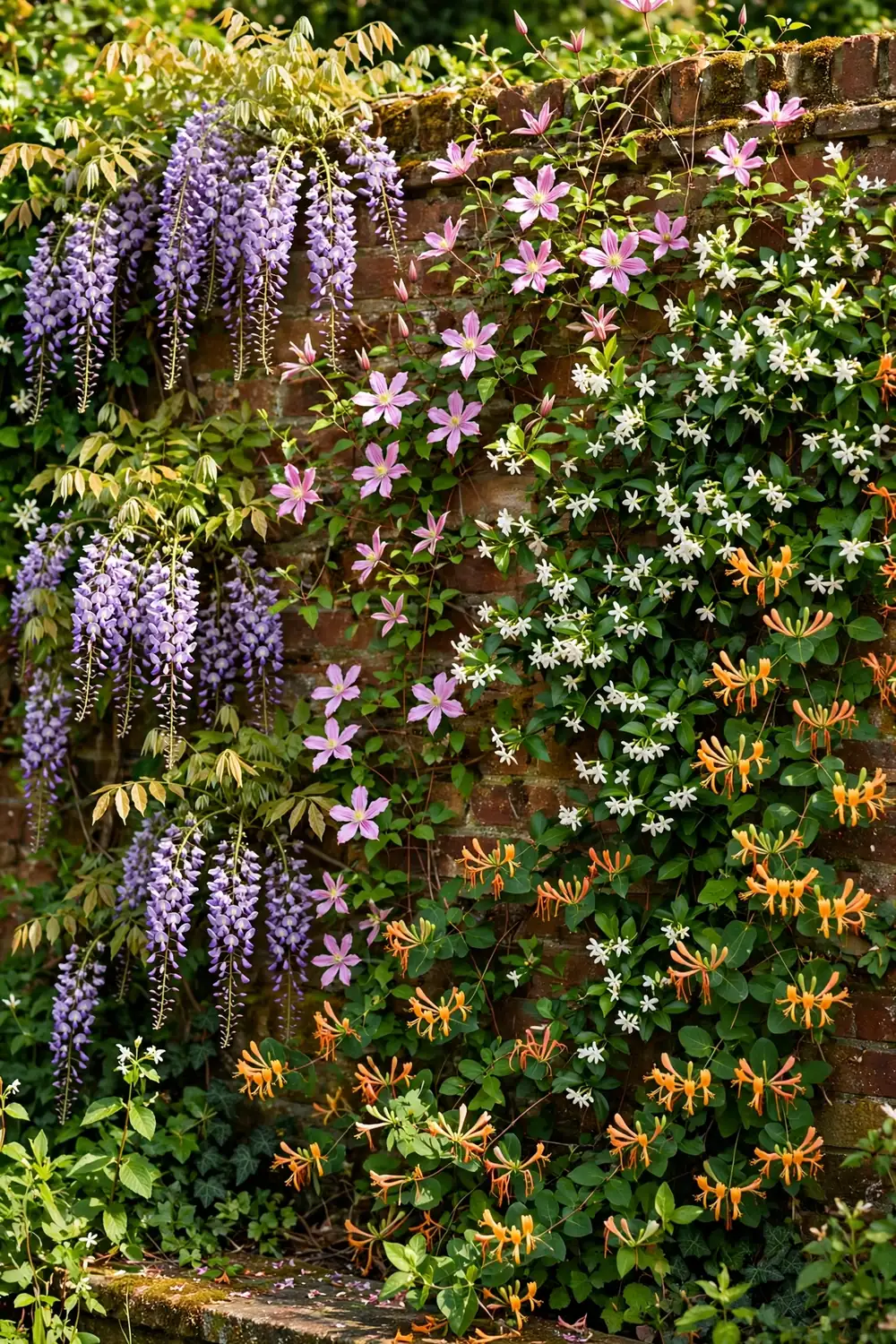
These are the climbing plants that consistently perform in British gardens — hardy, reliable and genuinely ornamental. They are grouped by the job they do best, so you can pick for your own garden rather than buying on looks alone. Heights and hardiness ratings are given for typical UK conditions; sheltered London gardens can usually push a little further than exposed gardens in the north.
Best All-Rounder: Clematis
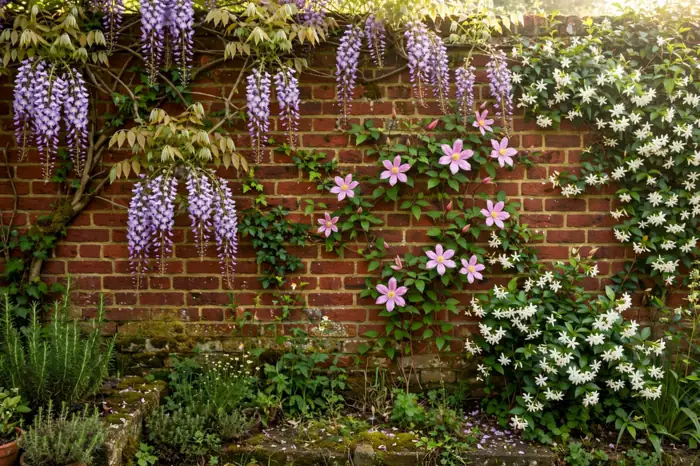
There is a clematis for virtually every situation in the UK — from tiny balconies to large country walls, from deep shade to full sun, and flowering from February to November. Large-flowered hybrids such as ‘Jackmanii’ and ‘Nelly Moser’ are the showiest, with a repeat flush in late summer, and many are compact enough for a small garden fence. Clematis is the premier fence climber: it is lightweight, flowers brilliantly, and the annual pruning required by most varieties prevents it ever becoming unmanageably heavy.
The key is matching the pruning group to the time you have — the clematis pruning groups are Group 1, Group 2 and Group 3, and they are the first thing to check on the label. Group 1 varieties (early-flowering, including Clematis montana and Clematis armandii) are pruned after flowering only. Group 2 (large-flowered hybrids) need a light prune in late winter. Group 3 varieties are the easiest of all — cut them back to ankle height every February and they regrow to two or three metres each season. Plant clematis with its roots in shade and its head in the sun, burying the rootball five to seven centimetres below soil level; that deep planting also helps modern varieties recover if clematis wilt ever strikes.
Best for Scent: Wisteria
Wisteria is arguably the most spectacular wall climber for a sunny aspect, and it is at its best on a south or west-facing wall. It is vigorous (ultimately reaching ten to fifteen metres), long-lived, and produces extraordinary hanging racemes of scented flowers in late spring — a sweet, vanilla-rich perfume that drifts across the whole garden. It needs firm support — substantial vine eyes and three-millimetre galvanised wire — and twice-yearly pruning to keep it tidy and flowering freely: a summer prune to shorten the whippy side shoots, and a winter prune to tidy the framework.
Wisteria is a commitment, not a casual purchase. It is too heavy for a timber fence and needs a solid wall, a sturdy pergola or a purpose-built arch. Give it that, and few plants in a British garden deliver more drama for the effort. Buy a grafted, named variety rather than a seed-raised plant, which can take many years to flower — or may never flower at all.
Best for Scent After Dark: Honeysuckle
Honeysuckle is equally well suited to fences and provides scent as a bonus — sweet, honeyed fragrance that is strongest at dusk, from June through to September. The native Lonicera periclymenum, woodbine, is loved by moths and bumblebees as well as gardeners, and it twines rather than grips, so it weaves attractively through trellis or wire without putting undue strain on fence panels. Its roots prefer shade even while its flowers reach for the sun, which makes it unusually forgiving of a fence line that is sunny at the top and shaded at the base. As a wildlife plant it is hard to beat: the flowers feed pollinators through the summer, and the berries that follow feed birds into autumn.
Honeysuckle will flower reasonably well in part shade provided some direct sun reaches the top growth during the day. Prune it after flowering to keep it in bounds, and choose a scented variety — some modern cultivars look lovely but have disappointingly little perfume.
Best for Shade: Climbing Hydrangea
Climbing hydrangea (Hydrangea anomala subsp. petiolaris) is the standout choice for a difficult north- or east-facing wall, because it is one of the very few flowering climbers that actually prefers shade rather than merely tolerating it. It is self-clinging, so it needs no wires or trellis, and in summer it produces broad white lacecap flowers that can reach twenty-five centimetres across, against bold heart-shaped leaves that turn buttery yellow in autumn.
The one thing to know is that climbing hydrangea is notably slow to establish — it can sit quietly for two or three years before taking off. Be patient, keep it watered in dry spells, and it will repay you for decades. It is fully hardy (RHS hardiness rating H6) and suits any soil that is moist and well-drained. This shade-loving climber is one of the few on this list that genuinely prefers partial shade to full sun, and it will flower well even on a partially shaded wall. For more shade planting ideas, see our guide to garden plants for shade.
Best for Shade and Wildlife: Ivy
Ivy (Hedera helix) is unmatched for dense, year-round cover on a north wall. It supports significant wildlife: birds nest in it, and the late-autumn flowers are a vital nectar source for insects before winter, followed by berries that feed birds through the coldest weeks. It is the ultimate evergreen climber for cold and shady walls, and it comes in a vast variety — variegated forms such as ‘Goldchild’ or ‘Glacier’, with silvery grey-green foliage edged in white, brighten a dark wall considerably and stop it looking gloomy, while giving the wall year-round interest.
Contrary to popular belief, ivy on sound walls rarely causes structural damage; it should only be avoided on old masonry that is already cracking or on walls with loose or flaking mortar. On a sound brick wall it is one of the lowest-maintenance climbers you can grow, and it will grow in conditions darker than almost anything else you could plant. The best evergreen climbing plants for UK gardens are ivy, star jasmine, Clematis armandii, Clematis cirrhosa and, in milder areas, passion flower and some honeysuckle varieties — evergreen climbers are especially valuable in small gardens where a bare fence in winter would be particularly exposed.
Best Autumn Colour: Virginia Creeper
Virginia creeper (Parthenocissus quinquefolia) earns its place on foliage alone. In autumn it turns the most spectacular crimson-scarlet, and it will cover an entire house wall without any fixings — it is self-clinging, fully deciduous, and probably the fastest-growing climbing plant you can use in the UK, adding three to five metres in a single season once established. If you want the fastest growing climbing plant for a bare wall, this is it — just give it room. It is a good match for a sound brick wall in any aspect, including a difficult north wall where little else on the list will grow at all, though the autumn colour is less vivid in shade.
The trade-off is that it gives no winter cover, and its vigour needs respect: clip it in late summer to keep it off gutters, windows and roof tiles, and never let it near a wall with defective mortar. Its close relative Boston ivy (Parthenocissus tricuspidata) gives the same autumn show on a slightly smaller scale.
Best Evergreen Scent: Star Jasmine
Star jasmine (Trachelospermum jasminoides) is a refined evergreen twiner producing masses of white flowers in summer — intensely scented, and opening over many weeks — a sweet, jasmine-like perfume that lasts for weeks. It is slower-growing than wisteria but reliably covers a sunny or lightly shaded wall over three to five years, and its glossy dark leaves give year-round cover even in January. Hardy to around minus ten degrees in a sheltered spot, it needs protection in colder counties, but in a sheltered London garden it is one of the most dependable evergreen climbers you can grow.
Star jasmine is my usual first recommendation when someone wants an evergreen climber that also flowers and smells wonderful. Give it a sheltered south, west or east wall, a trellis or wires to twine around, and a mulch in spring, and it will quietly become the best plant in the garden.
Best Early Flowers: Clematis armandii
Clematis armandii is the most handsome evergreen clematis — large, glossy, ribbed leaves and masses of small white or pale pink flowers in February and March, with an almond-vanilla fragrance that drifts surprisingly far on still days. It flowers when little else is in bloom, which makes it extraordinarily valuable in a British garden. It needs a sheltered, sunny wall and is borderline hardy in the coldest northern and Scottish gardens, but in London and the south it is a superb plant that can reach six to eight metres.
Plant it where you will pass it in late winter — by a front door, beside a path, or under a window you open in February. That early scent is the whole point of it.
Best for Pergolas: Climbing Roses
Climbing roses are the classic pergola and arch plant, and for good reason: trained along horizontal beams, they flower prolifically at head height, exactly where you walk beneath them. Varieties such as ‘New Dawn’ (soft pink, repeat-flowering) and the shade-tolerant ‘Madame Alfred Carrière’ — a super-scented climbing rose that blooms repeatedly from early summer until early autumn — are among the most reliable. Vita Sackville-West famously used ‘Madame Alfred Carrière’ on the massive north-facing wall at Sissinghurst to spectacular effect.
Roses need you to tie their stems in by hand, so budget a little time each autumn for training. Combining a climbing rose with a Group 3 clematis on a pergola is a time-honoured pairing: the clematis threads through the rose without needing separate support, and the two flower at complementary times. For more on the structure itself, see our guide to the Pergola on the Wharf and our garden arch ideas.
Best Exotic Flower: Passion Flower
Passion flower (Passiflora caerulea) is surprisingly tough in sheltered gardens and provides striking, exotic-looking flowers followed by orange-yellow fruits. It is vigorous but controllable on a fence, and it grips with tendrils, so a trellis or wires suit it perfectly. In milder areas it can hold its leaves through winter, giving useful semi-evergreen cover.
Give passion flower a sunny, sheltered spot — a south-facing fence is ideal — and it will flower from midsummer into autumn. It is one of the best climbers for a small garden that needs a talking point rather than just green cover.
Best for Sunny Walls: Jasmine
Jasmine (Jasminum officinale) is the classic cottage-garden scented climber for a sunny wall, with a classic jasmine perfume that is intense on a warm July evening. It is vigorous and somewhat unruly if not trained annually, but the scent is worth the effort. Grow it near a seating area or an open window, and tie in the new growth each year before it tangles.
For winter interest, its relative Jasminum nudiflorum (winter jasmine) flowers acid-yellow from November to February on bare stems — best as a trailer over a low wall rather than a true climber, but a cheerful sight in the darkest months.
Best Fast Cover: Clematis montana
If you need to cover a large expanse of fence, shed or wall quickly, look no further than Clematis montana. Once established this fast-growing climber will happily scramble eight metres or more in a single season, producing clouds of small flowers in spring — soft pink ‘Elizabeth’ with a vanilla scent, deep pink semi-double ‘Broughton Star’, or white, strongly scented ‘Fragrant Spring’. It is remarkably tolerant of shade and north-facing aspects, which makes it one of the most useful plants on this list.
The warning is the same as the recommendation: “fast” and “well-behaved” are not always compatible. Montana needs an appropriately large structure or it will need cutting back hard every one to two years. Prune it after flowering, never in winter, or you will cut off the next season’s blooms.
Best for Pots and Small Spaces: Sweet Peas and Annual Climbers
Not every climber has to be a permanent woody plant. Sweet peas (Lathyrus odoratus) are annual climbers with sweet scents, ideal for quick summer displays on trellises, obelisks and wigwam or tepee-style tripods in a border. Sow them in spring, give them a cane or obelisk to climb, and they will flower from June until the first frosts — and the more you pick them, the more they flower.
Annual climbers are also the fastest way to test whether a spot suits a climber at all. If sweet peas thrive on a fence, a permanent clematis probably will too. Other good annuals for the job include morning glory, black-eyed Susan (Thunbergia alata) and the everlasting sweet pea (Lathyrus latifolius), a dependable climbing perennial for a dark, cool spot.
Best for Tropical Drama: Campsis
Campsis, the trumpet vine, is a vigorous climber for a sunny, sheltered spot, with large trumpet-shaped flowers in orange and red through late summer — a genuinely tropical look that few British gardens expect. It needs a hot wall and a strong support, and it can be slow to flower in cooler gardens, but in a sheltered London garden against a south-facing wall it is a show-stopper.
Give it room: campsis can reach ten metres, and it suckers from the roots if it is happy. Plant it where its vigour is an asset, not a problem.
Best Wall Shrub: Japanese Quince
Japanese quince (Chaenomeles) is technically a wall shrub rather than a true climber, but it deserves a place here because it is among the first shrubs to flower every year, bearing small clusters of red, pink or white blossom along its bare branches before the foliage appears. Trained flat against a wall on horizontal wires in a fan shape, it turns a bare expanse into one of the earliest colour displays of spring.
It is tough, undemanding and long-lived, and it will grow in sun or part shade on almost any soil. Tie the branches onto the wires as they grow, and prune after flowering.
How to Plant and Train a Climbing Plant
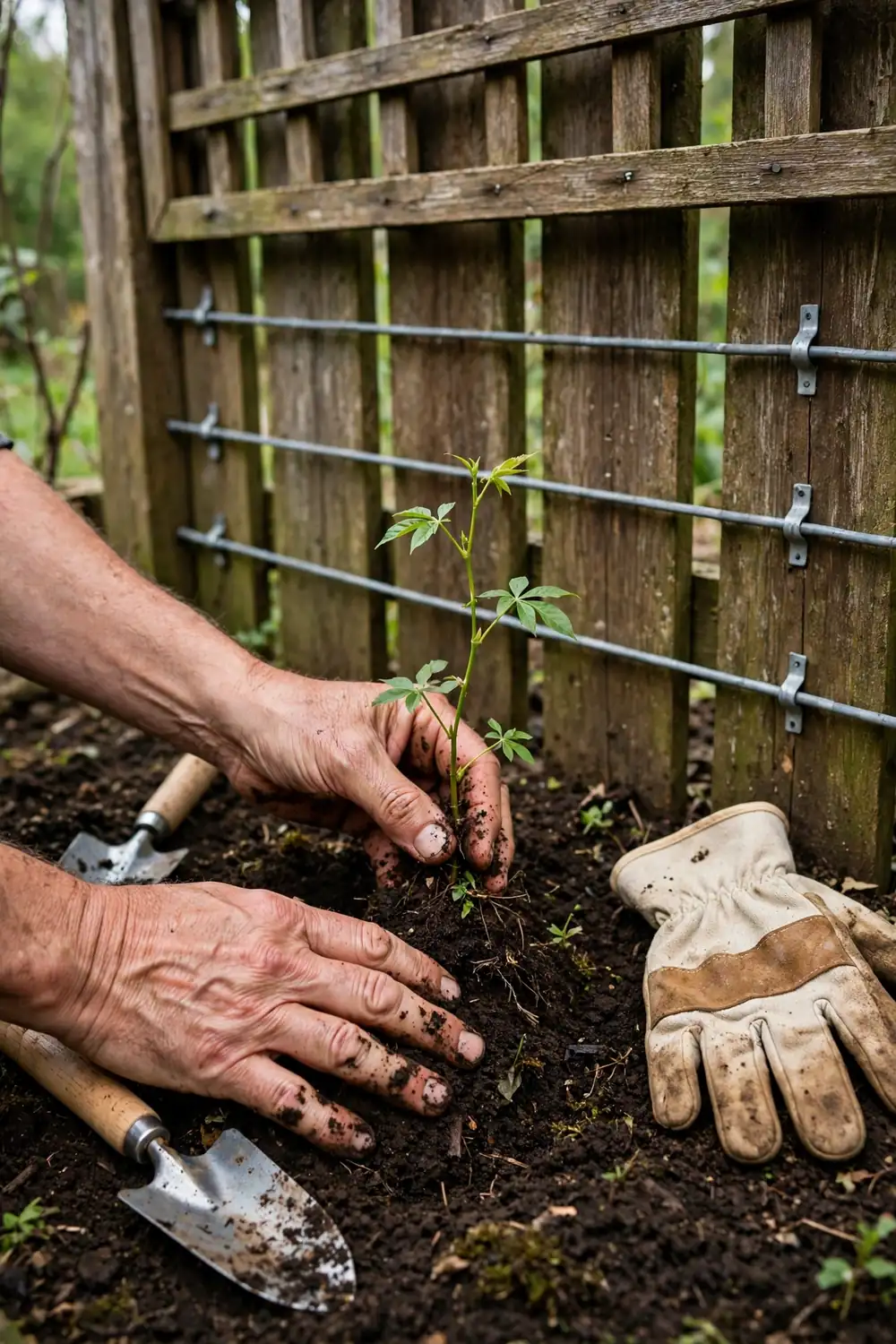
Growing climbing plants successfully comes down to a few fundamentals: most failures are caused by poor soil preparation, inadequate support or planting too close to a wall where the soil is dry. Get these right and establishment is almost guaranteed.
Plant 30–45 cm away from the base of the wall and lean the cane towards it. The soil at the base of a wall is often dry, compacted and alkaline from lime leaching out of the mortar, and it sits in the wall’s rain shadow, so a plant jammed against the bricks will struggle from day one. Dig a generous hole in moist, well-drained soil, work in garden compost or well-rotted manure, and water the plant thoroughly before and after planting.
Put the support up before you plant. For wire-trained climbers, install horizontal galvanised wires held proud of the wall by vine eyes, set about half a metre apart vertically. That gap behind the plant allows air circulation and makes it easy to repaint or repoint behind it later. For less vigorous plants, obelisks and wigwam tripods are a great choice to give height in a border. A trellis panel fixed a few centimetres off a fence gives twining climbers something to grip without trapping damp against the timber.
Plant in spring or autumn. Autumn planting lets roots establish over winter so the plant takes off in spring; spring planting suits less hardy varieties, which then have the whole summer to get established before colder weather arrives. Water well in the first year — even shade-lovers and drought-tolerant climbers need regular watering until their roots are down — and mulch in spring with garden compost to hold moisture and feed the soil.
Train young stems while they are flexible. Tie in new growth loosely with soft twine, spacing the stems out rather than letting them bunch. A well-spaced framework in the first two years is the difference between a climber that covers a wall evenly and one that becomes a tangled mass at the top with bare stems below.
Do Climbing Plants Damage Walls and Fences?
This is the question that stops more people buying a climber than any other, and the honest answer is: on a sound wall, almost never. Self-clinging climbers such as ivy and Virginia creeper can loosen already-defective mortar, but on sound brick or stone — whether they grow on walls or fences — the risk is very low, and ivy does not damage new-build bricks. The problems start when the wall is already failing — cracked render, crumbling pointing, loose mortar — because roots and adhesive pads exploit the weakness that is already there. If your wall is sound, plant with confidence; if it is not, repair the wall first.
Fences are a different calculation, because the risk is weight rather than damage to the surface. Choosing climbing plants for fences is mostly about weight: timber panel fences need lighter, well-behaved climbers that will not pull the structure down as they mature. Twining and tendril climbers are ideal; heavy self-clinging species and wisteria are generally not suitable for a standard fence panel. Climbing plants for walls, by contrast, can be as heavy as you like provided the wall is sound and the fixings are up to the job. If you love a vigorous climber but only have a fence, give it its own freestanding support — a sturdy pergola, an arch or a set of posts with wires — and let the fence stay out of the equation.
Climbing Plants for Small London Gardens
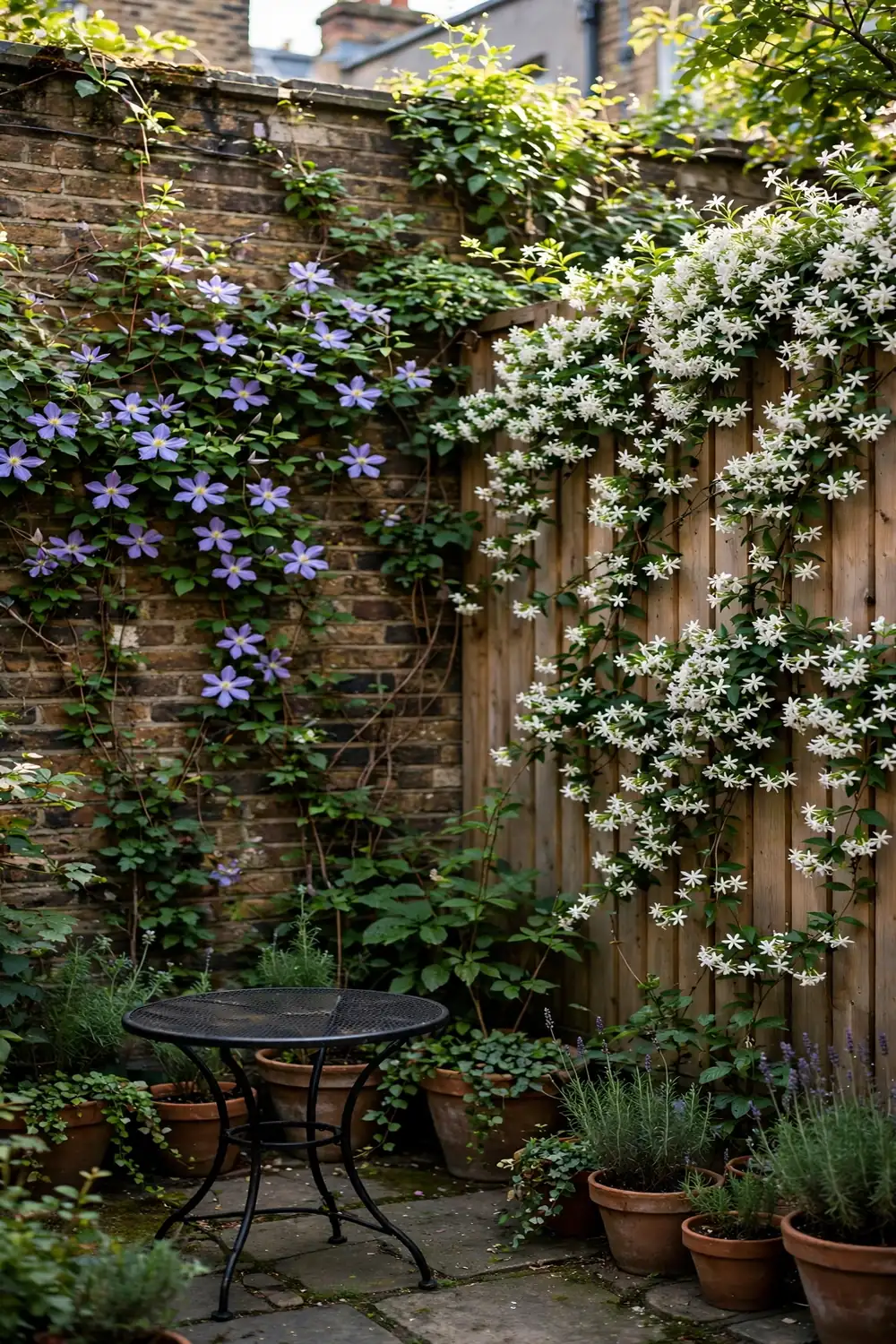
Small London gardens are where climbing plants earn their keep most of all. A courtyard or basement garden may have only a few square metres of soil, but it usually has a surprising amount of wall — and a climber turns that vertical surface into the garden itself. A single well-chosen climber can soften a bare fence panel, disguise an ugly shed wall, frame a doorway, and give a tiny plot the feeling of a green room rather than a paved yard. Whether the boundary is a wall fence, a trellis panel or bare brick, the approach is the same — and in a small outdoor space the vertical layer matters more than the ground layer, because the wall is the biggest surface you own.
For a small London garden, pick one or two climbers and give them a proper job. Star jasmine by a front door gives scent and evergreen cover in one plant. A large-flowered clematis on a fence gives colour from early summer to late autumn without ever getting heavy. Clematis armandii on a sheltered wall gives February flowers when the rest of the garden is still asleep. And in a shady London lightwell or north-facing yard, ivy or climbing hydrangea will do what nothing else can.
London’s mild microclimate is a genuine advantage: the city sits a degree or two warmer than the surrounding countryside, and a sheltered courtyard can be warmer still, which is why star jasmine, passion flower and campsis all perform better here than they do in exposed gardens further north. Just remember that a London garden is often drier than it looks — walls, paving and the rain shadow of neighbouring buildings all steal water — so water new climbers generously in their first summer.
Frequently Asked Questions About Climbing Plants
What is the easiest climbing plant to grow in the UK?
Clematis is the easiest all-rounder, especially Group 3 varieties, which you simply cut back to ankle height every February and watch regrow. Ivy is the easiest of all if you want evergreen cover with almost no maintenance, and honeysuckle is the easiest scented climber. All three are fully hardy and will grow in most UK gardens with basic care.
What climbing plant grows fastest in the UK?
The fastest-growing climbers are Clematis montana, Virginia creeper and wisteria, all capable of adding three to six metres or more in a single season once established. Russian vine (Fallopia baldschuanica) is the fastest of all but is extremely difficult to control and is generally not recommended for domestic gardens. Remember that fast growth means committed pruning — a fast climber on a small fence becomes a problem within a couple of seasons.
Which climbing plants are best for a north-facing wall?
Ivy, Virginia creeper, Clematis montana and climbing hydrangea are the most reliable climbing plants for shade and north-facing walls. Climbing hydrangea is the standout because it actually prefers shade, while ivy will grow in conditions darker than almost anything else you could plant. Several of these are RHS Award of Garden Merit winners, chosen after vigorous trials as the best choices for gardens of any size. Avoid wisteria, passion flower and star jasmine on a north wall — they need sun to flower well.
Do climbing plants damage brick walls?
On a sound wall, climbing plants rarely cause structural damage. Self-clinging climbers such as ivy can loosen already-defective mortar, so they should be avoided on walls with cracked render or crumbling pointing. Wire-trained climbers such as wisteria, roses and clematis never touch the wall surface at all, because they grow on wires held proud of it — and those wires also make it easy to repaint or repoint behind the plant.
When should I plant a climbing plant?
Plant climbers in spring or autumn. Autumn planting (September to November) is usually best, because the roots establish over winter and the plant grows away strongly in spring. Less hardy varieties such as passion flower and campsis are better planted in spring, so they have a full summer to get established before their first winter. Water well in the first year whatever the season.