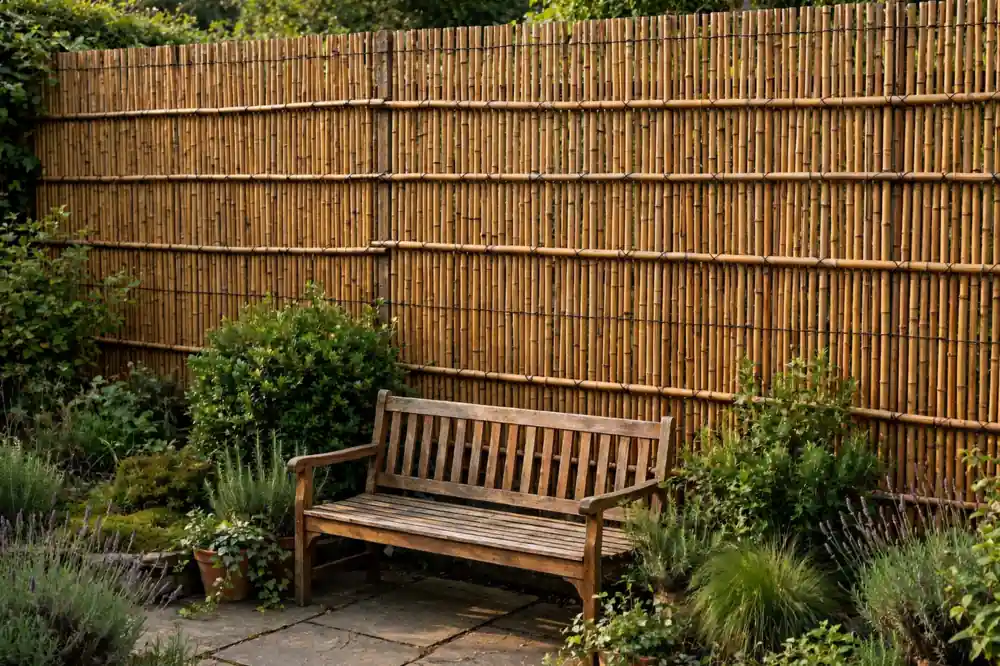
A neighbour’s upstairs window, a tired fence, a patio that feels like a stage — a garden can lose its privacy in a dozen small ways. Bamboo screening is the quickest, cheapest fix most UK gardeners reach for: a roll of natural canes that turns an old fence into a warm, tropical-looking privacy screen in a single afternoon, giving an overlooked garden instant garden privacy, usually for less than the cost of a takeaway for four. But not all bamboo screening is equal. Rolls, slatted panels, framed panels, living plants and artificial lookalikes behave very differently once they are up, and a few honest choices at the buying stage decide whether yours lasts two summers or ten. This guide compares every type, works out the real costs, shows you how to fit it properly, and covers the height rules that catch people out.
What Is Bamboo Screening?
Bamboo screening is a ready-made privacy screen made from bamboo canes, reeds or slats held together with wire, twine or a frame. It is sold in rolls and panels, in heights from about one metre to two metres, and you fix it to an existing fence, wall or posts — or, in the case of living bamboo, you plant it and let it grow into a screen of its own.
It works for three jobs at once. It blocks the view into your garden, it hides an ugly fence, wall or shed, and it softens a hard boundary with a natural, warm texture that suits both modern gardens and cottage-style plots. Because bamboo is one of the fastest-growing plants on earth — reaching maturity in three to five years without replanting — it is also one of the more sustainable fencing materials you can buy.
There is one important distinction to make before you buy anything: “bamboo screening” can mean a roll of cut canes you screw to a fence, or a living plant. The two solve the same problem in completely different ways, cost different amounts, and last for different lengths of time. Both are covered in this guide, because the right choice depends on how fast you want privacy and how much work you are willing to do.
The 5 Types of Bamboo Screening
Walk into any garden centre or search online and you will meet five main kinds. They look similar in a thumbnail, but they differ in density, strength, price and lifespan — and picking the wrong one is the most common reason people end up disappointed.

1. Bamboo Screening Rolls
The classic option. Thin bamboo canes or split slats are woven together with galvanised steel wire and sold as a roll — commonly 2 metres high by 3 or 4 metres long. You unroll it against a fence or posts and fix it with cable ties, wire or screws. It is the cheapest way to cover a long run, it bends around gentle curves, and a single person can fit a whole boundary in an afternoon.
The trade-off is density. A cheap reed screening roll can be gappy, and the canes are only as strong as the wire holding them. Look for cane thickness 8-10mm or more, and galvanised wire rather than glue or thin twine, which gives way sooner in wind and rain. A good roll should feel heavy for its size; a suspiciously light one is usually thin reeds that will not last.
2. Slatted Bamboo Panels
Slatted or split bamboo screening uses wider, flatter slats instead of round canes, overlapped so the gaps close up. The result is denser and more private than a roll, with a neater, more modern finish, and it takes climbing plants well — so it can be the base layer you grow into rather than a temporary fix. Panels are rigid, so they suit straight runs and seating areas where a see-through screen would be worse than none. Expect to pay more per square metre than a roll, but also to get a longer life out of it.
3. Framed Bamboo Panels
Framed panels are bamboo slats or canes set inside a timber or metal frame, sold in fixed sizes such as 6 by 6 feet or 6 by 8 feet. They install like a small fence panel: level, upright and solid. They are the tidiest-looking option and the best choice if you want a freestanding screen with no existing fence behind it — around a bin store, a compost heap or a seating area, for example. The downside is flexibility: you cannot bend a framed panel around a corner, and cutting one down wastes the frame.
4. Living Bamboo Plants
Living bamboo is the slow route to a permanent screen. Clump-forming varieties such as Fargesia grow into dense, evergreen clumps 2 to 4.5 metres tall, giving year-round screening that never needs replacing. They look softer and more natural than any roll, and they suit narrow borders and containers as well as open ground.
The catch is time and choice. A new plant takes two to three seasons to fill out, and you must choose a clump-forming bamboo, not a running one. Running bamboos spread through underground rhizomes and can push into a neighbour’s garden — the single biggest mistake in bamboo planting. Clumping types stay in a tidy, expanding clump and are safe to plant without a root barrier in most gardens.
5. Artificial Bamboo Screening
Artificial or faux bamboo screening is plastic made to look like cane, usually sold as an expanding trellis or a roll with a mesh backing. It never rots, never fades much, and needs no maintenance at all. It suits shaded, damp corners where natural cane would go soft, and balconies where weight matters. The compromise is the look: up close it reads as plastic, it can look flat in strong sunlight, and it does nothing for wildlife. Buy it for practicality, not for beauty.
How Much Does Bamboo Screening Cost in the UK?
Bamboo screening is one of the cheapest privacy fixes available, and the price range is wide enough that it pays to know what you are actually paying for. As a rough guide for late 2026, a basic reed or thin bamboo roll starts at around £16 for a 1 by 4 metre run, a good-quality slatted roll of 2m x 4m costs roughly £26 to £38, and framed panels run higher still. Fixings — UV-resistant cable ties, galvanised wire, screws and posts — add a few pounds per run.
Worked out as cost per square metre, a cheap roll can come in under £5 per square metre, while a thick slatted panel can be double that. The honest way to compare is cost per year of life: a £16 roll that lasts two seasons costs more than a £38 roll that lasts five. Realistically, £60 to £100 buys a proper screen along one exposed boundary, fixings included.
Two things push the price up legitimately: thicker canes and double-woven construction. Double-woven screening — two layers of reeds interlaced — is denser, stronger in wind and lasts three to five years or more, where a single-layer roll may only manage one or two. If the listing does not say the cane thickness or the weave, assume the cheapest version and price it accordingly.
How to Put Up Bamboo Screening
Fitting bamboo screening is a genuinely easy DIY job — no digging, no concrete and no specialist tools for the common case. The golden rule is that a roll is only as good as what it is fixed to: it needs a rigid structure behind it, whether that is an existing fence, a wall or new posts.

Attach It to an Existing Fence
This is the most common job. Unroll the screening flat on the ground first and check it against the fence, then lift it into place with a helper — one person holds, one fixes. To attach to existing fence boards, fix through the horizontal wires that hold the canes together, never through a single cane, using UV resistant cable ties every 300 to 400mm along the top, middle and bottom rails. A staple gun is handy for tacking the top edge to timber fence posts while you position the roll, but always follow up with cable ties or wire for the permanent fix. Galvanised wire or stainless steel screws work just as well and last longer; avoid ordinary nails, which can split the canes. Take the screening right down to ground level, because a gap at the bottom is the detail that gives a screen away. If you have a chain-link fence rather than solid boards, wire the roll through the mesh at the same spacing.
Build a Freestanding Screen With Posts
Where there is no fence, set new treated timber fence posts about 1.8 to 2.4 metres apart, fixed in the ground or in post spikes, with two horizontal rails between them. You can also build a screen from individual bamboo poles lashed to the two rails, which suits a rustic cottage garden. Fix the roll or panel to the rails in the same way as above, keeping the bottom edge a couple of centimetres off the soil so it does not sit in standing water. A freestanding screen catches more wind than one backed by a fence, so use thicker canes and closer fixings for better wind resistance, and keep the height at or under two metres unless you are sure about the rules below.
Cutting a Roll to Size
Adjusting the width is simple: cut the galvanised wires at the wanted length with wire cutters or pincers, then twist the cut ends closed so they do not unravel. To reduce the height, trim the canes with secateurs or a fine saw, cutting just above a node so the cane does not split. Measure twice — a roll that is cut short cannot be stretched back.
How Long Does Bamboo Screening Last?
Honest answer: it depends on the type, and sellers who promise decades are overselling. A thin single-layer reed roll in a wet, windy UK garden typically lasts one to two years before it thins and greys. A good double-woven bamboo roll (lifespan 3-5 years) is the sweet spot for most gardens. Thick slatted panels, especially treated or painted ones, commonly last five to eight years, and black bamboo is often quoted at up to ten. Living bamboo, once established, lasts indefinitely — it is a plant, not a product.
How to Make It Last Longer
Four habits add years. First, keep the bottom edge off damp soil and clear of leaves that trap moisture. Second, treat or paint the screening with an exterior wood stain or preservative before fitting, and recoat every couple of years — some painted finishes are rated for up to fifteen years. Third, fix it firmly: a screen that flaps in the wind works its fixings loose and snaps canes. Fourth, choose galvanised or stainless fixings so rust does not stain and weaken the wire. A little shade helps too — screening in full sun all day dries and cracks sooner than screening with some afternoon shade.
Bamboo Screening Rules: Height, Planning Permission & Neighbours
This is the section most guides skip, and it is the one that causes real arguments. Get the rules right before you go tall, because taking a screen down is far more annoying than fitting it.
The Two-Metre Rule
In England, a fence, wall or gate — including a bamboo screen fixed to it — does not normally need planning permission up to two metres high. Next to a road used by vehicles, or that road’s footpath, the limit drops to one metre. A trellis topper counts towards the total height, so a 1.8-metre fence plus a 0.5-metre bamboo topper is a 2.3-metre fence in the eyes of the rules. Measure from the ground on your side, and check with your local council if the ground levels differ across the boundary.
High Hedges and Neighbours’ Light
Living bamboo screens fall under a different set of rules. A line of two or more evergreens over two metres tall can count as a “high hedge”, and if it blocks a neighbour’s light they can make a council complaint and ask the council to investigate — the council can order it cut back, though not below two metres and not removed altogether, and there is usually a fee for the complaint. The same applies to any tall evergreen hedge, not just bamboo. Talk to your neighbours before planting a tall living screen, and keep it trimmed to an agreed height.
Clumping vs Running Bamboo — Get This Right
If you plant living bamboo, choose a clump-forming variety such as Fargesia. Running bamboos spread through underground rhizomes and can travel metres from where they were planted, including under a fence into a neighbour’s garden, where they are extremely hard to remove. A root barrier buried around a running bamboo helps, but the simpler and safer choice for most gardens is a clumper, which expands in a tidy clump and stays where you put it. If a nursery cannot tell you which type a plant is, do not buy it. If you love a running variety such as golden bamboo, plant it in raised beds or a large container so its rhizomes cannot escape into the rest of the garden.
Living Bamboo or a Screening Roll — Which Should You Choose?
It comes down to speed against permanence. A roll gives you privacy this weekend: buy it Saturday, fit it Saturday, sit behind it Sunday. It costs little, it hides an ugly fence instantly, and you can take it down if you change your mind. What it cannot do is grow, and you will be replacing it within a few years.

Living bamboo is the opposite bargain: two or three years of patience in exchange for a permanent, evergreen screen that looks better every year, shelters wildlife and never needs replacing. It suits a garden you plan to stay in, a narrow border where a fence would feel hard, and anyone who would rather plant once than re-fit rolls. Many gardeners do both — a roll for instant privacy now, with clumping bamboo planted behind it to take over as the roll ages. Pair it with the planting ideas in our guide to stunning garden borders and the effect is a boundary that looks designed rather than disguised.
Whichever you choose, keep the rest of the boundary honest. A screen hides a view; it does not stop noise, and it will not block a determined view down from a loft window. For the best result, combine the screen with planting at different heights — a low hedge or shrubs in front, taller bamboo behind — so the boundary reads as a garden with a tropical feel, not a wall. Our garden arch ideas and garden edging guide show how the smaller details pull the whole look together.
Frequently Asked Questions
Does bamboo screening give complete privacy?
Almost, if you choose well. A double-woven roll or a slatted panel at two metres high blocks a direct view from a neighbour standing in their own garden. It will not block a view from a first-floor window looking down at an angle — for that you need height plus planting, or a horizontal fix such as a sail shade over the seating area. Two layers beat one: something solid at 1.8 metres with taller planting behind it stops both the direct view and the angle over the top.
Can I put bamboo screening on a balcony?
Yes, and it is one of the best balcony privacy fixes because it is light. Fix it to the railing with UV-resistant cable ties, keep it below the railing height unless your lease or building rules allow more, and choose a slatted panel rather than a loose roll — it flaps less in the wind at height. Artificial bamboo screening is also worth considering on a balcony, since it weighs less and never rots.
How do I stop bamboo screening going grey?
Natural bamboo weathers to a silvery grey in sun and rain, usually within a year or two. It is cosmetic, not damage. To keep the warm honey colour, treat the screening with an exterior oil or wood stain before fitting and recoat it each spring. A painted finish lasts longest — some are rated for around fifteen years — but it does change the natural look, so test a small piece first.
Is bamboo screening good for wildlife?
Living bamboo is excellent: it shelters birds, gives insects somewhere dry, and its evergreen cover matters most in winter when other plants are bare. Cut-cane rolls are neutral — they are not harmful, but they offer little habitat. If wildlife matters to you, plant living bamboo or grow a climber up the screen, and leave a small gap at the base so hedgehogs can pass through.
What is the best bamboo for screening in the UK?
For a living screen, the safest recommendation is a clump-forming Fargesia — Fargesia robusta ‘Pingwu’ for height up to about 4.5 metres, or Fargesia murieliae for a smaller garden or a container. Both are hardy in the UK, evergreen, and non-invasive. For a roll or panel, there is no single best brand; judge by cane thickness of 8 to 10mm or more, galvanised wire fixings and a double-woven construction.
Can bamboo screening hide an unsightly fence?
Yes — that is one of its best uses. A roll or slatted panel fixed over the boards will hide unsightly fence panels and cover old fence boards that have gone grey or patchy, giving you instant garden privacy without replacing the fence itself. It works best on a sound fence; if the boards are rotten, fix the fence first, because screening only hides the problem, it does not fix it.
Does bamboo screening work in London gardens?
Yes, and London gardens are where it earns its keep — they are often small and overlooked, with neighbours close on every side and windows looking in from above. A two-metre screen blocks the direct sightline from a neighbouring garden, and taller planting behind it cuts the angled view from upstairs windows. Remember the height limit is one metre next to a road, so check the boundary before you go tall.
Is bamboo screening eco-friendly?
Mostly, yes. Bamboo grows fast without replanting and needs little water or fertiliser, so a natural cane screen is one of the more eco-friendly privacy options — and a living bamboo screen is better still, giving evergreen screening that shelters wildlife. Artificial bamboo screening is the exception: it is plastic, so it lasts longer but is not eco-friendly. If you want the lowest footprint, choose a natural roll or plant a clump-forming bamboo.